'We will fix it': Bilawal says if system has failed, hand Islamabad to Tharparkar
Updated 7 hours ago

Funding disputes, bureaucratic hurdles and shifting project plans delay domestic and industrial wastewater treatment
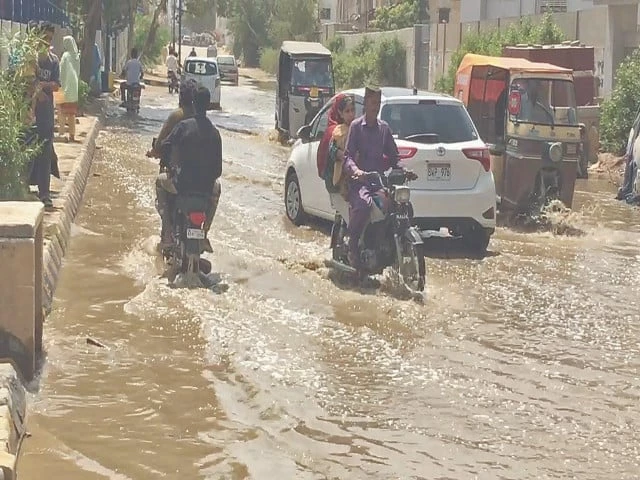
Karachi's sewage treatment crisis has persisted for two decades, with funding disputes, bureaucratic hurdles and repeated changes in project plans leaving most domestic sewage and industrial waste untreated before it reaches the sea.
According to a Karachi Water and Sewerage Corporation (KWSC) study, Karachi generates around 460 million gallons of sewage daily, but only about 35 million gallons per day (MGD) is currently being treated, while the remaining 425 MGD is discharged untreated.
The S-III project was designed to treat Karachi's domestic sewage. According to an engineer associated with the project, its design began in 2007, final approval was granted in 2013 and construction started in 2014. Its original cost was around Rs8 billion, to be shared equally by the federal and Sindh governments. The cost later increased to Rs36 billion, leading to disputes over funding.
The Executive Committee of the National Economic Council (ECNEC) approved the revised PC-I in 2023, with the federal government agreeing to pay its original share while Sindh would bear the additional cost. A project official said the federal government had already paid its original share but had now stopped further funding. The project was also largely stalled between 2019 and 2023 because of funding shortages and Covid-19.
Around 33 kilometres of trunk sewer pipeline from Surjani to Mauripur has almost been completed. Work continues at Treatment Plant-I (TP-I) in Haroonabad and TP-III in Mauripur. TP-I has a planned capacity of 100 MGD and TP-III 180 MGD.
TP-III was partially restored on Supreme Court directions and inaugurated by former Chief Justice Saqib Nisar on July 22, 2018. It initially treated 54 MGD, but silt in the old pipeline has reduced current treatment to 35 MGD.
The project engineer said the remaining S-III works are expected to cost around Rs29 billion after Phase-II, covering the Malir River trunk sewer and TP-IV, was removed and shifted towards a public-private partnership. The completion deadline has been extended from June 2026 to December 2027, while Sindh has allocated only Rs1 billion this financial year.
The problem, however, is compounded by untreated industrial effluent.
A senior Sindh government official said the Combined Effluent Treatment Plant (CETP) project had been delayed for around 20 years. The first feasibility study was prepared by the federal government in 2006, followed by a KWSC PC-I in 2009 costing Rs7.36 billion.
Following Supreme Court directions in 2016, a new five-plant CETP scheme was approved by the federal government in 2017 at Rs11.789 billion, with Sindh contributing 67 per cent and the federal government 33 per cent. The plants were planned for major industrial zones with a combined capacity of 94 MGD.
The project was later shifted to a public-private partnership, and responsibility was transferred from KWSC to the provincial Industries Department in 2020.
A provincial Industries Department official said a decision under Sindh Chief Minister Murad Ali Shah had been taken to revive the project through PPP. The first priority is now a 20 MGD plant at Haroonabad for the SITE Industrial Area.
Officials estimate that 35 MGD of wastewater from the area enters stormwater drains, including 20 MGD of industrial effluent and 15 MGD of domestic sewage, before flowing through the Lyari River into the sea.
However, KWSC has refused to provide 16 acres at Haroonabad, saying the land is required for TP-I expansion and a workshop. The official said the project could be abandoned if an alternative site is not secured. WWF Technical Adviser Moazzam Khan disputed the 460 MGD sewage estimate, saying it was calculated against Karachi's 650 MGD water supply from the Indus River and Hub Dam. "Growing population and increased groundwater use mean actual sewage generation may be considerably higher," noted Khan.
Khan added that marine biodiversity around the Lyari and Malir river mouths had largely disappeared and identified Sea View, Korangi Creek, Gizri Creek, Karachi Port, Port Qasim, Ibrahim Hyderi and Rehri Goth among the worst-affected areas. "Continued delays in treating industrial waste could cause irreversible damage to marine life within Pakistan's maritime boundaries," concluded Khan.













This material may not be published, broadcast, rewritten, redistributed or derived from. Unless otherwise stated, all content is copyrighted © 2026 The Express Tribune.



1727268465-0/Untitled-design-(42)1727268465-0-208x130.webp "roboking in pakistan")


COMMENTS
Comments are moderated and generally will be posted if they are on-topic and not abusive.
For more information, please see our Comments FAQ