Australian opposition party vows 'biggest cut to immigration' in country's history
Updated 3 hours ago

PM Shehbaz says that he is 'deeply saddened by the passing of a great leader and a good friend of Pakistan'
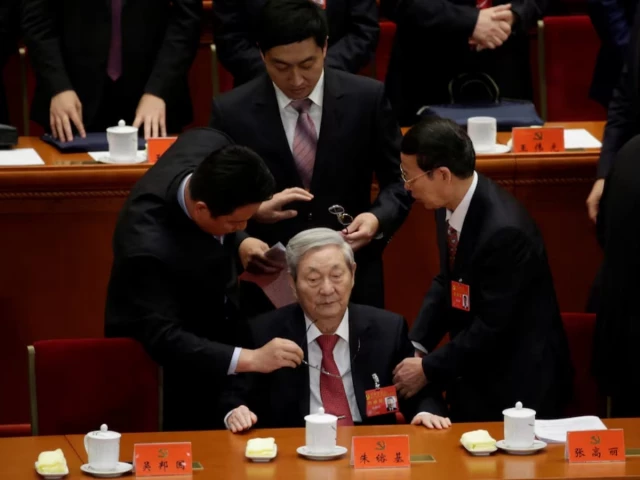
Former Chinese Prime Minister Zhu Rongji died in Beijing on Wednesday at the age of 97 after an illness, state-run Xinhua News Agency reported.
Zhu was born in October 1928 in Changsha, Hunan Province, according to The Paper.
He studied electrical engineering at Tsinghua University from 1947 to 1951. He later entered the civil service.
Zhu was sent to May Seventh Cadre School for labour from 1970 to 1975.
He was the vice-premier in charge of China’s economy between 1991 and 1998 before becoming China's fifth premier from 1998 to 2003, according to the South China Morning Post.
Zhu oversaw a period of major economic reform during his tenure as the country accelerated its transition from a "planned economy to a socialist market economy".
He also oversaw negotiations for China’s accession to the World Trade Organisation (WTO), which eventually happened in 2001, while promoting greater economic opening and deeper integration with the global economy.
Zhu was also known for his strong stance against corruption.
Reacting to the news, Prime Minister Shehbaz Sharif said that he was "deeply saddened" by the death, calling the deceased a "great leader and a good friend of Pakistan".
"On behalf of the government and people of Pakistan, I extend heartfelt condolences to President Xi Jinping, Premier Li Qiang, the Chinese people and the bereaved family. Pakistan shares the grief of our iron brother China at this sad hour," he said in a post on X.
Deeply saddened by the passing of former Chinese Premier Zhu Rongji, a great leader and a good friend of Pakistan.
— Shehbaz Sharif (@CMShehbaz) August 12, 2026
On behalf of the Government and people of Pakistan, I extend heartfelt condolences to President Xi Jinping, Premier Li Qiang, the Chinese people and the bereaved…
Chinese premier who cajoled economy into modern era
He was never one to mince his words.
When the four-volume selection of his speeches came out in 2011, it shocked readers with his description of "tofu dregs" flood dykes built by "parasites", and erring bankers labelled as "half-wits".
It was little wonder that his blunt comments from his years in power became best-sellers, finding eager readers in a nation whose then leaders were seen as wary, prone to often bland public pronouncements.
Yet the reaction to Zhu's speech selection from his time as vice premier from 1991 to 1998 and then as premier until early 2003 also reflected deeper anxieties coursing through China as it approached a transition that ushered in Xi Jinping as leader.
Reformist former officials and intellectuals held up the 2,042 pages of Zhu's words, many made public for the first time, as an unflattering mirror to the conservatism and conformism of current leaders. Magazine editors and internet users scoured the volumes for any comments that offer a message for the present.
Indeed, many of the problems that dogged China's economy as Xi prepared to take power dominated "The Authentic Speeches of Zhu Rongji": local government debt and reckless bank loans, inflation and feverish urban growth, and corruption devouring public trust and coffers.
"Our country faces many potential crises that could erupt at any time," Zhu said early in 1998. "Ordinary people are discontent about us in many ways. Especially, there is corruption among officials, the gulf between rich and poor, and the way some local officials act like tyrants."
READ: Bonds and roads
Zhu graduated from Beijing's elite Tsinghua University, joining the Communist Party in 1949, the same year Mao Zedong declared the People's Republic of China.
Sent to the countryside during the chaos of the Cultural Revolution, he gradually worked his way up through the ranks after being politically rehabilitated and was appointed Shanghai mayor in 1987, overseeing its first steps into becoming the global financial hub it is today.
Moving to Beijing in 1991 to work for the central government, he helped push the reforms that transformed China from a beleaguered hold-out against the collapse of Soviet-style Communism in the early 1990s to an emerging superpower with economic growth rates envied by other governments.
Zhu dragged back the Chinese economy from overheating in the early 1990s, and then, as premier, pushed through reforms that shut or privatised many state-owned firms and laid off workers, wrenched tax power from local officials to the central government and launched housing ownership reforms that gave birth to a feverish real-estate boom.
Above all, Zhu coaxed and cajoled China's way into the WTO in 2002 through gruelling negotiations. At the time, many Chinese officials feared he had made so many concessions to gain entry that China's economy would be hobbled.
By no means did all Chinese observers think Zhu's tenure was an unalloyed success. Some said missteps in grain policy, tax distribution and state factory shutdowns left messes that his successors had to clean up in quieter ways.
Zhou Ruijin, a former senior editor of the People's Daily, the Communist Party's official newspaper, suggested in a 2011 interview that the leaders likely to succeed then-president Hu Jintao and then-premier Wen Jiabao had much to learn from Zhu.
"The Zhu Rongji era was one of promoting big reforms, and it nurtured a group of brave risk-takers who were at the forefront of pioneering a market economy," Zhou, a cheerleader for rapid market reforms in the 1990s, said in an interview with South Breeze Window, a historically pro-reform magazine published in south China.
"Today ... there is still potential for big steps in reform."











This material may not be published, broadcast, rewritten, redistributed or derived from. Unless otherwise stated, all content is copyrighted © 2026 The Express Tribune.




COMMENTS
Comments are moderated and generally will be posted if they are on-topic and not abusive.
For more information, please see our Comments FAQ