G-B launches €54.24m climate resilience project
Updated Sep 24, 2026

Purja completed the first winter ascent of K2 along with a team of nine other Nepali climbers
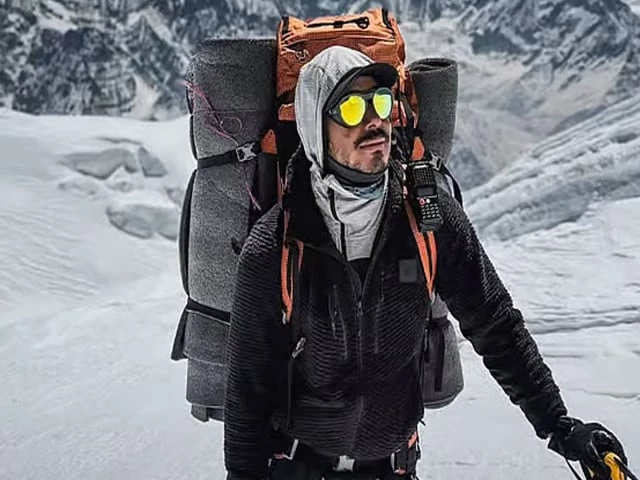
Famed climber Nirmal Purja, who set a record for the fastest ascent of the world's 14 highest mountain, died in an avalanche on the world's 12th highest peak in Pakistan, his company said on Saturday.
"Today it is with profound sadness and immense heartbreak that we confirm that Nirmal 'Nimsdai' Purja , tragically lost his life following the avalanche on Broad Peak," his expedition organising company Elite Exped said in an Instagram post.
Purja, 43, who served with British special forces as a Gurkha, completed the record climbs in six months in 2019. He became widely known internationally after the Netflix documentary chronicling his journey 14 Peaks: Nothing Is Impossible was released two years later.
He climbed all 14 "eight-thousanders" (peaks above 8,000 metres, or 26,000 feet) in six months and six days between April and October 2019 -- then a record.
In 2021, Purja completed the first winter ascent of K2 along with a team of nine other Nepali climbers.
Purja had written on X this week that he was close to becoming the first person to climb all 14 "super peaks" twice without oxygen.
"Broad Peak, I ask for nothing but safe passage up and back down," he wrote. "I take zero mountains for granted. Not one. The moment my foot leaves basecamp, it's 100%. Always has been. Always will be.
"My purpose has never been about me. It's about what I represent. It's about showing YOU that your own mountains- whatever they are- are climbable."
Earlier, search and rescue operations on Broad Peak resumed as high-altitude porters and rescue teams continued efforts to locate seven missing climbers following an avalanche that struck a 10-member international expedition in Pakistan's Karakoram range.
Search-and-rescue teams recovered three bodies on Friday after the avalanche struck an international climbing expedition on one of Pakistan's highest peaks a day earlier. The expedition, led by Purja, lost contact after the avalanche.
The search operation was suspended at the end of Friday and resumed on Saturday.
According to the Gilgit-Baltistan Police spokesperson, rescue personnel restarted the operation at first light to continue the search for the missing mountaineers in the challenging high-altitude terrain.
The avalanche struck an international expedition while climbers were ascending from Camp 2 to Camp 3, killing three mountaineers. The deceased were identified as Nadhira Ahmed Abdullah Al Harthy of Oman, Sarah Mallory of the United States, and Pur Bahadur Gurung of Nepal.
The body of the Omani climber, which had been shifted to Skardu on Thursday, was flown to Islamabad on Friday morning. The body of the Nepalese climber remains in Skardu, officials said.
Pakistan Army Aviation deployed helicopters, rescue personnel, and specialised equipment to support the operation, while a civilian rescue team led by renowned Pakistani mountaineer Sirbaz Khan continues ground efforts in the difficult terrain.
The Alpine Club of Pakistan said the expedition comprised 10 people, including five Nepalese, a Pakistani, an Omani, an American, and a climber from China. Police did not mention an American citizen and said two British nationals-a man and a woman-were in the missing team.
Drone footage indicated the possibility of additional casualties, but adverse weather conditions, including heavy snowfall, have hampered rescue efforts. Authorities said the search operation would continue as conditions permit.
The incident has drawn international attention, with the global mountaineering community closely monitoring developments from one of the world's most challenging peaks.
Broad Peak is located in the Karakoram range in northern Pakistan, and is regarded as one of the toughest and most technical climbs of all the 8,000 metre-plus ascents.
It was first summited in 1957 by an Austrian team.











This material may not be published, broadcast, rewritten, redistributed or derived from. Unless otherwise stated, all content is copyrighted © 2026 The Express Tribune.

1727268465-0/Untitled-design-(42)1727268465-0-208x130.webp "the reverse renaissance")




COMMENTS
Comments are moderated and generally will be posted if they are on-topic and not abusive.
For more information, please see our Comments FAQ