‘Dropping seniors from T20 squad is ridiculous’
Updated 14 minutes ago

FIFA drops plan to sell a 20% stake in a new commercial entity after strong opposition, Infantino says
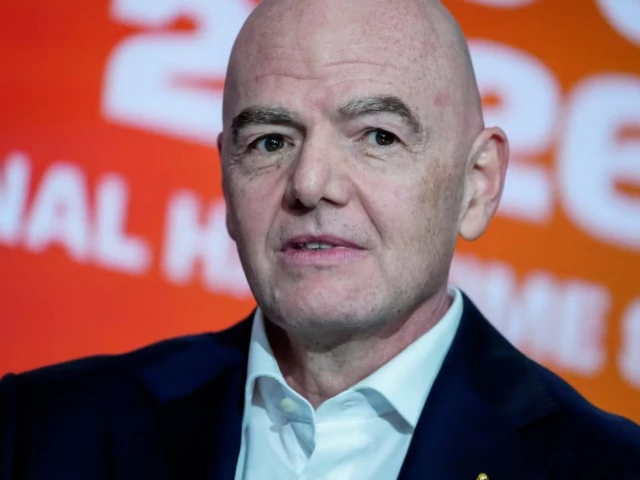
FIFA president Gianni Infantino, hitherto untouchable at the helm of football's global governing body, suffered a crushing blow on Friday when his bold reach for private equity riches was brought to an end in the face of a ferocious backlash.
A FIFA statement, attributed to Infantino, conceded that the proposal to create a commercial entity to run the World Cup and other tournaments, 20% of which would be sold to private investors, was divisive and dead in the water.
The concession ended three days of civil war in the football world, which peaked when Europe's UEFA, the richest and most influential of football's six regional confederations, announced a boycott of all FIFA events until the proposal was ditched.
The plan was Infantino's baby and its demise less than two weeks after the most lucrative World Cup in history has left the 56-year-old Swiss administrator isolated at the top of an organisation he had been planning to run for another 4-1/2 years.
"A week ago, Infantino's riding high and was almost certain to get elected overwhelmingly because he's run against such a financially successful tournament," Victor Matheson, professor of economics at the College Of The Holy Cross in Massachusetts, told Reuters. "That's all in jeopardy now."
"It's hard to think of a situation where a person's political fortunes changed so rapidly," he added.
"As close as two weeks ago, he's riding, you know, on top of the world, the most successful sports mega event in the history of this planet. And just two weeks later, he's fighting for his political life."
Before the World Cup, Infantino's re-election for a fourth term at the FIFA Congress in Morocco in March had looked like a slam dunk with no rival candidates in the frame.
The picture has shifted radically after three days during which even the most loyal confederations raged at the lack of consultation over the proposal, and Infantino faced accusations of selling the soul of the game.
After FIFA doubled down on the plan on Friday with a statement that reiterated the promise of millions of dollars of new funding for national federations, some of those closest to Infantino distanced themselves from it.
Senior adviser Carlos Cordeiro resigned in protest, calling it "a bad deal for football", while FIFA Chief Operating Officer Kevin Lamour alleged staff had been "deceived" by Infantino and described the proposal as a "project of one person".
Exasperated by leadership style
Infantino, who took over at FIFA in 2016 after a corruption scandal had ended Sepp Blatter's 17-year reign as president, had frequently exasperated those around him with his independent leadership style, sources told Reuters.
His authority and ability to keep FIFA's coffers full, though, had previously been strong enough to allow him to recover from his missteps.
He backed down from a plan promising 25 billion dollars in private investment for the Club World Cup in 2018 after strong opposition from UEFA.
He sailed through a storm of outrage over his defence of Qatar as the 2022 World Cup host and his bizarre pre-tournament speech in which he declared: "Today, I feel gay. Today, I feel disabled. Today I feel a migrant worker."
This week's gambit, however, backfired spectacularly.
Infantino failed to build any consensus and key stakeholders knew nothing of the plan until FIFA's rushed announcement on Tuesday, when details leaked to newspapers.
They were kept in the dark as Infantino met investors and chose Joshua Kushner-founded Thrive Capital, a firm with close familial links to US President Donald Trump, to lead the proposed investor group.
For the Asian Football Confederation, it was a "totally unacceptable" dismissal of the usual protocols and the 47-member body on Friday called for institutional reform at FIFA.
Close relationship with Trump
Infantino's close relationship with Trump was already under scrutiny after FIFA awarded the US president its inaugural Peace Prize last December.
Jim Boyce, a former FIFA vice-president who knew Infantino when the Swiss worked at UEFA, suggested Infantino's head might have been turned by his proximity to political power.
Read More: FIFA vows to go ahead with investment proposal
"I think what has happened here is that fame appears to have gone a little bit to Gianni's head and his relationship with Donald Trump during that World Cup is nothing more than astounding," the Northern Irishman told the BBC this week.
At the World Cup, Trump said he had called Infantino to ask for US player Folarin Balogun's suspension for a red card to be rescinded so he could play in a knockout match.
That Balogun was ultimately allowed to play after a ruling by FIFA's independent disciplinary body did nothing to dispel the perception that Trump was interfering with football matters through Infantino.
"It didn't help that you had a Kushner involved in this whole thing," Sports Marketing analyst Bob Dorfman told Reuters.
"Especially what was going on during the World Cup with Balogun and Trump. To have a Trump relative involved in this only made the whole thing much worse."
Trump said on Friday that he did not speak with Infantino about the proposal to sell stakes in the World Cup.
Too early to write off Infantino
Although rival candidates are now almost certain to emerge before the presidential election, it is probably too early to write off even a wounded Infantino if he decides to run.
The stake sale proposal was always aimed squarely at the 211 national football federations who will vote, many of which rely on FIFA funding to make ends meet and have done well under Infantino's patronage.
Infantino would need a two-thirds majority in the first round or a simple majority in subsequent rounds to extend his presidency until 2031 and Dorfman said a note of contrition might just do the trick.
"I know that's not in his manner to do things like that but maybe he has to start apologising a little bit and say: 'Maybe I handled this wrong'."
The controversy comes at an awkward moment for Infantino, who said in April he intends to seek re-election for a fourth term as FIFA president.
Since taking over from Sepp Blatter in 2016, he has been re-elected unopposed twice and appeared firmly in control of the organisation.
While his re-election for the 2027-31 term had appeared a formality, experts told Reuters the backlash against the failed proposal had exposed dissatisfaction among some FIFA members and could complicate his path ahead of next March's FIFA Congress in Morocco.
"He's obviously been kind of egomaniacal in everything that he's done. I know that he's rubbed many of the member associations the wrong way with some of his decisions," Bob Dorfman, a sports marketing analyst, said.
"Some of the countries that have been awarded World Cups have been kind of questionable. Politics has gotten involved in this a little too much."
UEFA loses trust in Infantino over FIFA transparency concerns
UEFA said it had lost confidence in Infantino after world football's governing body abandoned plans to sell a stake in the commercial rights to the World Cup.
The swift reversal has exposed growing unease within world football over Infantino's leadership style, with football officials demanding greater oversight of decisions that could reshape the governance and commercial future of the sport.
UEFA, whose 55 members had unanimously rejected the proposal earlier this week, declared FIFA's retreat a "victory for the whole game" while adding that the "task of rebuilding trust in FIFA" had only just begun.
"The current FIFA leadership has not only lost UEFA’s confidence but also that of many other members of the football family," UEFA said in a statement.
"UEFA thanks all the fans, leagues, clubs, players, individuals, associations and confederations that opposed the scheme, alongside the many prime ministers, heads of state and commentators who have demonstrated to the FIFA president that football is not for sale," it said in a statement.
"We cannot keep going on like this with secret schemes on fast-track timescales, cooked up by faceless individuals and of dubious benefit to the game. We must identify those responsible and hold them to account."
'Shabby, back-room opaque deal'
The backlash raised questions about Infantino's political capital as he prepares to seek another term in office.
UEFA reminded Infantino about the promises he made when he was elected FIFA president in 2016, vowing to work with transparency and saying FIFA's money belonged to the national associations.
"On both these promises, he has failed to deliver. The shabby, back-room, opaque deal he hatched and tried to force through was anything but transparent," UEFA added.
"And with reserves standing at over $5 billion, he has also failed to use associations' money for the benefit of the game.
"UEFA will begin work immediately with partners and stakeholders all over the world and right across the game to propose a new way of distributing resources through the existing FIFA Forward programme."
FIFA and Infantino declined to comment on UEFA's statement.
Asian Football Confederation President Sheikh Salman bin Ebrahim Al-Khalifa welcomed FIFA's reversal.
Bahrain's Sheikh Salman said he expected that "any initiative that has the potential to impact global football will be presented and discussed with the Confederations, the FIFA Council, Member Associations and other stakeholders in a timely, transparent and meaningful manner."
"The future of global football must always be shaped through proper consultation, collective dialogue and respect for the established governance structures of our game."
Football Australia chairman Anter Isaac struck a similar note, backing innovation while warning against bypassing core governance principles.
"Football has never stood still, nor should it," Isaac said.
"Some principles, however, should never change. Integrity. Independence. Good governance. Transparency. Meaningful consultation. Due process."
"These are not constraints on progress. They are what make lasting progress possible."




This material may not be published, broadcast, rewritten, redistributed or derived from. Unless otherwise stated, all content is copyrighted © 2026 The Express Tribune.



COMMENTS
Comments are moderated and generally will be posted if they are on-topic and not abusive.
For more information, please see our Comments FAQ