
In April 1953, Dwight Eisenhower stood before the UN General Assembly and offered the world a bargain. The United States, he said, would share the "peaceful atom" — nuclear reactors, medical isotopes, research training — with any nation willing to accept American oversight of how that knowledge was used. "Atoms for Peace" was sold as generosity. In practice, it was architecture. It built a system in which the United States decided who was permitted to know, who could be trusted with the knowledge once they had it, and who would be cut off the moment they stepped out of line.
Pakistan learnt this lesson more intimately than most. The Pressler Amendment, following the Symington Amendment before it; decades of sanctions calibrated to the country's nuclear ambitions, gave Islamabad a masterclass in how the world's most powerful nation treats knowledge as a weapon to be holstered and unholstered at will. Expertise was never really shared. It was leased, with the lessor retaining the right of eviction.
Seventy years later, a new peaceful atom has arrived, and the same bargain is being offered again, dressed in the language of chips and clusters instead of uranium and centrifuges. Artificial intelligence has become the substance over which the twenty-first century's great powers are fighting for control, and once more, the Global South is being asked not whether it wants to participate in the future, but on whose terms it will be allowed to.
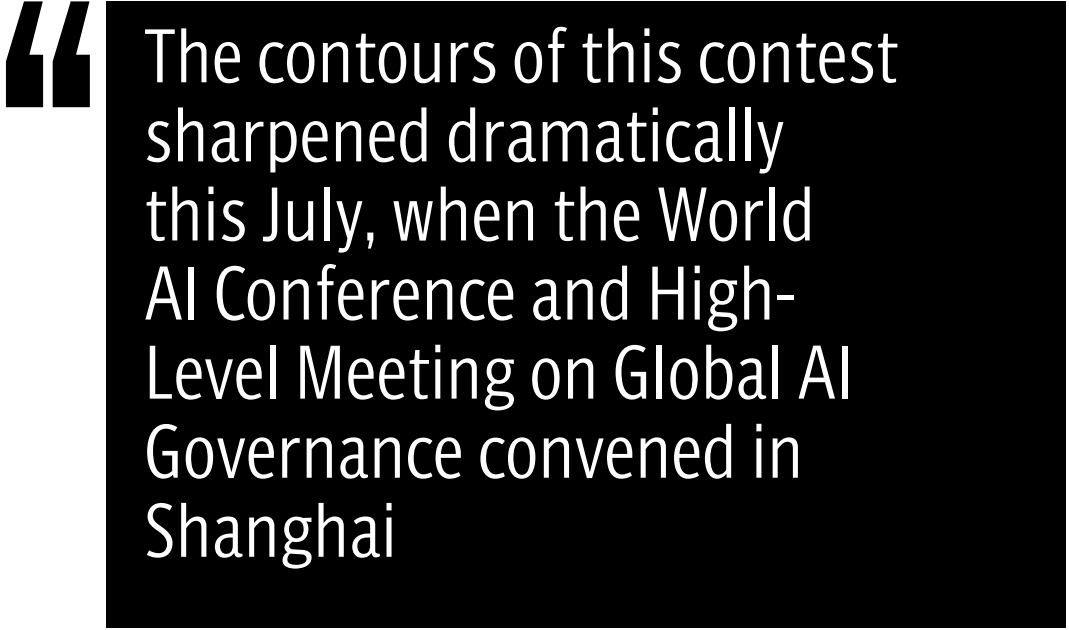
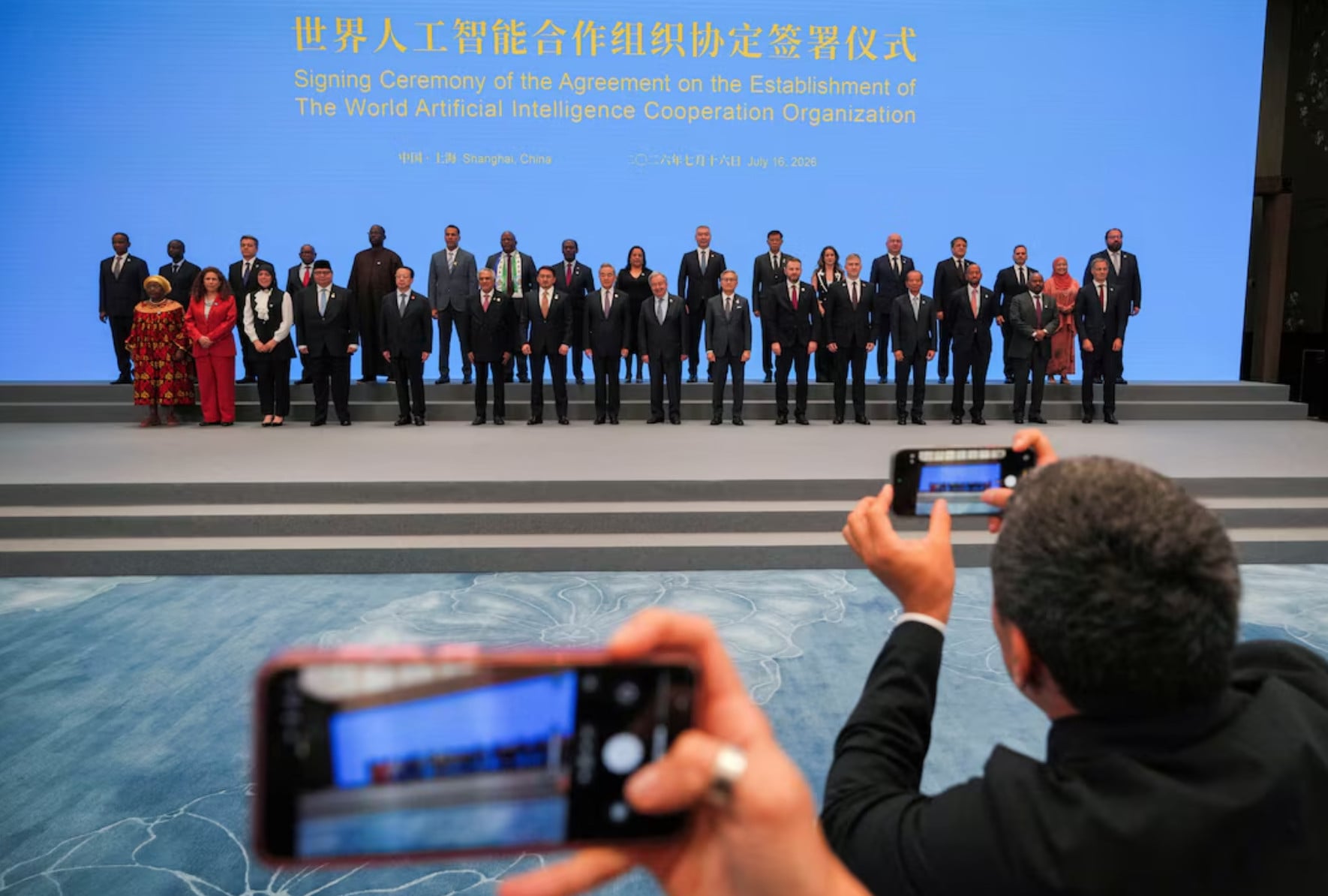
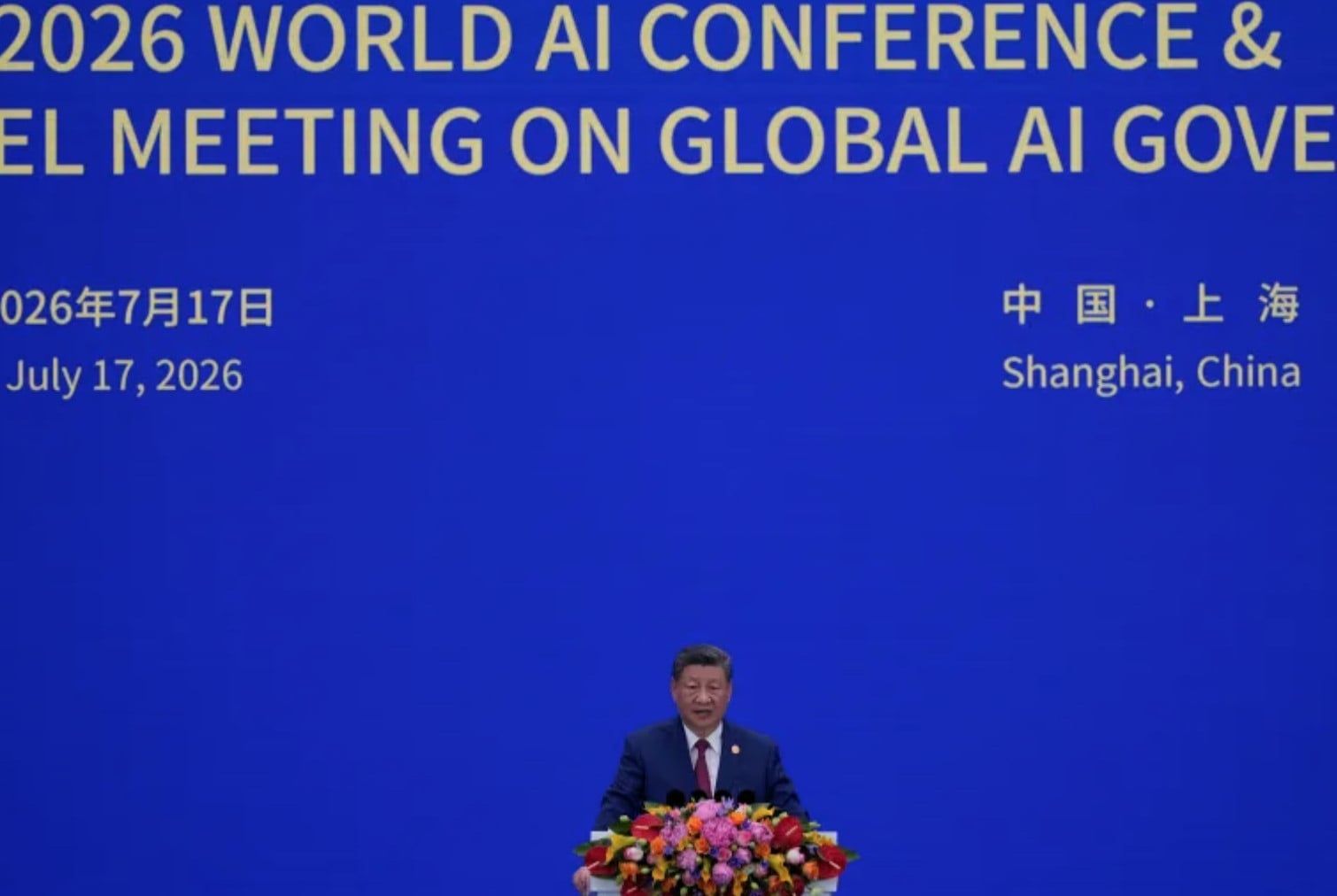
The contours of this contest sharpened dramatically this July, when the World AI Conference and High-Level Meeting on Global AI Governance convened in Shanghai. For the first time since the event's founding in 2018, President Xi Jinping himself took the stage, using the moment to announce the creation of the World Artificial Intelligence Cooperation Organisation, a body twenty-nine countries have already signed on to as founding members. Xi described it as China's answer "to the call of the Global South," pledging 5,000 training and seminar opportunities for developing nations over the next five years and calling for "a just and equitable system for global AI governance." His premier, Li Qiang, has spent two consecutive WAICs refining the same pitch: AI as a public good rather than private property, and computing power and technical know-how as things to be distributed rather than hoarded.
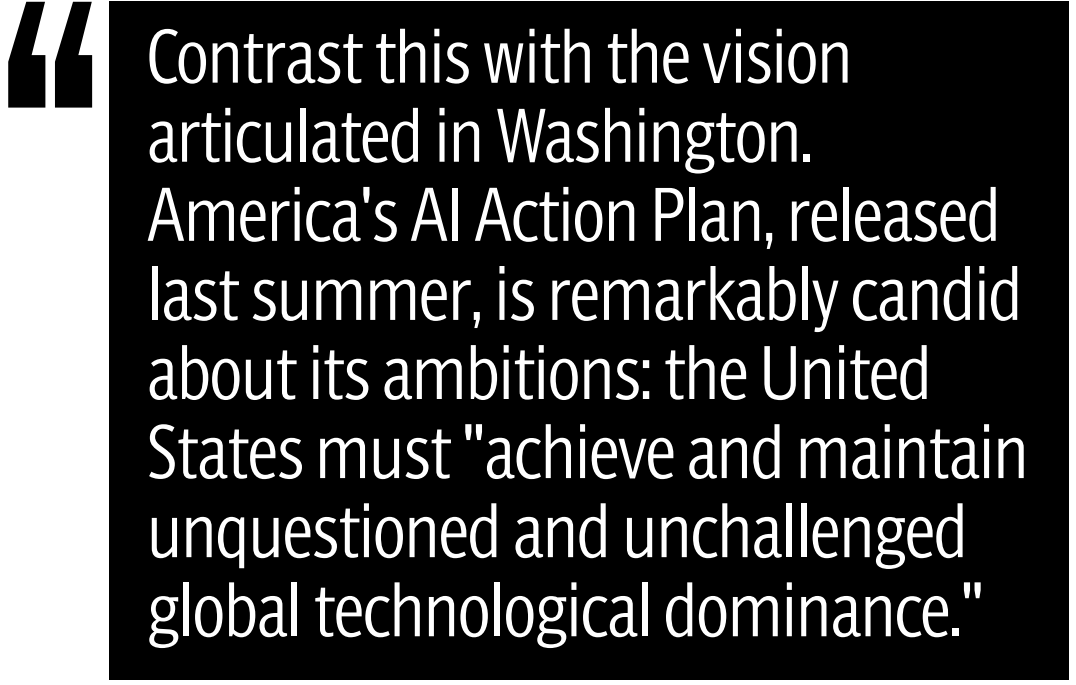
Contrast this with the vision articulated in Washington. America's AI Action Plan, released last summer, is remarkably candid about its ambitions: the United States must "achieve and maintain unquestioned and unchallenged global technological dominance." Its international pillar exists explicitly to counter Chinese influence in governance forums, and its central offering to the rest of the world is not access on equal terms but membership in what amounts to a gated alliance — an "AI stack" exported to partners willing to accept American terms, American export controls, and American veto power over how the technology is ultimately used. At February's India AI Impact Summit, the White House's technology chief, Michael Kratsios, was blunt about rejecting multilateral governance altogether in favour of bilateral deals in which Washington decides, country by country, who gets what.
The word Washington prefers for this arrangement is "sovereignty." Nations are invited to build "sovereign AI ecosystems", so long as those ecosystems run on American silicon, American models and American rules. It is worth sitting with the irony here. Sovereignty, in this formulation, is granted rather than exercised. A country's ability to think for itself, at scale, using the tools that increasingly mediate research, commerce and governance, is treated as something Washington confers as a gift, revocable the moment strategic calculations shift. Lawfare's Pablo Chavez has called this the "sovereignty gap" in American AI statecraft, the growing distance between the independence countries actually want and the dependence Washington is engineering under sovereignty's own name.
 That gap has never been more visible than in the pattern of America's chip export regime, which has ratcheted tighter with almost every quarter since October 2022, when the first restrictions targeted Nvidia's most advanced processors bound for China. Each rule closed a loophole the last one had left open, from the China-specific A800 and H800 chips to the H20, banned outright this April alongside Huawei's Ascend 910C. But the arbitrariness of the regime is what should worry the rest of the world more than its severity. Within months of banning the H20, Washington reversed course and cleared it for export to China with a 25% tax attached, having already taken a 15% cut of Nvidia and AMD's China sales as the price of a license. Rules that can be rewritten by a single Commerce Department memo are not rules at all. They are leverage, and leverage is precisely what a Global South country cannot plan a university, a health system or a research agenda around.
The clearest illustration of how quickly that leverage can be turned against anyone came only weeks ago, when the US Commerce Department briefly moved to bar foreign nationals — including researchers at international universities and multinational firms already relying on the models in production — from using two frontier AI systems, before restoring access at the end of June under export-control obligations. It was, by multiple accounts, the first time such controls had been applied retroactively to commercial models already embedded in classrooms, laboratories and companies around the world, rather than to experimental prototypes still on the drawing board. For a Pakistani university running a research programme, or an Indian hospital using a diagnostic model, or a Nigerian fintech built on an American API, the message could not have been clearer: the knowledge you have integrated into your institutions is not yours. It is licensed, and the license can be pulled.
This is where the language of "colonisation" earns its place. Classical colonialism extracted raw materials and shipped back finished goods at a markup the colonised had no power to negotiate. Digital colonialism, as scholars researching AI's impact on the Global South have taken to calling it, extracts something more valuable: data, behaviour, and increasingly, the right to reason. Training datasets are built disproportionately from the internet's English-language, Global North-produced text, and the infrastructure required to build anything comparable — the chips, the energy, the capital — is concentrated in a handful of countries that then decide, contract by contract, who else is permitted to draw on it. A 2026 review in Frontiers in Education, examining AI's spread through classrooms in Latin America and Southeast Asia, found heavy dependence on imported tools and English-language datasets, with national AI strategies chasing economic competitiveness while all but ignoring who actually controls the underlying data and infrastructure. The pattern repeats in research: publishing infrastructure, citation metrics and even the tools now used to summarise, translate and analyse scholarship are calibrated to Global North institutions, reproducing precisely the disparities in research capacity that colonial-era education systems first inscribed.
This is the epistemic apartheid worth naming plainly. It is not merely that the Global South has less access to AI; it is that the terms of knowing itself are being re-centralised in Washington. Who gets to train a model that understands challenges unique to country like Pakistan? Whose research gets flagged as a security risk and locked out of a lab's most capable model, and whose gets waved through? As universities, newsrooms, courts and startups from Karachi to Lagos to Jakarta increasingly route their thinking through systems built, trained and licensed by a superpower, the very infrastructure of inquiry becomes something the Global South rents rather than owns.
The chip regime is only half the story; the other half is who gets to sell into whom. Even as Washington restricts what reaches rivals, it has been remarkably generous with certain partners. The UAE has secured a preliminary agreement to import up to 500,000 of Nvidia's most advanced AI chips annually, with the Emirati firm G42 alone receiving 100,000 a year in a deal expected to run through at least 2027. Saudi Arabia's Humain has been promised an initial tranche of 18,000 Blackwell processors.
Countries in the "middle tier" of what was once the Biden-era Diffusion Rule — India among them — have no such fixed entitlement, their access instead subject to case-by-case bilateral bargaining that can be revised as swiftly as the underlying politics. Compute, in other words, now flows along the same fault lines that have long determined who receives development aid, preferential trade access or military hardware.
While China's alternative is by no means offered from pure altruism — the inclusive rhetoric it uses is also strategic outreach to deepen influence in regions where Belt and Road ties already run deep — there is a meaningful difference between two systems of unequal power, and it lies in what each asks of the weaker party. Washington's model demands political alignment as the price of admission. Beijing's model at least gestures toward capacity-building as an end in itself — training programmes, open-source releases, a seat at a table rather than a place in a queue. One treats AI capability as a currency of loyalty; the other treats it as infrastructure to be shared. Neither is a gift, but a discerning Global South does not need a gift. It needs to know which door, once opened, cannot later be slammed shut on a memo's notice.
The arms control regimes of the last century offer one final, uncomfortable lesson. The Nuclear Non-Proliferation Treaty, the Wassenaar Arrangement, the export-control lists that followed the Cold War's various technology races, all were sold as instruments of global stability, and all functioned, in practice, as mechanisms by which existing powers preserved a monopoly on capability while managing the terms under which everyone else was permitted to approach it. AI governance today risks repeating that history with software instead of centrifuges. An arrangement in which "responsible" access is defined entirely by those who already possess the technology, and in which the rest of the world's role is to apply for admission rather than help write the rules.
For Pakistan and countries like it, dependency of any flavour is still dependency. The lesson of the peaceful atom was that expertise offered as generosity comes with strings long enough to be pulled from a continent away. AI is being offered the same way. The task now is to build, however incrementally, the compute, the talent and the institutions that make the question of dependency less severe than it currently is.