Meghan vowed to keep kids away from her father
Updated 43 minutes ago

Veteran Indian lyricist urges young writers to read more and resist the pressure to chase viral trends
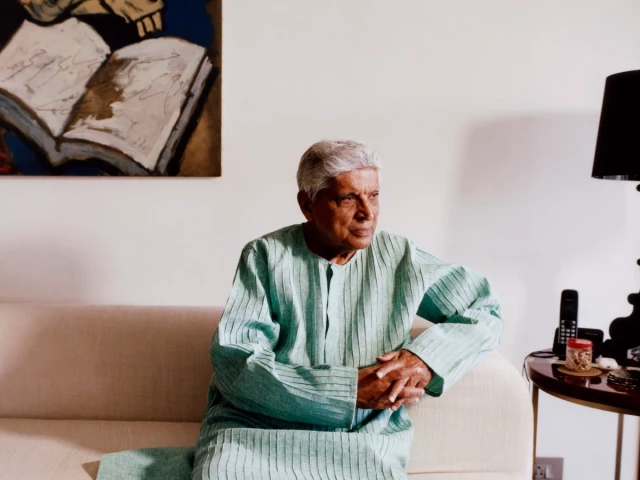
Indian lyricist and screenwriter Javed Akhtar believes the internet has fostered a culture in which people are increasingly afraid to step outside their comfort zones, arguing that meaningful creativity is being sacrificed in favour of chasing trends.
Speaking to Vogue India, the veteran writer reflected on how social media, algorithms and the pursuit of virality have reshaped music and storytelling. He also stressed the importance of reading, reflection and originality, urging younger generations to look beyond fleeting trends and reconnect with literature.
"The echo chambers created by the internet have made most people afraid to do something for the first time. Once someone else does it, they're fine to follow in their footsteps," Akhtar said.
"People no longer want to pause, think, analyse or sit with an idea. They are living happily, so why would they bother to think about this universe or the vastness of nature? For them, it is a waste of time."
He argued that meaningful art cannot exist without patience and introspection.
"But meaningful creation requires time, discomfort and reflection. Perhaps that is why I have never hesitated to question dominant voices and widely accepted ideologies, especially when there is a gap between what is preached and what is practised."
Akhtar also criticised the industry's growing obsession with what is considered "trendy", saying commercial priorities have diminished the role of lyrics in music.
"Today, words have become less important because the marketing team has decided that slow music won't 'trend'. They say music preferences have changed and that old music is no longer in currency.
"But then they take those same songs, edit the mukhras and remix them with some inferiorly written antaras," he said.
"There was a time when writers had more space. Today, other forces dictate what music gets made. And yet, songs that are decades old still endure, while many recent ones have a short shelf life."
The celebrated lyricist also urged aspiring writers to cultivate the habit of reading, regardless of genre.
"They must read. We grow up being told to read classical literature and big writers. Yes, read respected fiction and non-fiction authors, but at the same time, don't shy away from reading light literature. The real loss is not in reading something trivial but in not reading at all," he said.
Reflecting on the creative process, Akhtar described writing as a balance between imagination and technical skill.
"All arts can be divided into two parts. On one hand, there's imagination, passion, fantasy and romance, and on the other, there is craft. Every art has a craft. You can learn the craft in a crash course. But imagining, fantasising and romanticising cannot be learned. There are no courses for yearning."
Akhtar further said inspiration rarely followed a fixed formula and could emerge from almost any experience.
"Sometimes, it is a social issue that refuses to leave my mind, sometimes a person I have encountered, a story I have heard or a fleeting incident. At times, something as simple as good weather can stir a thought or a line. I do not follow a fixed ritual. I do not have tantrums. I can write in a room full of people, even at a party, even in dim light. The only thing I need is a plain sheet of paper without lines. When words, thoughts, scenes and lines knock, you have to welcome them in."
Concluding the interview, Akhtar shared a lesson from his father that continues to shape his approach to writing.
"My father had once told me that it is very easy to write in difficult language, but very difficult to write in easy language. When you write simply, there is no space for your idea to hide behind big words. Only if you are totally convinced of what you are writing can you afford to use transparent language."



This material may not be published, broadcast, rewritten, redistributed or derived from. Unless otherwise stated, all content is copyrighted © 2026 The Express Tribune.





1727268465-0/Untitled-design-(42)1727268465-0-208x130.webp "the reverse renaissance")

COMMENTS
Comments are moderated and generally will be posted if they are on-topic and not abusive.
For more information, please see our Comments FAQ