
Ashok Swain’s Climate Security is not a comfortable book, nor does it pretend to be. At a time when climate anxiety is increasingly wrapped in diplomatic slogans and defence policy jargon, Swain strips away the language of preparedness to expose something far less reassuring: a global response to climate change that often looks more like a blueprint for preserving privilege than protecting humanity.
The book arrives in a policy landscape saturated with the phrase “climate security,” a term that has moved from academic conferences into military doctrines and even UN Security Council briefings. The idea carries an obvious appeal—and who could object to securing the planet against climate chaos? Swain’s concern is not with the aspiration itself but with how the concept is being used to justify militarised borders, surveillance states and geopolitical opportunism under the banner of environmental concern.
What makes Climate Security compelling is that it never questions the severity of the climate crisis. The author treats climate disruption as an existential emergency. His criticism is directed instead at the way powerful states have chosen to respond, often prioritising the protection of wealth, territory and influence over the security of those most vulnerable to climate impacts.
At the heart of the book is a challenge to one of the most widely accepted assumptions in contemporary climate discourse: that environmental change inevitably fuels conflict. The narrative is attractive because of its simplicity. Rising temperatures produce droughts, droughts create resource scarcity, and scarcity leads to violence. Around the world, it has become a staple of security briefings and political speeches. Swain spends much of the book showing why reality is rarely so straightforward.
Drawing on a wide range of case studies, he argues that climate stress rarely translates directly into armed conflict. Environmental pressures interact with political marginalisation, weak governance and entrenched inequality. Climate change acts less as a trigger for violence than as a force that magnifies existing instability, deepening crises that are already taking shape. The distinction matters because it carries significant policy implications. If climate change is framed as an inevitable source of conflict in poorer countries, wealthier nations can cast themselves as future victims rather than historical contributors to the crisis. That argument comes into sharp focus in Swain’s discussion of water politics. Water scarcity is frequently presented as the defining climate flashpoint, with politicians and analysts warning of inevitable “water wars” across shared river basins. In his book, Swain dismantles that assumption with characteristic care. Swain argues that shared water resources are more likely to encourage cooperation than conflict. River basins governed by fragile agreements often prove remarkably resilient, with states choosing negotiation over confrontation even during periods of severe scarcity. But the myth of inevitable water conflict persists because it serves powerful strategic narratives. Governments can invoke it to justify aggressive infrastructure projects, securitised resource management and nationalistic rhetoric under the guise of environmental necessity. The fixation on future water wars, Swain suggests, tells us less about hydrology than geopolitics. Scarcity becomes a tool for political mobilisation, obscuring the governance failures and social inequalities that determine how water is managed and distributed.
The chapters on climate-induced migration are among the book’s most provocative. The author challenges the dystopian imagery that often dominates political debate in the West, where climate refugees are portrayed as vast populations poised to overwhelm fortified borders. Drawing on empirical evidence, he shows that most climate displacement takes place within national borders or neighbouring countries. That has done little to weaken the political appeal of the narrative. Climate migration continues to shape some of the toughest immigration policies in the Global North. Swain argues that migrants have become convenient symbols in populist politics, allowing governments to recast environmental displacement as a security threat rather than a humanitarian challenge. In doing so, victims of a crisis driven largely by industrialised economies are recast as perceived aggressors. The consequences extend beyond political rhetoric, as framing displacement as a border security issue allows governments to expand detention regimes, militarise migration routes and outsource asylum responsibilities, all while presenting those measures as climate preparedness.
Another recurring concern is the growing role of military institutions in climate governance. Armed forces are increasingly taking on responsibilities in disaster response and adaptation planning, partly because they possess logistical capabilities that civilian agencies often lack. Swain accepts the practical rationale but warns that militarising climate policy changes the way the crisis is understood. Security institutions tend to prioritise control, surveillance and strategic defence. When adaptation is viewed through that lens, protecting infrastructure and maintaining order can take precedence over reducing social vulnerability. The danger, Swain argues, is the emergence of a climate response shaped by fortress thinking. Infrastructure is hardened, borders fortified and surveillance expanded, while the structural causes of vulnerability remain largely untouched. Climate adaptation becomes less about reducing risk than insulating wealth from its consequences. The same logic, he argues, can be seen in the way authoritarian governments exploit climate security narratives. Environmental emergencies become a rationale for centralising power, expanding surveillance, restricting civil liberties and suppressing dissent. Climate governance, in these cases, serves political consolidation as much as ecological protection.
 The discussion of global climate inequality is among the book’s strongest sections. Swain describes a world edging towards what he calls climate apartheid, in which wealthy countries invest heavily in adaptation and protective infrastructure while poorer nations confront increasingly severe disasters with limited support. Those most responsible for greenhouse gas emissions are often the best equipped to shield themselves from the consequences. Those least responsible remain the most exposed. For Swain, this is not simply an unfortunate consequence of economic inequality but a defining feature of today’s climate security paradigm. Prioritising national resilience and border protection allows powerful states to protect their own populations while shifting the humanitarian costs of climate disruption elsewhere.
The book also examines the role of international institutions in reinforcing securitised climate discourse. Swain acknowledges the growing attention climate risks receive within UN peace and security frameworks but questions whether these initiatives genuinely advance human security. Too often, he argues, global governance reflects existing power hierarchies, allowing dominant states to shape climate policy around their strategic interests.
Stylistically, Climate Security is restrained and the author relies on case studies and policy analysis rather than dramatic rhetoric, allowing the evidence to carry his argument. Readers may disagree with some of his conclusions, but by the final chapters it becomes difficult to dismiss the questions he raises about the politics of climate security.
The book is less persuasive when it turns to solutions and Swain calls for a human-centred approach built on social justice, international cooperation and a fairer distribution of resources. The vision is compelling, but it leaves relatively little guidance on how governments might overcome the political interests that have entrenched the current security framework. That may reflect the scale of the challenge as much as any weakness in the book itself. Swain is diagnosing a political mindset rather than offering a policy manual, though he does argue that developing countries must prioritise adaptation instead of waiting for wealthier nations to act.
The book arrives as governments face growing pressure to demonstrate that they are prepared for a more volatile climate. Security-driven responses are politically attractive because they project decisiveness. Fortified coastlines, expanded surveillance and militarised disaster response create an appearance of control. Swain asks whether that sense of control comes at the expense of justice. The question running through Climate Security is ultimately a simple one: whose security is climate policy designed to protect? Swain’s answer is unsettling. Too often, today’s climate security framework appears more concerned with managing the geopolitical consequences of climate change than preventing human suffering.
For readers accustomed to climate books centred on technology or economics, Climate Security offers a different perspective. The Sweden-based author argues that climate change is not only an environmental crisis but also a political and moral one, and that the choices governments make today will shape global inequality, migration and international relations for decades to come.
Climate Security is unlikely to reassure policymakers committed to defence-centred climate strategies, nor readers looking for easy answers. Instead, it offers a carefully argued critique of how the world’s most powerful states are preparing for environmental disruption. As the climate crisis reshapes global politics, Swain leaves readers with a question that extends well beyond environmental policy. Will a warming world encourage greater international cooperation, or accelerate a retreat behind fortified borders, expanding surveillance and widening inequality?
To understand the author’s expectations for the future, the Express Tribune spoke with him about his book and its place in today’s geopolitical landscape. Here’s what he had to say:
ET: Your book comes out at a time when climate change is all but deprioritized. What factors do you think are pushing it down the priority list?
AS: It’s worrying that climate change is being pushed down the list, but in many ways, it’s predictable. Short-term thinking, fear of electoral backlash, and the political cost of rapid economic transitions all play a role, even though inaction will cost far more in the long run. Misinformation, lobbying, and rising right-wing populism have made climate action politically divisive and easy to delay. The US leaving the Paris Agreement hasn’t helped—it signals that major powers can step back from global responsibility. And with the world focused on wars and other crises, there’s a dangerous illusion that climate risks can wait, even as they continue to build.
ET: One of the most striking threads in your work is the shift from solidarity based climate cooperation to security driven climate governance. Do you see this shift as reversible, or has it become structurally embedded in international climate politics?
AS: The shift toward security-driven climate governance is real and increasingly embedded, but it’s not irreversible. Climate change is now framed as a national security concern because it affects borders, disasters, migration, and military readiness, which draws political attention. But these risks can’t be solved through isolation or military measures alone—climate change has no borders and demands cooperation. That means the security framing can either push countries toward narrow self-preservation or toward collective action if leaders use it wisely. Wars dominating headlines and the US withdrawal from the Paris Agreement make solidarity harder, but cooperation is becoming structurally unavoidable.
ET: Has the climate security discourse, intentionally or otherwise, reinforced stereotypes about fragility in the Global South?
AS: Yes, even when unintended, climate security discourse can paint the Global South as naturally fragile or permanently unstable. Climate impacts hit poorer regions harder because of weaker economies, limited institutions, governance challenges, and fewer resources for adaptation. The danger is that this vulnerability is often framed as a local failure rather than the result of global injustice—unequal responsibility and capacity. The cruel irony is that the poorest countries have contributed least to emissions but suffer most, while having little influence in negotiations. Climate security narratives need careful handling to highlight these structural inequalities instead of stigmatizing vulnerable societies.
ET: You show that most climate displacement remains internal or regional, yet the fear of mass migration toward wealthy states dominates global policy. Why has this misconception become so politically useful?
AS: It’s politically useful because it lets wealthy states treat climate migration as a border threat rather than a human security and justice issue. Most climate-related displacement happens within countries, but the idea of cross-border arrivals hits harder politically—it taps into domestic polarization, rising ethno-nationalism, and election concerns. This fear justifies tougher migration controls while shifting attention away from the deeper responsibilities of emissions reductions and adaptation support. With global attention now on war, migration fears are even easier to weaponize as part of broader security agendas.
ET: In the book, you caution that climate emergencies can legitimise expanded surveillance and restrictions on civil liberties. Are we already witnessing early forms of climate authoritarianism?
AS: Yes, we’re already seeing warning signs, even if climate authoritarianism isn’t the dominant model everywhere. Climate stress can undermine economic stability, deepen inequality, and weaken trust in institutions, opening the door to stronger state control and less democratic accountability. When repeated disasters and growing insecurity hit, governments often seek faster decision-making and expanded powers, which can reduce transparency and public scrutiny. Treating the climate crisis as a national security issue gives leaders more authority to act quickly, sometimes bypassing normal democratic processes. The risk is that emergency measures introduced during climate shocks could gradually become permanent tools of governance.
ET: Your book calls for human centred climate security rooted in justice and cooperation. Given current geopolitical tensions, how politically realistic is this transformation?
AS: It’s politically difficult, but both necessary and possible—especially since the alternatives are far more destabilising. Climate change isn’t just an environmental issue; it multiplies insecurity, poverty, and conflict, meaning countries will have to respond sooner or later. Human-centred climate security only works if leaders treat climate action as essential to stability and legitimacy, not optional. Multilateral cooperation is still possible, and progress can happen even in a divided world. But with the space for justice-based cooperation shrinking, leadership and pressure from society are more important than ever.
ET: Are international climate governance structures capable of delivering justice-based solutions, or are they structurally shaped by existing geopolitical hierarchies?
AS: They have potential, but unequal power and geopolitical hierarchies still shape how they function. Countries most vulnerable to climate change often have the least influence in negotiations and struggle to field enough qualified negotiators. Climate finance promises frequently fall short, undermining trust and fairness.
These aren’t just technical problems—they reflect deeper inequality between Global North responsibility and Global South consequences. Still, collective progress is possible through stronger agreements and renewed engagement from major powers. Justice-based solutions can emerge, but only if governance becomes less driven by self-interest and more grounded in obligation and equity.
ET: After completing this book, are you hopeful that global climate governance can still shift toward protecting the most vulnerable, or do you believe the trajectory toward fortress style adaptation is already well underway?
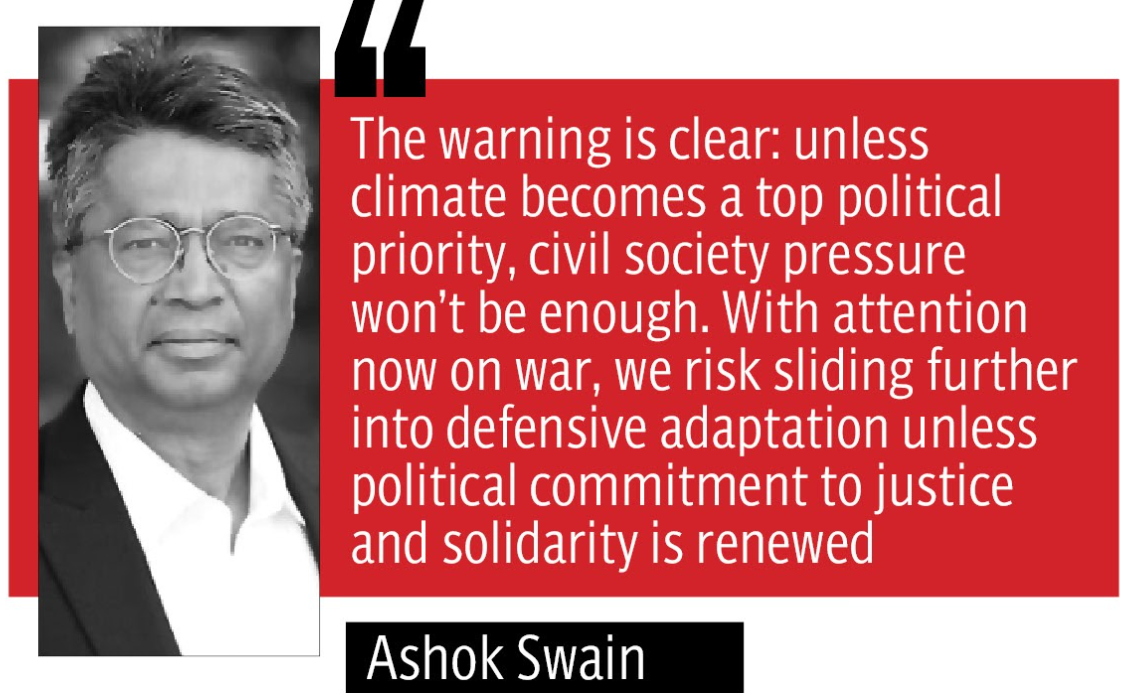
AS: The book leaves room for hope, but it’s cautious and urgent. Global climate governance is moving slowly, often blocked by apathy and self-interest, though there are signs cooperation can strengthen as impacts intensify. At the same time, fortress-style adaptation is already visible—wealthy states focus on borders, control, and protecting their own populations rather than the most vulnerable. The warning is clear: unless climate becomes a top political priority, civil society pressure won’t be enough. With attention now on war, we risk sliding further into defensive adaptation unless political commitment to justice and solidarity is renewed.