New provinces debate and the good governance challenge
Updated 29 minutes ago

Institutional privileges meant to protect the independent functioning of the Legislature are essential
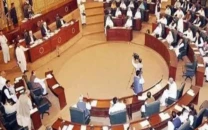
The enactment of the Khyber Pakhtunkhwa Provincial Assembly (Powers, Immunities and Privileges) Act, 2026, granting lawmakers expanded benefits, has sparked intense public backlash and a subsequent government review.
Undoubtedly within the framework of the Constitution, the Provincial Assembly is all competent to legislate on its own powers, immunities and privileges. Articles 66 and 127 of the Constitution expressly outlines that jurisdiction. Parliamentary privilege is not just a concession derived from the Executive, but a constitutional safeguard meant to ensure the independence of the Legislature, enabling the elected representatives to perform their duties without fear or external interference.
However, the Constitution imposes limits, subjecting actions to constitutional scrutiny and by independent watchdogs. All organs of the state, including parliament and the provincial assemblies, derive their authority from the Constitution and are to exercise that authority within the orbit of Constitution. In this perspective, the distinction between institutional privileges and personal privileges becomes all the more important.
Institutional privileges meant to protect the independent functioning of the Legislature are essential. Freedom of speech within the House, immunity for votes cast, protection against intimidation while attending legislative proceedings and the authority to summon witnesses for legitimate legislative purposes are recognised features of parliamentary democracy in all the Commonwealth countries.
Personal privileges are of a different nature. Weapon licences for lifetime, exemption from toll taxes, official plaques on private vehicles and powers resembling those exercised by Justices of the Peace have no relationship with legislative independence; they rather reflect a VIP culture. Such legislative measures definitely raise legitimate questions under Article 25 of the Constitution, which says that every citizen is equal before the law and under the equal protection of law.
Similarly, another important issue is the constitutional doctrine of ministerial responsibility.
Our current system has been evolved on the lines of the Westminster model of parliamentary government. Under this model, government departments are headed by ministers who remain accountable to the provincial assembly for the administration of their departments. Civil servants, governed under the Rules of Business, implement the policy given by government under the direction of the minister. Simultaneously, the secretary to government is the administrative head and principal accounting officer of the department.
A few sections of the Act authorise individual members to visit and inspect government institutions or preside over departmental meetings – that too without any responsibility. This might have been done with the intention to strengthen oversight. However, such provisions risk weakening the very constitutional structure upon which executive accountability depends.
Legislative oversight is an essential of parliamentary democracy but it has to be exercised through parliamentary institutions rather than direct intervention in the executive administration. In case members independently start inspecting hospitals, prisons, schools and government offices, a chaotic situation is likely to emerge. Public servants may find themselves caught between ministers, secretaries and legislators. Such parallel lines of authority weaken governance, rather than strengthening it, and hinder decision-making.
The Constitution provides clear mechanism for an MPA to raise departmental concerns through questions, calling attention notices, adjournment motions, budget debates and standing committees. Ultimately, the minister, as departmental head, remains directly accountable to the assembly.
The most critical constitutional concerns regarding those provisions are establishment of a judicial committee to determine breaches of privilege, impose punishment and exclude ordinary appellate remedies. Thus, these provisions attract legitimate questions under Article 10A, which provides the right to a fair trial before an independent and impartial tribunal.
Undoubtedly, the Legislature has jurisdiction to protect its proceedings. But, in matters of criminal liability and imprisonment, constitutional principles require that judicial functions may remain with the independent judiciary established under Article 175 of the Constitution.
Freedom of expression is another important area which requires careful reconsideration.
Sanctity of the assembly is paramount, and must be shielded against deliberate falsehoods that obstruct its proceedings. But a public body is not immune from public criticism. Strength of such institutions lies in openness and not insulation against scrutiny and public debate. Matters of defamatory nature are already comprehensively governed by the ordinary law. Adoption of different course for criticism of the assembly or its members risks discouraging legitimate political discourse and investigative journalism.
A sliver lining has, however, emerged from the media debate on the issue. Reportedly the Chief Minister has advised a review of the legislation in order to strike out provisions which go beyond the legislative privileges and give the impression of a VIP culture.
Good Governance demands that instead of enlarging the personal authority of individual legislators, the province should build its institutions on sound foundations. It is high time to comprehensively review the Khyber Pakhtunkhwa Government Rules of Business than conferring additional executive powers upon assembly members. If greater ministerial accountability is desired, the Rules of Business should be amended accordingly. It goes without saying that Westminster framework works efficiently, with strong standing committees, improved departmental reporting and enforcement of ministerial responsibility effectively.
The objective should not be to diminish parliamentary privilege, but to align it with constitutional principles. A confident Legislature would never fear constitutional scrutiny, rather its proceedings would always be open to public debate to elicit feedback. This will surely lend credibility to legislation. Laws that respect the separation of powers, protect fundamental rights and preserve institutional accountability ultimately strengthen both parliament and democracy.
Therefore, the true challenge for the K-P government is ensuring that assembly privileges remain within the bounds of the Constitution, democratic conventions and good governance.


1727268465-0/Untitled-design-(42)1727268465-0-208x130.webp "story")





This material may not be published, broadcast, rewritten, redistributed or derived from. Unless otherwise stated, all content is copyrighted © 2026 The Express Tribune.





COMMENTS (1)
Comments are moderated and generally will be posted if they are on-topic and not abusive.
For more information, please see our Comments FAQ