Pakistan, NZ seek to boost agri cooperation
Updated 1 hour ago

Tells SC constitutional court will hear bail pleas and appeals under amended law
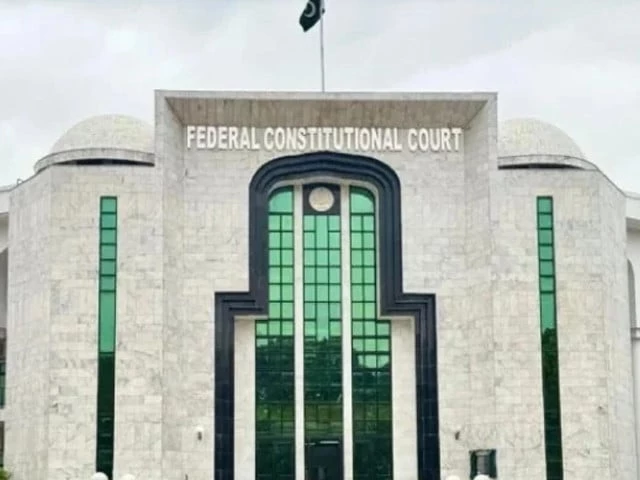
The federal government has informed the Supreme Court that, following recent amendments to the National Accountability Ordinance (NAO), bail matters as well as appeals in National Accountability Bureau (NAB) cases fall within the jurisdiction of the Federal Constitutional Court (FCC).
A three-member SC bench headed by Justice Muhammad Ali Mazhar, and comprising Justice Mussarat Hilali and Justice Shahid Bilal Hassan, is examining whether pending appeals in NAB cases should be transferred to the FCC and whether bail applications in such cases also fall within the constitutional court's jurisdiction.
The latest amendment to the NAO designates the FCC as the second appellate forum in NAB cases. The bench is scheduled to resume hearing the matter on Tuesday.
In a written reply submitted to the apex court, Additional Attorney General Umar Aslam stated that all matters relating to the NAB law, including bail issues, would now be heard by the FCC.
However, Ibad ur Rehman Lodhi, counsel for an accused in a NAB case, argued that while all appeals, including those currently pending before the SC, would be heard by the FCC, bail matters under the NAO, 1999, should remain within the SC's jurisdiction.
Lodhi cited the example of Hudood law cases, where appeals are heard by the Federal Shariat Court while bail applications continue to be adjudicated by the high courts. He argued that the same principle should apply to NAB cases.
The counsel further revealed that after the recent amendment to the NAB law, an SC bench headed by Justice Naeem Akhtar Afghan granted bail to an accused in a NAB case.
Lodhi, who previously served as a judge of the Lahore High Court, contended that the amendment was "person-specific" and should have been struck down by the courts.
The jurisdictional dispute carries significant implications for former prime minister Imran Khan, who has been convicted in NAB cases. If the Islamabad High Court upholds his conviction in the Al-Qadir Trust case, he would be entitled to file a second appeal before the FCC, established under the 27th Constitutional Amendment, whose judges are appointed by the executive.
The issue gained prominence after the SC Registrar's Office returned appeals filed by Imran Khan and his wife, Bushra Bibi, challenging an IHC order that declined to decide their applications for suspension of sentence on merit in the £190 million Al-Qadir Trust case.
The registrar held that the appropriate remedy against the IHC order lay before the FCC.
However, their counsel, Salman Safdar, challenged the objections, maintaining that the appeals are maintainable before the SC under Article 185(3) of the Constitution.
According to the petition, Article 175A(1)(a) provides that an appeal to the FCC lies only where it is expressly provided by law.
The petition further states that Section 32A of the NAO, 1999, provides a second appeal to the FCC only against a decision made by a high court under Section 32 of the ordinance.
It argues that the NAO does not expressly provide an appeal to the FCC against orders passed on bail applications under Section 9(b) of the ordinance read with Section 497 of the Code of Criminal Procedure (CrPC), or against orders on applications for suspension of sentence, even where such applications are filed in criminal appeals under Section 32.
"In the absence of any specific statutory remedy of appeal under the NAO, 1999, the impugned order is assailable before the SC under Article 185(3) of the Constitution," the petition states.
However, another section of the legal fraternity maintains that an application for suspension of sentence is a continuation of the appeal itself and, therefore, such applications should now be filed before the FCC.
Previously, litigants aggrieved by high court decisions in NAB cases approached the SC by filing civil petitions for leave to appeal (CPLAs). Lawyers note that although styled as CPLAs, these petitions effectively functioned as criminal appeals, particularly in cases where convictions had been upheld by the high courts.
The recent amendments have also triggered a broader debate within legal circles over why the FCC, rather than the SC, has been designated as the second appellate forum in NAB cases, especially since FCC judges are appointed by the government. Some legal experts have questioned whether the government intends to gradually replace the Supreme Court's role with that of the FCC.
They also argue that the present SC, particularly under Chief Justice of Pakistan Yahya Afridi, has made no serious effort to safeguard the apex court's constitutional jurisdiction and powers.
Senior lawyer Faisal Siddiqi described the new second appellate mechanism as "another silent and incremental attempt to destroy the criminal jurisdiction of the Supreme Court and to control the destiny of politicians through NAB proceedings."
"I am surprised at the tragic short-sightedness of the PPP and the PML-N. They will be victims of this second appeal sooner rather than later," he said.
Former law officer Muhammad Waqar Rana argued that assigning second appeals in NAB cases to the FCC is apparently ultra vires the Constitution.
"Article 185(2) states that if a high court interferes in an acquittal, the appeal shall lie to the Supreme Court. It is unprecedented, as nowhere in the last 200 years has a second appeal been provided in this manner, and it is also violative of Article 25, which grants a statutory right of appeal only in certain cases," Rana said.
Advocate Abdul Moiz Jaferii described the amendment as "a logical advancement of the dismantling of the structure of the judiciary first envisaged by the 26th Amendment and cemented by the 27th."
"The NAB has been used for the past 25 years to effect political engineering. No such arrangement would be complete without its engineering being handled by engineered courts. Whilst the SC is a shell of what it was and supreme in all but name, it still cannot compete with the completely cherry-picked FCC and hence that's where all NAB second appeals must go," he said.
Barrister Asad Rahim Khan said the latest changes reflected a broader shift in judicial power.
"No unity regime was possible without ensuring dozens of accountability cases magically went away, and no unity regime was possible without Justice Qazi Faez Isa and the disempowerment of the SC in favour of the FCC," he said.
"It is fitting that these twin threads will now get to meet. What began with the decision passed by Qazi and his like-minded judges endorsing the person-specific mauling of the NAB law now gets to conclude with the FCC, a court our ruling parties are infinitely happy with."
Defending the amendments, Hafiz Ahsaan Ahmad Khokhar said the changes seek to harmonise NAB proceedings with the Code of Criminal Procedure, 1898, particularly Sections 497, 498 and 499, which empower courts to grant bail.
"By clarifying the powers of accountability courts and high courts to grant bail in accordance with the general criminal procedure framework, the amendments aim to ensure a balance between effective accountability and the constitutional guarantees of liberty and due process protected under Articles 9 and 10A of the Constitution," he said.
Advocate Waqas Ahmad argued that the recent amendments and the FCC's evolving jurisprudence following the 27th Constitutional Amendment have effectively curtailed the Supreme Court's authority to decide questions of law.
"The result is a peculiar situation: a high court, though subordinate, may decide questions of law, yet the Supreme Court faces limitations. From a Rent Controller or Magistrate to the Federal Constitutional Court, direct petitions can be filed across the judicial hierarchy, but the Supreme Court stands almost alone as the only forum where a direct petition cannot ordinarily be filed," he said.







This material may not be published, broadcast, rewritten, redistributed or derived from. Unless otherwise stated, all content is copyrighted © 2026 The Express Tribune.








1727268465-0/Untitled-design-(42)1727268465-0-208x130.webp "delightful dystopia and orwell in pakistan")

COMMENTS
Comments are moderated and generally will be posted if they are on-topic and not abusive.
For more information, please see our Comments FAQ