An inch towards Pakistan
Updated 5 hours ago

.
I write this after the conclusion of the two-day summit of the NATO nations held in Ankara from July 6 to 7 at the Turkey Presidential Palace. The meeting was chaired by Recep Erdogan, the president of Turkey, who has governed his country with an iron hand. His main opponent was in jail as the heads of NATO states travelled to Ankara. The United States President Doanld Trump who likes strong leaders said that he was attending because the Turkish president was the type of political leader he felt comfortable with.
While Turkey is an important member of NATO with an army that was second in size to those in the alliance, its role in global affairs remains undefined. The largest army is that of the United States. Hakan Fidan, Turkey's Foreign Minister, dwelt at some length on the relationship between Trump and Erdogan. This he did in an interview with western journalists. There is recognition of Turkey's importance to NATO. "There is an awakening in light of the new security and threat environment in Europe," said Fidan.
The summit took place amid an extensive crackdown on President Erdogan's opponents. However, the democratic situation in Turkey did not figure in the summit discussions. "The wolf at the door is not the state of democracy in the host country for Europeans," said John R Bass, a former US ambassador to Turkey. The wolf was an expansionist Russia under the leadership of President Vladmir Putin.
I often take the Turkish Airline when I travel to and from Pakistan. Since Erdogan has been in power, there are signs that he is taking Turkey back to its Islamic past. The video system in the planes announce prayer times as they are flying. This is quite a change since the Turkish Republic had been guided back to its situation as an important country in the European south by Kamal Ataturk. The name "Ataturk" meant the "father of the Turkish nation". He took a number of steps to make Turkey a European country. His governance included banishing the old Turkish script that was derived from Arabic. It was Romanised. I got a good impression of this change when I guided two senior World Bank officials of Turkish origin to visit the Autonomous Region of Xinjiang in China's west. The region was peopled by Yugurs, a Muslim minority in China. They used a language that was close to Turkish. The signs in the main urban centres in the region used the old script that Ataturk had Romanised. I was able to read the signs, and they translated them in English for me.
There was a fair amount of commentary in the western press about Turkey as the NATO leaders arrived in Ankara for the summit. The reporting also went into what was the likely future of NATO, as a defense organisation in which the United States had played an important role. Under Donald Trump, the current United States president, the Americans were withdrawing the type of support they had given at the time of the founding of NATO as a defence organisation and its evolution. In the period following the end of the Second World War, the American leadership was determined to contain Stalin's Russia. This they did by organising three defence organisations – North Atlantic Treaty Organization (NATO); Central Treaty Organization (CENTO); and Southeast Asia Treaty Organization (SEATO). Pakistan was actively involved the last two.
Radoslaw Sikorski, Poland's former defence minister, outlined the transformation of NATO after it was founded in the aftermath of the Second World War. The war ended in 1945, with America having contributed both men and material to the victor. In the global order that was created to rebuild Europe and avoid future conflicts, defence organisations played an important role. NATO 1.0 was a clear defence against Soviet aggression and expansionism, and NATO 2.0 was post-Cold War search for purpose, said Sikorski, with the alliance looking outside North America and Europe after September 11 terrorist attacks on the United States mounted by Islamic extremists, to fight terrorism in Afghanistan and the Middle East. Russia was seen as a possible ally and certainly less of a threat resulting in some European nations effectively disarming.
But the world has changed in recent times with Russia's full-scale invasion of Ukraine in 2022, China's rising ambitions and Washington's desire to shift resources to Asia and the Midde East and away from Europe. "NATO 3.0 will mean that Europe will take more of the burden for conventional defense and the U.S. will take more a cavalry-over-the hill kind of ally. Time may be short to prepare," said Sikorski. Germany and many NATO officials say a battle-hardened Russia would be ready for a war against NATO by 2029, so the pressure is on Europe to become more "war ready" as the Germans say, and on the United States not to create unnecessary vulnerabilities in the meantime.
In the Ankara NATO summit, President Trump kept the pressure on other NATO members to pay more for defence, and to stick to the commitment made in the 2025 summit to increase spending to 5 per cent of gross national product by 2035. Mathew Whitatker, the US ambassador to NATO, signaled to allies before they came together for the summit in Ankara that there may be benefits for those who pay up and difficulties for those who lag behind the others.
That the Middle East was on Trump's mind became clear at the news conference he addressed after the summit. He used harsh words to describe how he saw the Middle East leadership. This was true, in particular, for the leaders of Iran. He called them "evil, sick people, scum, liars, cuckoo" and announced that he was walking away from the ceasefire agreement JD Vance, his Vice President, had negotiated with the Iranian leadership. Pakistan was actively involved as a mediator, with Field Marshal Asim Munir shuttling between Tehran and Islamabad to bring the two sides together. Munir also stayed in touch with Trump and the White House.
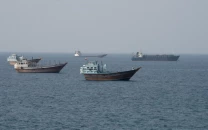
"The United States is holding Iran accountable for recent unjustified aggression against commercial shipping and civilian crews feely navigating a vital international waterway," said the US Central Command in a statement. President Trump posting of Truth Social said the strikes were carried out in "retribution" on ships on July 8. "If it happens again, it will get much worse."






This material may not be published, broadcast, rewritten, redistributed or derived from. Unless otherwise stated, all content is copyrighted © 2026 The Express Tribune.
COMMENTS (4)
Comments are moderated and generally will be posted if they are on-topic and not abusive.
For more information, please see our Comments FAQ