
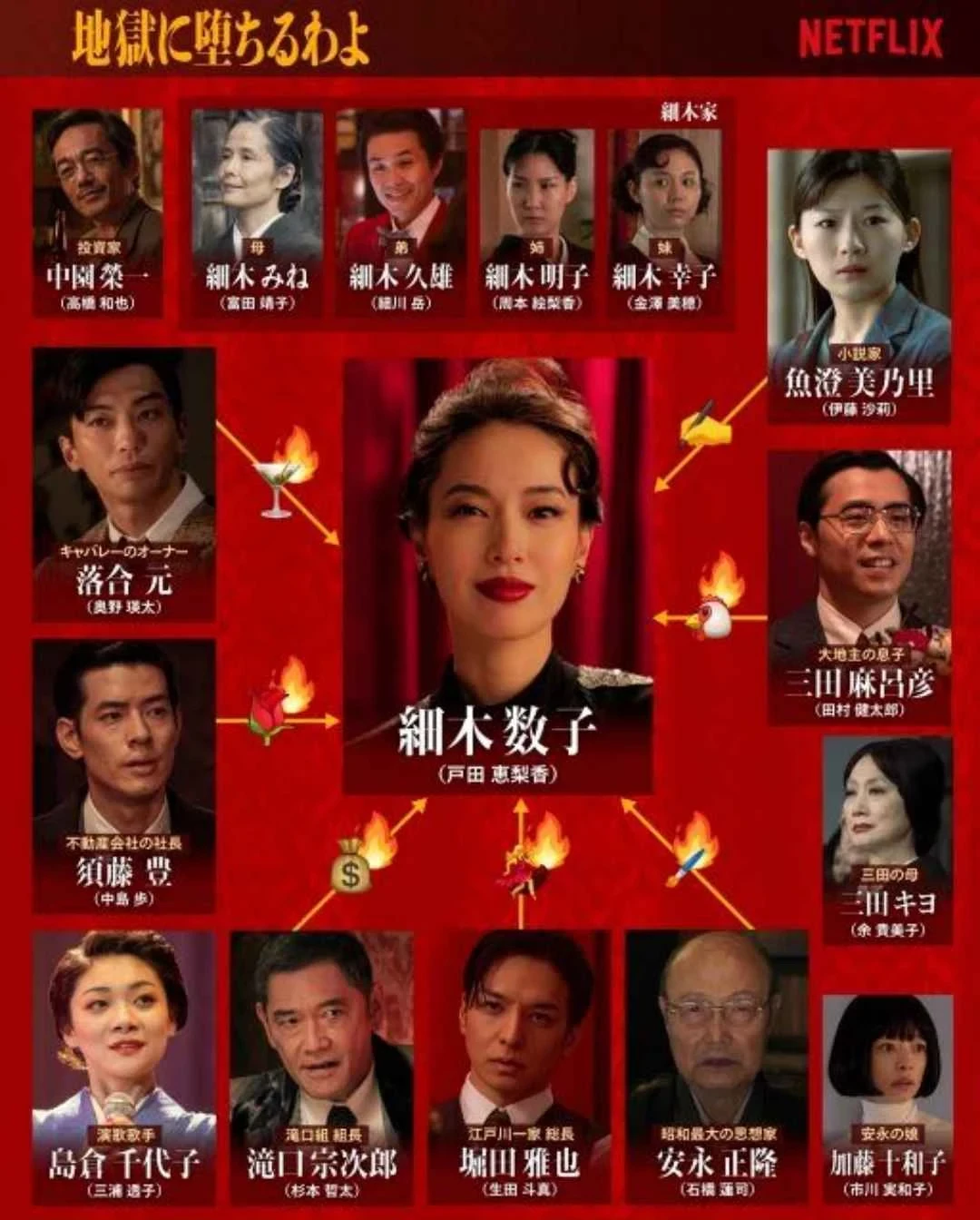
Netflix’s latest Japanese prestige series Straight to Hell is a biographical drama that transcends the mere retelling of historical facts and becomes something transcendent—a tapestry of psychological ambition and cultural evolution. Masterfully directed by Norichika Oba and Tomoyuki Takimoto, and penned with elegance by Manaka Monaka, the series chronicles the meteoric, scandalous, and utterly mesmerising life of Japan’s most infamous and controversial fortune teller Kazuko Hosoki.
Hosoki was a cultural phenomenon who utilised divination, charisma, and a fierce understanding of human desperation to build herself an empire. Straight to Hell could have been a standard rags-to-riches Hollywood-y glitzy and glamorous affair, heavy on the pity that stomach-grumbling poverty evokes and heady and lustful for meteoric rise and fame. Instead, it delivers a visually stunning, addictive, and thoroughly enthralling saga that explores the dark underbelly of ambition, the cost of survival, and the fluid boundaries between an antihero and a villain. It grips you from its opening frames and refuses to let go.

Rags, scams, and riches
At its core, Straight to Hell is an epic chronicle of reinvention. A fictional journalist, Minori Uozumi (played with grounded scepticism by Sairi Ito), interviews an older, fiercely guarded Kazuko Hosoki for a definitive biography. As Minori digs beneath the polished, glamorous exterior of the legendary fortune teller, the series plunges the audience into the past, tracing Hosoki’s journey from the ashes of World War II to the neon-drenched heights of Tokyo’s nightlife. Her present-day throne sits before millions of devoted followers on television stages as a fortune-teller but her past was far from this profession.
The story begins in the destitution of post-war Tokyo. We meet Kazuko as a young girl in a tattered red dress, scurrying through a war-devastated landscape, starved and desperate. Her family is barely surviving, and she feeds her younger siblings first when she gets a chance and ignores her empty stomach. The battle for survival lights in her the fiery obsession to acquire wealth at any cost. Money, to Kazuko, is not just comfort; it is the only shield against a cruel world.
As she grows into a daring, resourceful young woman, the series charts her rapid, chaotic ascension in society. Kazuko enters the cutthroat world of Tokyo’s nightlife, transforming herself into a formidable nightclub owner. But success is never a straight line. The narrative operates as a thrilling cycle of empire-building and devastating collapse. She builds businesses from the ground up through sheer willpower and cunning manipulation, only to watch them burn down due to bad debts, changing political tides, or betrayal.
Yet, every time Kazuko loses everything, she mutates into something more dangerous. The ultimate evolution happens when she pivots to the ancient arts of divination. Recognising that people’s fears are the most lucrative commodity on earth, she crafts a persona as an uncompromising, blunt fortune teller. She doesn't just predict the future; she commands it, swindling the desperate, counseling the powerful, and turning her prophetic insights into a multi-billion-yen industry. In her life story every victory is wrapped in deception, and every rise to power carries a hidden, devastating cost.
Japan rises from the ashes
One of the most brilliant and thematic achievements of Straight to Hell is the way it seamlessly parallels Japan’s post-war macro-transformation with Kazuko’s micro-evolution. The series treats the setting not merely as a backdrop, but as a secondary character that directly shapes the protagonist’s moral compass.
In the early episodes, the visual palette is stark, desaturated, and heavy with the weight of a country in trauma. The crowded, muddy streets of Tokyo are populated by people clawing for survival. As a response to this environment, Kazuko learns that the world rewards ruthlessness over kindness.
As the decades progress, the show undergoes a breathtaking visual and narrative evolution that mirrors the country’s volatile economic miracle. The rubble gives way to the monumental architectural and societal boom of the 1964 Tokyo Olympics. The series brilliantly captures this era of global rebirth; as Japan reintroduces itself to the world stage as a modern, high-tech powerhouse, Kazuko rides the wave of optimism, transforming from a street-level survivor into an opulent nightclub mogul catering to the newly rich elite. Her status flourishes in tandem with the nation's soaring GDP.
However, the narrative refuses to present a simplistic upward trajectory. The show takes a dark, chaotic turn during the 1973 oil crisis, capturing the sheer panic that gripped a resource-dependent Japan as energy prices skyrocketed and the post-war economic miracle ground to a sudden, terrifying halt. The directors masterfully use this historical flashpoint to trigger one of Kazuko's most devastating business collapses. As inflation surges and the nightlife industry dries up overnight, Kazuko watches her hard-earned empire disintegrate due to bad debts and market panic.
The brilliance of this section lies in its systemic critique. The show explicitly demonstrates that Kazuko's scams and ruthless business tactics were not anomalous evils; they were direct products of a capitalistic system characterized by the volatile economic bubbles that defined late-20th-century Japan. By charting her cycle of building empires and losing them across historical milestones—from the triumphs of Olympic hosting to the desperation of global energy crashes—the series highlights how she learned to treat human fear and economic stability as highly transactional commodities.

A complex and fascinating heroine
A narrative this expansive requires an extraordinary emotional anchor, and Erika Toda delivers an unforgettable performance as Kazuko Hosoki. Toda achieves the feat of playing the character across vastly different eras of her life, executing a portrayal so nuanced that it leaves the viewer utterly spellbound.
The contrast Toda depicts between the young and old versions of Kazuko is so stark that the two versions look and feel entirely distinct. However, they are psychologically continuous. In her youth, Kazuko is portrayed as an endearing, charismatic, and resourceful underdog. Despite her growing capacity for manipulation, Toda plays her with a vulnerability that makes it impossible not to root for her. You see the pain of a woman exploited by powerful men, and her subsequent decision to become the exploiter feels like a tragic, necessary act of self-defense. Yet, she remains vibrant, radiating a lust for life.
The older depiction is a chillingly different creature. As the decades wear on and the wealth accumulates, the warmth completely evaporates from Kazuko's face. The older woman is a formidable and deeply cynical media mogul. She has fully embraced the facade of the infallible mystic. Her movements are calculated, her voice is a controlled, authoritative weapon, and her empathy has been replaced by a transactional worldview.
Toda’s genius lies in showing how the scars of the young Kazuko hardened into the icy armour of the older woman. The transformation is so radical that when the show cuts between the two timelines, the physical and emotional disparity makes you do a double-take and squint your eyes to check if it is the same actress. It is a masterclass in character progression that avoids the caricature trap entirely.
The Yakuza and the layered society
No story about the rise of Tokyo's post-war entertainment and financial sectors would be authentic without addressing the criminal underworld, and Straight to Hell handles the intermixing of the Yakuza with an uncompromising eye. The inclusion of organized crime provides a vital and gritty layer to the depiction of Japanese society, showcasing the invisible strings that governed politics, entertainment, and commerce.
Mid-series (particularly from Episodes 4 through 7)the show takes a deep dive into the treacherous waters of the yakuza-backed nightlife. Kazuko’s ascent as a nightclub owner forces her into complex power dynamics with powerful syndicates. The show illustrates how the boundaries between legitimate business and criminal enterprises were entirely porous during Japan’s economic boom, showing businessmen, politicians, and syndicates operating in the same corrupt circles.
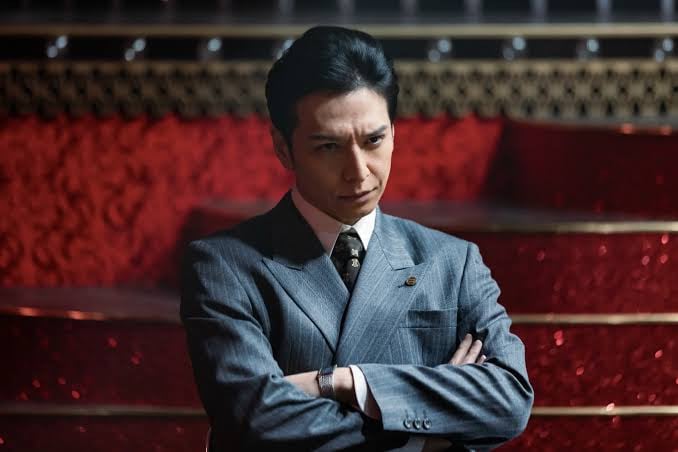
Masaya Hotta (played with a magnetic charm by Toma Ikuta) serves as the perfect conduit for this world. Through his interactions with Kazuko, the series explores how she learns to navigate, manipulate, and occasionally outsmart men who hold the literal power of life and death over her. The Yakuza are not presented as stylized movie villains, but as deeply entrenched institutional forces. They represent the ultimate manifestation of the patriarchal, ruthless world Kazuko is determined to conquer. Her willingness to entangle herself in their schemes—and her ability to survive the inevitable fallout when those schemes collapse—adds an intoxicating level of tension to the narrative.
Seamless flow
With a story that spans over half a century and tackles post-war ruin, yakuza thrillers, corporate espionage, and media satire, Straight to Hell should, by all accounts, feel disjointed. Yet, nothing feels out of place.
The screenplay exhibits a flawless narrative architecture. The transitions between the historical eras and the modern-day journalistic investigation are seamless, with each era feeding thematic information into the next. When Kazuko suffers a business loss in the past, the narrative immediately contextualises the psychological fallout in the present. The storytelling formula is delightfully unpredictable; just when you think the show is settling into a comfortable rhythm as a boardroom drama, it pivots into a high-stakes psychological thriller or a critical look at television culture.
The pacing starts as an atmospheric slow-burn in the post-war ruins, allowing the audience to fully absorb the trauma that motivates Kazuko. Once she enters the nightlife scenes, the tempo accelerates, mimicking the frantic energy of a country on the long road to stability. The editing keeps the viewer in a state of perpetual momentum, making the series one of the most intensely binge-worthy on television.
Visually, the series is an absolute triumph. Cinematographers utilise distinct colour profiles and camera movements for each era—the vibrant, saturated tones for the nightlife boom eras will stay with you after you’ve turned your TV off. The costume design alone, particularly the evolution of Kazuko’s striking wardrobe, tells a story of power, opulence and impeccable elegance.
What elevates Straight to Hell to the upper echelon of television is its refusal to offer moral platitudes. The show does not excuse Kazuko’s predatory scams, nor does it ask the audience to absolve her. The ending deliberately avoids the comforting cliché of total ruin and cosmic justice; instead, it reflects the messy, cynical reality of the world she conquered. Kazuko Hosoki adapts, survives, and ultimately thrives, capitalising on the digital age just as she did the television era.
It is a stunning, deeply addictive, and profoundly enthralling character study that holds a mirror up to modern society. By the time the final credits roll, you may not love Kazuko, but thanks to Erika Toda’s legendary performance and the show’s flawless execution, you will undeniably understand her. Straight to Hell is an unforgettable television landmark that demands to be seen.