Green CPEC offers Pakistan a win-win
Updated 15 hours ago

Govt okays Rs5b share, AD Ports refuses to absorb 2,545 workers forcing KPT to bear Rs19b liability
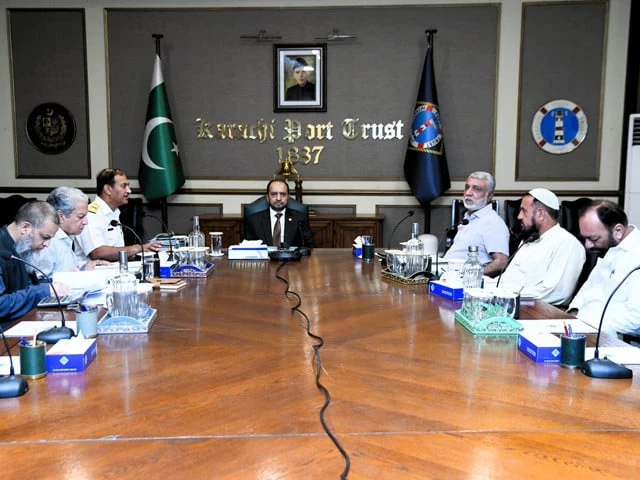
The government has moved to lay off around 2,545 dock workers of the Karachi Dock Labour Board (KDLB) after AD Ports refused to take their services. These workers, employed for over 50 years, will cost approximately Rs24 billion to lay off.
The Karachi Port Trust (KPT) said it was unable to bear this cost as it is spending around Rs200 billion on various projects. AD Ports had requested KPT to own the liability of all dock workers, as it was not utilising their services and would not contribute towards any payments. However, the abolition is expected to face strong opposition from dock workers' unions due to job security concerns.
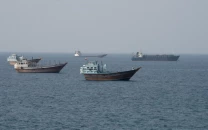
The Bulk & General Cargo and Container Terminal of Karachi Port were outsourced to AD Ports, minimising the role of dock workers. AD Ports has not been utilising their services. Earlier, the finance division refused to provide funds for the layoffs and asked KPT to generate funds from its own resources. However, the government has now approved its share of Rs5 billion.
The Ministry of Maritime Affairs (MoMA) briefed the Economic Coordination Committee (ECC) that the KDLB is governed by the Dock Workers (Regulation of Employment) Act, 1974. Under the Act, a dock worker is defined as any person employed in any port on loading or unloading ships. The registration of dock workers is done under a scheme made pursuant to Section 3 of the Act. Presently, about 2,545 dock workers are registered under the scheme.
The Karachi Dock Labour Board was established under the Act to ensure regular work and incomes for dock workers and to oversee labour relations between workers and KPT.
MoMA informed the ECC that the Prime Minister's Task Force on Revamping of Pakistan's Maritime Sector directed KPT to initiate a legislative proposal to abolish the Act. As KDLB workers' services were not required by most terminal operators, they had limited utility.
The Implementation Committee of the Prime Minister's Task Force, during its meeting on March 11, 2025, decided that the layoff proposal presented by KPT was cost-exorbitant at over Rs24 billion. MoMA was directed to approach the Management Services Wing of the Establishment Division for clarity.
Accordingly, the matter was referred to the Law and Justice Division and the Establishment Division. The Law and Justice Division responded that being an employee-related issue, it pertained to the Establishment Division. The Establishment Division responded that the analogy of the proposed layoff plan for Pakistan Public Works Department employees, being civil servants, was not relevant.
A draft bill for repealing the Act and the Karachi Dock Workers (Regulation of Employment) Scheme, 1973 was prepared and shared with the Law and Justice Division for legal vetting, which was completed. A committee was constituted under the chairmanship of the deputy prime minister, which held meetings on October 31, November 12 and December 1, 2025, deliberating on three compensation packages ranging from Rs7.582 billion to Rs12.780 billion.
The committee decided that the finance division would provide Rs5 billion, while KPT would arrange the remaining amount from its own sources. However, the finance division stated it did not have the fiscal space to provide budgetary support, citing KPT's healthy liquidity position.
MoMA requested reconsideration, stating that KPT had to finance projects worth over Rs200 billion. Moreover, KPT had to arrange a surplus amount of around Rs10 billion despite limited resources. Winding up KDLB was the federal government's decision, making it the finance division's responsibility to contribute.
The ECC approved the proposal for Rs5 billion as the federal government's contribution through a technical supplementary grant for the compensation package to lay off KDLB workers in the current fiscal year. KPT will arrange the remaining amount from its own funding.






This material may not be published, broadcast, rewritten, redistributed or derived from. Unless otherwise stated, all content is copyrighted © 2026 The Express Tribune.






COMMENTS
Comments are moderated and generally will be posted if they are on-topic and not abusive.
For more information, please see our Comments FAQ