Oman presents Iran with Gulf-backed plan for voluntary fees to use Hormuz
Updated 4 hours ago

Defamation: SC allows Imran to contest claim
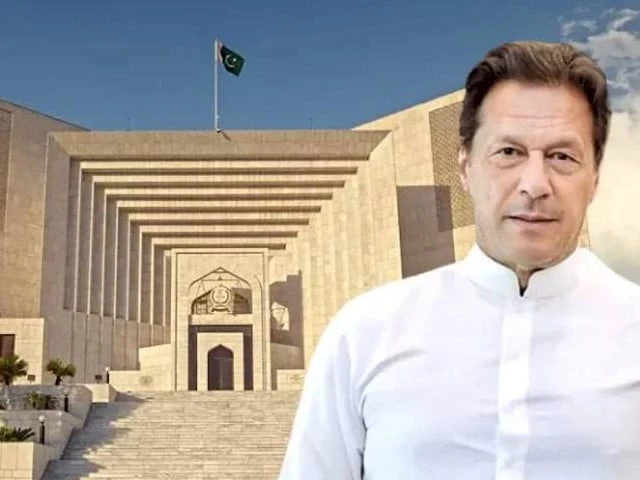
The Supreme Court on Thursday restored former prime minister Imran Khan's right to defend himself in a long-running Rs10 billion defamation suit filed by Prime Minister Shehbaz Sharif, setting aside lower court orders that had barred him from contesting the case in a majority verdict.
The apex court directed the trial court to provide Imran "reasonable opportunity" to file his reply to the interrogatories and proceed with the suit in accordance with law.
"By a majority of two-to-one (Muhammad Hashim Khan Kakar,J., dissenting) Civil Review Petition No.2-L of 2023 is allowed and the majority judgment dated 29.12.2022 is hereby set aside alongwith the judgments of the High Court and the Trial Court. The matter is remanded to the Trial Court with the direction to provide the Petitioner reasonable opportunity to file his reply to the interrogatories and proceed with the suit in accordance with law. Civil Review Petition No.1-L of 2023 is hereby dismissed", the top court order said.
A three-member bench of the Supreme Court, headed by Justice Ayesha Malik and comprising Justice Muhammad Hasham Kakar and Justice Ishtiaq Ibrahim, heard a review petition filed by Imran against an earlier majority opinion that had closed his right of defence in the case. Justice Kakar had dissented from the majority verdict.
Shehbaz's defamation claim stems from Imran's 2017 allegations, which suggested that Shehbaz offered him Rs10 billion through a common friend in exchange for withdrawing from the Panama Papers case, which was then pending before the Supreme Court.
According to the suit, these "baseless and malicious" statements were widely circulated by the media, damaging Shehbaz's public image and causing "extreme mental torture, agony, and anxiety".
Shehbaz's legal team had asked the court to issue a decree for the recovery of Rs10 billion in compensation for the defamation, as well as for the harm caused by the statements. The prime minister contended that the accusations were false and led to significant reputational damage.
Justice Ibrahim, who authored the majority judgment, observed that the earlier verdict had erred in upholding the striking out of the petitioner's right of defence despite the absence of a formal application seeking such relief.
He noted that the decision was based merely on an unsubstantiated assumption that an oral request had been made. The judge held that these errors were apparent on the face of the record and warranted corrective intervention through the court's review jurisdiction.
"For a penal action as grave as the deprivation of the right of defence, such informal assumptions are legally insufficient; in my understanding, a formal, written, and documented application is a mandatory prerequisite, following the principle that the more serious the request, the more rigorous the procedural compliance must be."
The court held that the trial court had erred by striking out the defence in the absence of a statutory basis for doing so. It further observed that the majority judgment, by endorsing the move on the assumption that the trial court possessed suo motu authority, had disregarded the clear provisions of the law.
"This disregard for the procedural mechanism constitutes a patent error on the face of the record, as no other inference regarding suo motu authority can be legally drawn from the explicit wording of the provision."
The order noted that Imran had sought numerous adjournments since the inception of the proceedings, as correctly pointed out in the majority judgment. However, it observed that the trial court had continued to grant those requests without resorting to any of the lesser penalties available to it before striking out his defence.
"Had the Court truly determined that the Petitioner was employing strategic delay tactics, it was empowered to ensure the expeditiousness of justice through the imposition of heavy costs or peremptory orders with realistic timeframes. Instead, the Court remained dormant in its disciplinary capacity for years, only to jump to the most extreme penalty on 24.11.2022, less than a month after the documented firing incident on 03.11.2022. Such an approach ignores the principle of proportionality as the judiciary's duty to ensure expeditious justice does not grant a license to commit summary injustice," the order said.
Justice Ayesha, in her additional note, stated that in a case plagued by repeated adjournments since 2017, the court was required to strike a balance between ensuring a fair trial and assessing the validity of the reasons advanced for the most recent adjournment request.
"The courts are entrusted with the responsibility to dispense justice, for which they are under a duty to ensure a timely trial, which duty may have been overlooked in some of the previous instances of adjournment where requests were granted mechanically and without due consideration."
Justice Ayesha observed that Imran's public shooting and injury sustained at a political rally justified the grant of a adjournment under the circumstances. She added that the right to defence could not be struck out without considering all relevant factors, and that the court must balance the right to a fair trial with the prevailing circumstances of the case.
"The order sheet shows that the court proceeded in a mechanical manner with the case, and granted numerous adjournments without so much as imposing cost so as to discourage the same. No doubt that the courts are overburdened with work and judges are faced with the daunting task of handling a vast number of cases every day, nevertheless, it is the court's responsibility to manage each case before it diligently by applying the provisions of the procedural law."
The judge observed that striking out Imran's right to defence at this stage, while ignoring the relevant and legitimate factors involved, would amount to a gross injustice.
She further stated that the balance of justice must be upheld, and that under the circumstances, the right to a fair defence must prevail.
In his dissenting opinion, Justice Kakar observed that the record reflected a classic case of delay on the part of Imran and the inability of the trial court to conclude the proceedings within a reasonable time.
"Record reveals that the suit was instituted in the year 2017, whereas, the written statement was filed after a delay of about 4 years. Similarly, the interrogatories were made on16.3.2022 and despite of availing 5/6 opportunities, the petitioner failed to respond the same. As per order sheet dated 26.4.2022, answers to the interrogatories was ready and the draft was only required to be signed by the senior counsel, however, on next date of hearing, instead of answering the interrogatories in compliance of Court directions and previous under taking, once again objections were filed just to delay the proceedings. Such conduct on the part of petitioner was apparently willful disobedient," he further held.












This material may not be published, broadcast, rewritten, redistributed or derived from. Unless otherwise stated, all content is copyrighted © 2026 The Express Tribune.






COMMENTS
Comments are moderated and generally will be posted if they are on-topic and not abusive.
For more information, please see our Comments FAQ