
Artefacts of wheeled transport from the Indus Valley Civilisation have greatly helped the understanding of one of the world's oldest urban cultures. The excavations at Harappa and Mohenjo-Daro brought to light many examples of terracotta carts, miniature wheels, and models of animal-drawn vehicles, which provide evidence of the technological inventiveness, economic organisation, and social life of the Indus people. These artefacts are not just toys or decorations but also an indication of sophisticated knowledge of transportation systems that facilitated urbanisation, trade networks, and communication across a large geographical area extending from modern-day Pakistan to western India.
The Indus Valley Civilisation was a flourishing period from around 2600 BCE to 1900 BCE and is considered one of the four major ancient river valley civilisations, alongside Mesopotamia, Egypt, and China. The Indus world is recognised for its urban planning, standardisation, sanitation, and commerce before most other ancient civilisations, whose splendour has chiefly been based on the magnificence of kings and monumental temples. Wheeled vehicles were an integral part of such an urban and economic system.
The excavations carried out at Harappa and Mohenjo-Daro in the 1920s dramatically transformed the understanding of ancient South Asian history. Under Sir John Marshall, the Archaeological Survey of India uncovered an ancient civilisation that was older and more advanced than previously believed. Marshall realised the need for artefacts of transportation in building up the life of the people of the Indus. In his monumental book Mohenjo-Daro and the Indus Civilisation (1931), he noted the terracotta carts and wheels “showed the continued survival of ancient forms of transport still found in the villages of India today.” Marshall emphasised the amazing continuity of old and new transportation systems in South Asia.
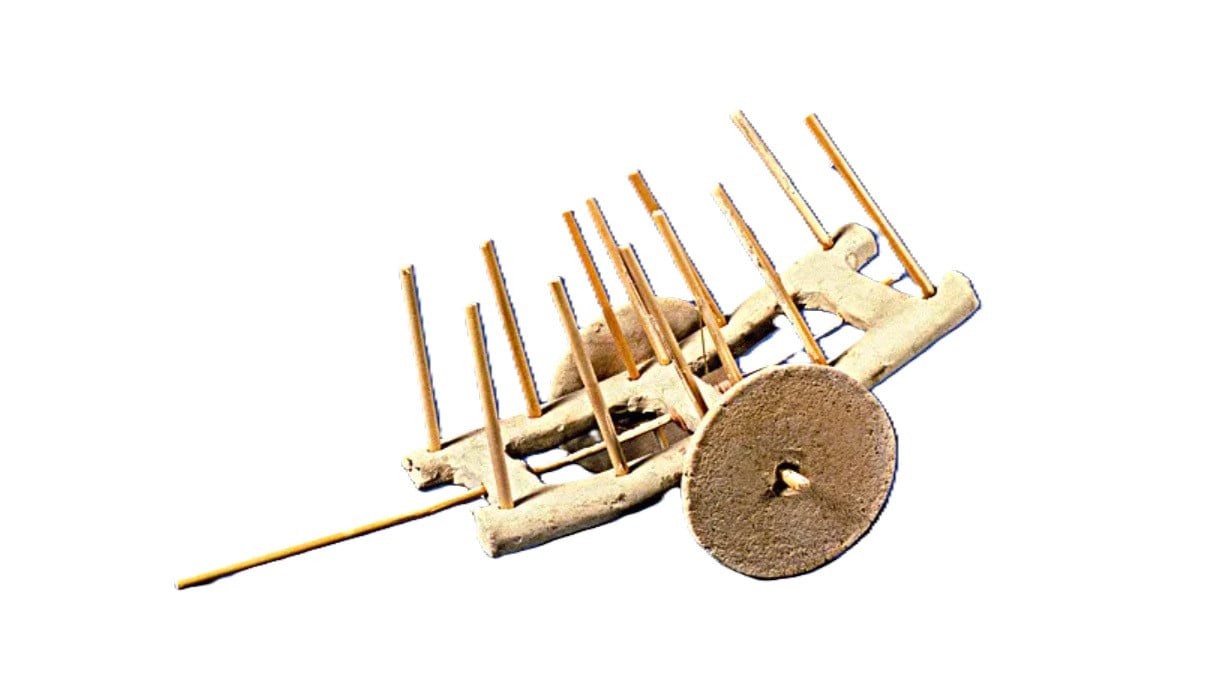
The most important of which were terracotta models of two-wheeled carts. Usually, these miniatures are made of a plate or a slightly curved surface, and are mounted on solid wheels attached to the central axle. The wheels were easily detachable and were part of an understanding of rotational motion and axle usage. The simplicity of the design shouldn't be at the expense of its sophistication. The development and improvement of wheeled transport in the Bronze Age changed the way people moved, traded and farmed. The use of wheels was a technology adopted by the Indus Valley people to suit their environment and economic needs.
Numerous terracotta wheels with perforated centres were found at Harappa, suggesting that wooden axles were used there. The excavations at Mohenjo-Daro by the archaeologist Ernest Mackay are important, and he made a careful record of such discoveries. The carts were similar to those in modern Punjab and Sindh, said Mackay. In Further Excavations at Mohenjo-Daro (1938), he noted that “the resemblance between the ancient cart models and the carts which are now still traversing the plains of Sind is striking.” This observation is one of the most frequently quoted examples of continuity between the Indus civilisation and the rural culture of South Asia today.
The Harappa and Mohenjo-Daro wheels are not spoked, but solid. Solid wheels were heavier but more robust and better suited to slow-moving agricultural and transport applications. The spoked wheels, linked subsequently to fast-moving chariots in Indo-European cultures, are very rare in more advanced Harappan contexts. The difference may indicate that the Indus was made for trade and agriculture, or for urban transportation rather than warfare. The findings corroborate the general archaeological picture of the Indus Valley Civilisation as a relatively peaceful urban civilisation, with little evidence of militarism.
The role of wheeled transport in the Indus economy was extremely significant. The civilisation had a long-distance trade network of settlements. Archaeological finds show trade links between the Indus Valley and Mesopotamia, and Mesopotamian texts mention a land called “Meluhha”, generally interpreted as the Indus region. Items traded on these paths included beads, cotton fabrics, shells and ornaments, copper goods and semi-precious stones. The wheeled carts would have allowed the transport of goods from rural agricultural regions to urban centres and ports.
The wide boulevards of Mohenjo-Daro also give credence to the importance of wheeled transport. The road system was well-planned, with the main roads running at right angles to each other, indicating a structured approach to traffic flow. The ruts and wear patterns found in some streets date back and may have been caused by frequent cart use. Marshall stated that the city of Mohenjo-Daro was an “extraordinary civic organisation” and that the use of wheeled vehicles would certainly have aided its functioning.
Indus transportation systems were based on animal power. The presence of many figurines of humped zebu bulls at Harappa and Mohenjo-Daro confirms the importance of cattle, both in agriculture and as beasts of burden. In some terracotta carts, projections or yokes indicate they were used by draught animals. Bulls were important in the Indus culture for strength, fertility and prosperity. They are depicted in transport artefacts, which show the intertwining of human, animal and technological systems in everyday life.
In the 1940s, when Wheeler was excavating at Harappa, he also noted the efficiency of transport systems in the Indus area. According to Wheeler, the urban planning of the civilisation suggested efficient communication and supply lines, using packs and carts. He often referred to the cities of the Indus as “highly disciplined and ordered urban societies.” This idea of administrative and technological uniformity was strengthened by the presence of standardised cart models in geographically distant settlements.
The artefacts of wheeled vehicles were also used for practical purposes and had cultural and symbolic meanings. The terracotta carts are quite small and could have been used as toys by children. Some examples have movable wheels, indicating interactive use. The artefacts give a rare glimpse into the lives of children in the Indus world. The toys are often influenced by the activities and technologies common in society, and the presence of cart toys suggests that wheeled transport was a part of everyday life.
But a few scholars have suggested that these miniature vehicles had also ritual or symbolic significance. Archaeologist Stuart Piggott theorised that the toy carts of ancient civilisations might have had ceremonial significance related to fertility, mobility, or agricultural changes. In the Indus context, where the religion itself is difficult to reconstruct because the script has not been deciphered, interpretations are speculative. Repeated motifs of wheels, however, hint at their more general cultural significance.
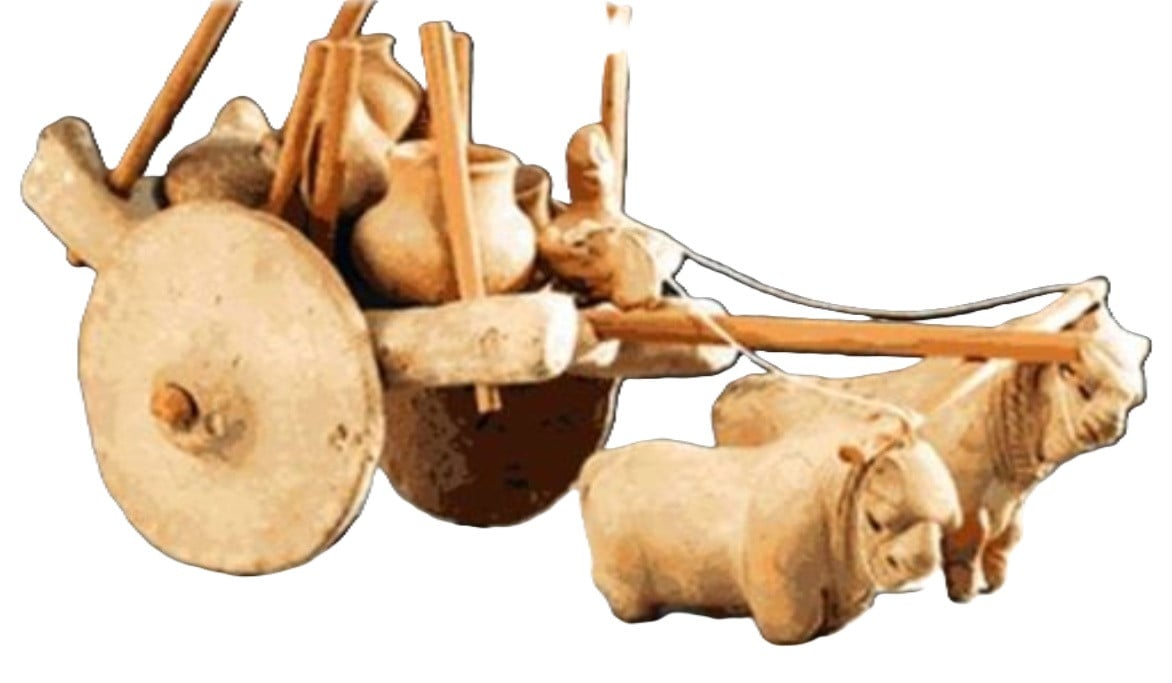
The craftsmanship on display in these artefacts attests to the technological skills of the Indus craftsmen. The majority of cart models were made of terracotta, handmade and fired in kilns. Many examples are very well-crafted and uniform, indicative of well-developed craft traditions. Many features of the material culture of the Indus era were standardised, such as bricks, weights, seals, and pottery. The wheeled vehicle artefacts are part of this general trend toward regulated manufacture and technological uniformity.
In the last few decades, the association between transport technology and urbanism in the Indus Valley has been a growing subject of scholarly interest. Archaeologist Jonathan Mark Kenoyer has suggested that transportation technologies were key to the economic integration of the vast expanses of the civilisation. Carts allowed raw materials like grain, timber and stone to be transported from one area to another with different ecological resources, Kenoyer says. He also stresses the importance of transport systems as a part of social interaction and cultural cohesion among fragmented urban centres.
In the same manner, Gregory Possehl called the Indus civilisation an “interconnected interaction sphere”. Possehl argues that wheeled vehicles were vital to the integration of villages, towns and cities into a single economy. Such interpretations go beyond the simple objectivity of the artefact and beyond the idea of the cart as a stand-alone object, and see the cart in relation to systems of trade, governance and social organisation.
The Indus wheeled vehicles are especially interesting because they bear a striking resemblance to the bullock carts of today in South Asia. Two-wheeled wooden carts, pulled by oxen, are still in use in rural areas of Pakistan and India today. Their fundamental architecture is very similar to that of the ancient terracotta models. The continuity has captured the interest of archaeologists and anthropologists. Both Mackay and Marshall stressed this phenomenon, which they interpreted as a sign of long-lasting environmental adaptation and technological feasibility.
A parallel in vehicle forms over the ages proves the indigenous design effective for the plains of Punjab and Sindh. Bullock carts are flexible and useful on narrow village streets, in agricultural fields and on rural terrain compared with modern mechanised transport, which relies on paved surfaces. The ancient Indus carts may have been similar in environmental features.
The wheel-based transportation of the Indus Valley also offers a general understanding of technological development in the Bronze Age. The wheel is sometimes referred to as one of mankind’s most revolutionary inventions. It was used in the transportation sector and changed productivity and long-distance communication. Wheeled transportation was used not only for trade but also for agricultural growth and for the sustainability of cities in the Indus context. Grain could be brought in from the rural hinterlands, and manufactured products could be sent out to adjoining settlements.
Although these artefacts are valuable, several questions remain unanswered. The Indus script is undeciphered and inaccessible as a written source of information on transport systems, trade regulations and vehicle terminology. Comparative analysis and material evidence are key to the archaeological interpretation.
Experimental archaeology and residue analysis have been used in recent years to reconstruct the use and function of ancient carts. Scholars have tried to replicate wheels from Harappan sites to better understand the durability of the wheels, axle mechanisms and their load-bearing capacity. The results of these studies indicate that Indus carts were highly functional and could carry significant amounts of agricultural and trade produce over long distances.
The importance of wheeled vehicle artefacts goes beyond archaeology! They are part of a larger conversation on cultural continuity, indigenous technology and regional identity. The Indus Valley Civilisation is also an integral part of the national heritage and national consciousness in Pakistan, especially. The terracotta carts serve as a testament to the ingenuity and creativity of ancient communities and their achievements, which continue to resonate in today's society.
To sum up, the wheels of the Indus Valley Civilisation were no ordinary terracotta objects. These items, unearthed from Harappa and Mohenjo-Daro, shed light on the technological advancements, economic structures, and social dynamics of one of the world's oldest urban societies. The discoveries continue to capture the scholarly interest of archaeologists such as Sir John Marshall, Ernest Mackay, Mortimer Wheeler, Gregory Possehl and Jonathan Mark Kenoyer. Their investigations uncover the role of the wheel in the trade, communication, agriculture and urban planning in the Indus world.
The terracotta cart and wheels remain iconic examples of the ingenuity of ancient South Asian people. These simple but extraordinary objects offer contemporary viewers a meaningful glimpse into how the Indus cities lived, worked and were connected 4,000 years ago.
The writer is a Lahore-based author, educationist, local historian, and brand strategist, and can be reached at arshadawan@msn.com
All facts and information are the sole responsibility of the writer