
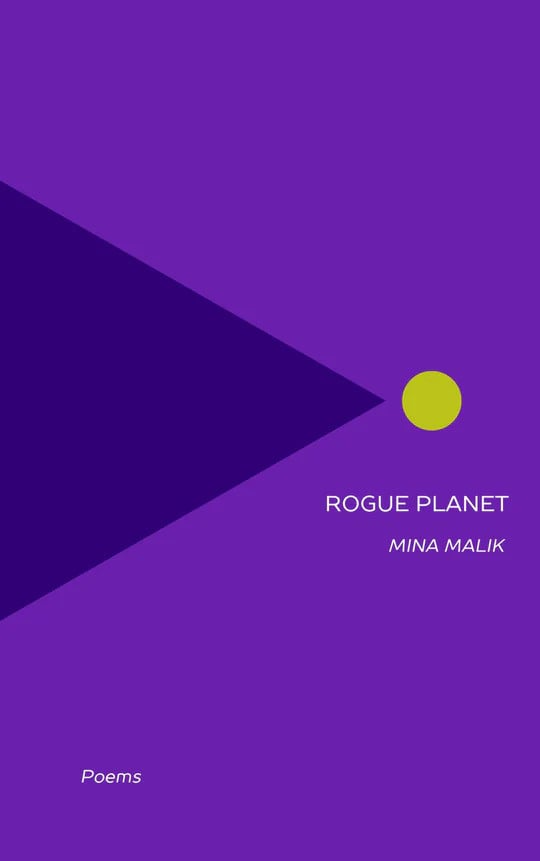
Mina Malik, an Oxford-trained poet and writer, recently published her first collection of poems, Rogue Planet (The Peepul Press, 2026). The title is quite enthralling and can work as a spoiler for the poems to come. Scientifically, a rogue planet is a floating planet which is not bound to any gravitational pull, much like the unbounding desires in NM Rashid’s hasan kuza-gar: tamannā kī vus.at kī kis ko ḳhabar hai jahāñ-zād lekin/tū chāhe to ban jā.ūñ maiñ phir/vahī kūza-gar (Who knows the bounds of desire, Jahanzad, but/if you wish, return/I will to my abandoned pots).
We all have seen in life how entanglements in relationships direct our way of life, our way toward the world, and our inner worlds. Logically, then, the interiority of being and belonging is very often the subject of writers. As De Quincey, an English writer and literary critic, wrote, “The problem before the writer is to project his own inner mind; to bring out consciously what yet lurks by involution in many unanalysed feelings.”
On a more linguistic terrain, ‘rogue’ could be understood in the sense of deviation/outlier, which in turn can be caused by someone else’s jostling from the otherwise straight path or one’s own vagabondry, titillating toward uncertainties and ambiguities like the famous similes-ridden poem of Wordsworth, I Wandered Lonely as a Cloud. But of course, this wanderlust is not aimless in itself; a rogue, unlike a strayed, is on some mission, and this poet’s errand seems to be ruminating over grief and longing, unfurling the alienation of planetary movements in the brutal black sky; these levitating vistas are then superimposed on everyday life through the coarse syntactic units of verses, crisscrossing in this thin chapbook.
She penned, “the gravity of the situation/was clear. Once you’ve seen the sun/you can’t look away, once you eat/the apple what can the Pope do” in the poem Galileo, inspired by the symbol of the apple from Bertolt Brecht’s The Life of Galileo, where this digression is aptly circumambulating the desire. This fascination with natural objects is not the evidence of imitation only; rather, we see interminably a kind of creation which, though taken from the outer world, becomes a cartography of the inner microcosm. And this tangent of poetry is archaic, well settled by Neoplatonists in the 16th century: in this view, the artist does not merely imitate an imitation (given the real world is replicating the forms from the ideal world), as in Plato, nor does he represent the universal aspects of Nature, as in Aristotle. Now the poet creates in his imagination a new world.
Mina, in the poem I Follow My Heart, writes, “the sunset is a coral smear of wonder,/we could pitch a tent here,/look/the babies are small forever,/the lake is full even when it isn’t.” Here, the sunset, normally considered beautiful and serene, is a “coral smear of wonder,” suggesting it to be both beautiful and messy; and also due to the wonderment, the oxymoronic situation is ubiquitous and not easily graspable. Then there is a desire to stay in that imagination, where babies are small, again a counterintuitive imagery, and the lake is a mirage. Thus, this phantasmic scene belongs to the inner consciousness (or heart, if I follow the title) of the poet, which lingers in the meta-linguistical universe.

Architecture of language
Further the architecture of her language is very Ezra Poundian; as described in his famous essay, “A Retrospect” and “A Few Don’ts”, the three fundamental principles of good poetry is: (i) Direct treatment of the “thing” whether subjective or objective; (ii) To use absolutely no word that does not contribute to the presentation; and (iii) As regarding rhythm: to compose in the sequence of the musical phrase, not in sequence of a metronome.” This formula of poetry is antithetical to the Victorian restraint and formalism, and is known for its relentless quest for experimentation and the invention of new kinds of poetry and novels.
Generally, this “not in sequence of a metronome”, or non-metrical poetry, irks the South Asian readers, given our ghazal tradition. Throwing away the formal features -- frameworks, rules, conventions -- seems gruesome. After all, these forms are not utterly nonsensical; it aligns with the language they are exploited in. For instance, Haiku goes perfectly well with Japanese, which is fond of overstretched syllables. Ergo, severance from these structures could let us go “rogue.”
But with the world becoming more and more meaningless and topsy-turvy, it seems not completely absurd to foment new diction, new (frizzy) rhythms, and new (null) rhymes to reflect the world we observe. And, needless to assert, creativity isn’t and must not be expected to be a normal phenomenon. It is bound to have aberrations, disruptions and subversions. One can gauge it from one of the interviews of the great modern Poet T.S. Eliot, who said in response to being asked about his poem, The Wasteland, being cerebral: “Speaking for myself, if this poem, The Hollow Men and The Love Song of Alfred. J Prufrock sound sterile to some readers, it is because I want to present the contemporary man in his true form. Don’t we live in an age which is a wasteland where nothing grows except briars and brambles? There are no longer roses or marigolds around us, only cacti. So you can say that my poetry holds a mirror to contemporary reality.”
Mina is, ergo, a modern poet who sidelines the elevated diction: beautiful, lofty-sounding words, words formal and polite, or stately words, only to be heard in a king’s court or in literature dealing with it. Here, the greatness comes with the mastery of contemporary and ordinary diction, with deft naturalness. She writes, “i think this is what germans meant by/doppelgänger/--it looks the same, but it isn’t” and at another instance, “Excellent bone-knives, peeling your flesh-fruit open/spitting the pips – we’re done.” The choice of words, the manner of words, and the temperament of verses vis-à-vis each other are unfamiliar, uncanny, disturbing, and topsy-turvy (like the world we live in).
Further, the novelty is not only earmarked to linguistic structure; the insertion of scientific themes, like Einstein's theory of relativity in poetry, also plays a great imagination to picturise the alienation between the weltanschauungs of the lover and beloved, while at the same time, this craft of contrived terms doesn’t paint the poem as constructed coarsely; it feels natural, notwithstanding. She writes: “If I were here and you were running,/the sky would be different. This is because/of light, of relativity,/of motion changing time.” Here, ironically, the poet is, in a way, saying you, the muse, don’t affect me; rather, it is only the space-time fabric eligible to distort my vision. And of course, it is a lie; the existence of the poem itself vouches otherwise.
Moreover, for the author, the blank spaces, or the functional white, on the page are as telling as the inked anatomy. In the poem Inventory, inspired by the inventory poem genre, where a poem takes stock, gathering and naming objects, memories, sensations, or fragments of experience in a deliberate list, she lists down her inventory of different things: pens, space, belonging, time (in years, months, days), etc. Interestingly, this poem, unlike all the other poems, is printed in landscape orientation. One may wonder why? The reason could be many: to create a poetic field, where silence transcends the text; to have elongated lines which are not possible in the portrait manner, like the first line of the poem: “2 pens: 1 fountain, 1 ballpoint. I signed with a Scheaffer I only use for Special Occasions”; and maybe, it is the depiction of the muddled memory, where the past is half-remembered and haunting, and is still shaping and reshaping (moving the normal poem by 90 degrees) the present. Images and objects, here, are placed together as a catalogue to resonate the relationship of the poet with the subjects of the poem, and this associative topography evokes a poetic meaning through the accumulation of the list, lingering between blackness (text) and blankness (white space).
These are the days
These are the days is the poem I liked more than any other in the chapbook. It presents a heap of broken images, situated in the modern world. Starting with the description of the present: “these are the days of the dirge, the desolate/plod of single feet across a yawning horizon/mouth of the dust, dust of heart.” The second line reminds me of Ghalib: hai kahāñ tamannā kā dūsrā qadam yā ra/ ham ne dasht-e imkāñ ko ek naqsh-e pā pāyā (Translated by Pritchett: where is the second step of longing, oh Lord? / we found the desert of possibility [to be] a single/particular/unique/excellent footprint).
Then, she writes, “these are the nights centred around the glowing/cigarette in the dark: tiny firelight for a single-syllable story/turning to ash before the next breath.” The first line presents solitude, then cigarette becomes the anchor of this shared intimacy in an otherwise empty night; the glow of cigarette is feeble and can be compared to single syllable, which is extremely minimal, like the emotions unexpressed; and the ash appears without the unfurling of the whole story, much like the beloved who doesn’t care about the poet and so, the relationship is always mono-directional. Paradoxically, here, the economy of words is the method the poet uses to express. Then, we observe more images, like those of ghazals, exhibiting disunity with some epigrammatic value and yet coherent with the main theme. Ending the carousel with the overarching message of this poem (or the book): “my heart is a wasteland where nothing grows;/we don’t believe in miracles here.” The creative inventiveness of this poem and others in the book, as an art piece of exploration and exhaustion, asserts, again and again, the barrenness of the time, the pathetic space we dwell in, the societal decay, and the unnatural and even sickly nature of human relationships.
Mina’s poetry is a collage of images extracted from the poet’s consciousness and drenched in the absence of the object of desire (borrowing from Lacan), and these images may or may not make sense on their own, unless, as a reader, we allow the poem to arouse those direct projections in our own minds. Thus, reading the book may tempt the reader as a poetic object (or it may not, given the diction of low order and disparities amongst lines), but to trap its meaning, one has to allow it to affect us and to be possessed by it, like the space-time fabric dictates our experience of the world in the Einsteinian as well as the Kantian world. After all, poetry is that art of figuration, the art of shaping the imagination.
The writer is a Peshawar-based researcher who works in the financial sector. He can be reached at alifurqan647@gmail.com
All facts and information are the sole responsibility of the writer