‘NAPA Repertory Festival’ concludes with musical finale
Updated 2 hours ago

New documentary lets indigenous community narrate its story in its own words
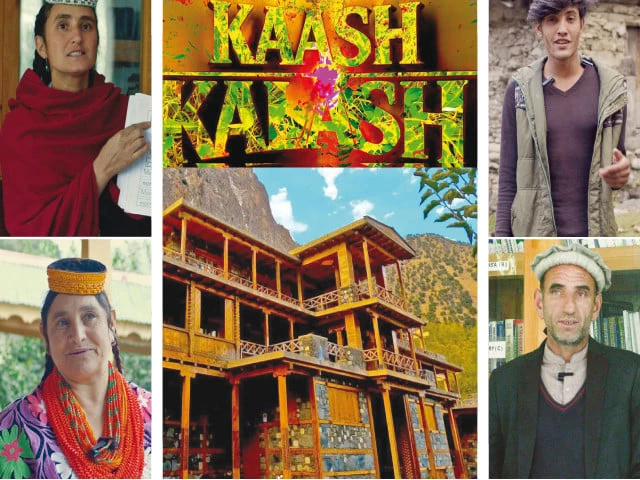
A powerful new feature documentary, 'Kaash Kalash', is offering an unprecedented look into one of Pakistan's most unique and endangered communities, told for the first time in their own voice and from their own perspective.
Set against the dramatic backdrop of northern Pakistan's mountain ranges, the film captures the lived reality of the Kalash people, a small indigenous community whose population has dwindled to around 3,800.
Rather than interpreting their story through an external lens, the documentary allows the Kalash to narrate their own identity, history and struggles in their native language - an approach rarely seen in mainstream storytelling.
"This is not just a film; it is an attempt to let the Kalash people speak for themselves, without any imposed narrative," filmmaker Khalid Hasan Khan told The Express Tribune. "For the first time, audiences will hear their myths, beliefs and daily realities directly from them."
The Kalash, known for their distinct culture and polytheistic beliefs, trace their lineage to Alexander the Great, a claim that is debated by historians yet continues to shape their identity. The documentary treats this connection as a living cultural narrative, reflected in their attire, festivals and social customs.
A key visual element in the film is the Kalasha Dur complex in Bumburet Valley, a striking structure gifted by the Greek government. It stands as a symbol of cultural linkage and international recognition. The film also highlights the contributions of Greek volunteer Athanasios Lernous, who helped lay the foundation for early education within the community.
Through intimate storytelling, 'Kaash Kalash' explores a wide range of themes, from mythology and spiritual practices to economic survival. It sheds light on agriculture, livestock rearing and limited employment opportunities, while also portraying the growing tension between traditional lifestyles and modern pressures.
"Climate change, lack of education and limited access to basic facilities are not abstract issues here - they are part of everyday life," Khalid Hasan said. "The community is constantly negotiating between preserving its heritage and adapting to a rapidly changing world."
The Kalash is an enclave spread across three remote and relatively inaccessible valleys - Bumburet, Birir and Ramboor - located in the Chitral district of Khyber Pakhtunkhwa. Earlier this week, the United Nations Educational, Scientific and Cultural Organization (UNESCO) included Kalash Valley in its Tentative World Heritage List.
"The Kalasha Valley cultural landscape possesses outstanding universal value (OUV) as an extremely rare and exceptionally well-preserved example of a living indigenous cultural system," the UN's cultural arm stated on its website.
"This system has continued without interruption for centuries within its original geographic and cultural setting. Despite historical changes, outside influences and social pressures, the Kalasha community has successfully maintained its distinct identity," it said.
The valley's tangible heritage includes more than 140 recorded ceremonial structures, ritual platforms, ancestral graveyards featuring distinctive wooden carvings, and traditional villages. Each of these places has its own name, purpose and meaning in the memory and identity of the community.
"These features are not abstract ideas or symbolic references to the past; they are actively practised and clearly connected to the physical landscape, where specific places serve as designated locations for particular ceremonies and ritual activities," Unesco said.
The 'Kaash Kalash' documentary also touches on the complex role of tourism. While it provides economic relief, it simultaneously introduces cultural dilution and environmental strain, raising difficult questions about sustainability.
According to media reports, Chitral Valley attracted over 2,700 foreign tourists in 2025, marking a 15% increase over 2024. This growth highlights Chitral's rising appeal as an emerging destination for global travellers seeking nature, culture and adventure tourism.
The release of the documentary also comes ahead of the vibrant Chilam Joshi Festival, scheduled from May 13 to 16, 2026. The annual spring festival, showcasing traditional dance, music and colourful attire, celebrates renewal and community spirit - elements deeply woven into the film's narrative fabric.
As global conversations around indigenous representation continue to evolve, 'Kaash Kalash' stands out as a rare and meaningful effort - one that not only documents a culture but empowers it to tell its own story.










This material may not be published, broadcast, rewritten, redistributed or derived from. Unless otherwise stated, all content is copyrighted © 2026 The Express Tribune.












COMMENTS
Comments are moderated and generally will be posted if they are on-topic and not abusive.
For more information, please see our Comments FAQ