Are superheroes losing grip on Hollywood?
Updated 7 hours ago

Inside the rise of a Dutch glovemaker dressing pop royalty
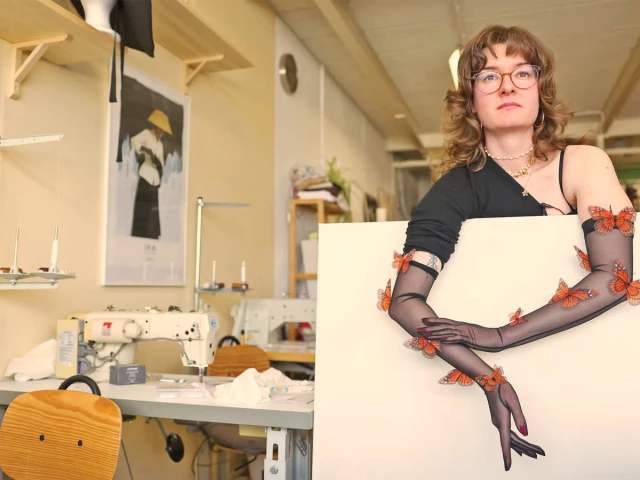
In a fashion industry dominated by mass production and rapid turnover, a Dutch designer quietly stitching gloves by hand has carved out a global following, proving that patience and precision still hold currency in a market driven by speed and scale.
At just 30, Jeanne Hermans has built a distinctive brand from her modest atelier, C'est Jeanne, in Zaandam, a subdued city north of Amsterdam.
Her creations - often adorned with butterflies, florals and intricate embroidery - have found their way onto the hands of global pop icons such as Cher, Dua Lipa and Miley Cyrus, retailing between 300 and 975.
Despite the celebrity endorsement and a social media following nearing a quarter of a million, Hermans remains committed to a fully handcraft process.
Each pair is meticulously constructed, with simpler designs taking a few hours while more elaborate pieces - involving sequins, rhinestones or layered embroidery - can require days, even hundreds of hours, to complete.
Her journey into glove-making was almost accidental. While studying tailoring in Amsterdam, Hermans found herself ahead of her peers and searching for a creative challenge.
A chance encounter with a book on leather glove-making sparked what would become both a niche and a vocation. By 2017, she had produced her first collection, recognising early on that few others were exploring such intricate, decorative glove design.
Visibility, however, did not come overnight. It was her disciplined 'Glove of the Week' series on Instagram, launched in 2022, that gradually drew the attention of stylists and fashion insiders.
Consistency, rather than virality, proved decisive. Within months, her work began circulating widely, eventually reaching celebrity circles.
Yet the glamour of Hollywood comes with its own misconceptions. Hermans is candid about the realities behind celebrity placements, noting that such exposure is rarely paid.
Items are often loaned, worn, and returned - valuable for visibility but not necessarily for immediate revenue. Even viral moments, she observes, do not guarantee a surge in sales. "It builds reputation, not instant business," she has suggested in interviews.
The pressures of sustaining a handcraft business are equally stark. Hermans admits to working relentlessly, often at the expense of personal time, as she balances creative ambition with the demands of running a growing label alongside her sister.
Still, she remains wary of scaling too quickly, citing the risk of compromising both craftsmanship and workplace culture.
In an era where fast fashion giants can replicate trends within weeks, Hermans acknowledges the looming threat of imitation but remains cautiously optimistic. The complexity of her designs, she believes, offers a degree of protection.
For Hermans, the true reward lies not in celebrity validation but in the craft itself - the quiet satisfaction of bringing a difficult design to life, one careful stitch at a time. REUTERS









This material may not be published, broadcast, rewritten, redistributed or derived from. Unless otherwise stated, all content is copyrighted © 2026 The Express Tribune.












COMMENTS
Comments are moderated and generally will be posted if they are on-topic and not abusive.
For more information, please see our Comments FAQ