Yumna Zaidi marks 14 years in showbiz with heartfelt reflection on journey and success
Updated 3 hours ago

31st International Mushaira features prominent Pakistani, foreign poets; promotes message of global peace
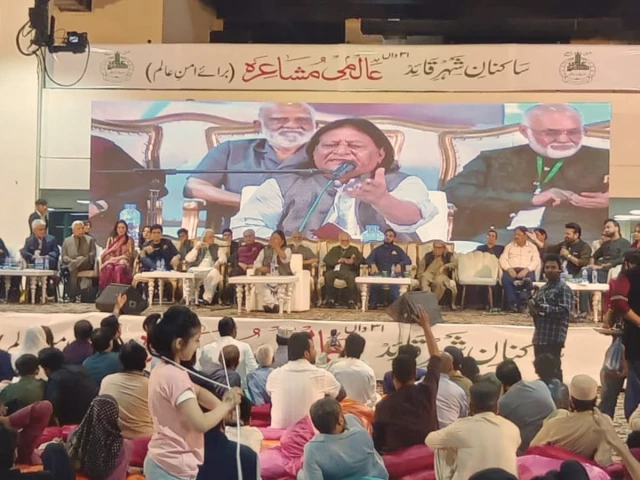
A vibrant celebration of Urdu literature took place in Karachi, where the 31st International Mushaira brought together prominent poets from Pakistan and abroad at the Expo Centre.
Organised by Sakinaan-e-Sheher-e-Quaid, the event was themed around "global peace", highlighting messages of harmony, cultural unity and the enduring power of language.
The mushaira was presided over by renowned poet Iftikhar Arif, while hosting duties were carried out by Wajeeh Sani and Ambreen Haseeb Amber.
A number of leading literary figures, including Pirzada Qasim Raza Siddiqui, Anwar Shaoor, Khalid Irfan, Wasi Shah, Abbas Tabish, Nasira Zuberi and Sabeen Saif, recited their poetry to an engaged audience.
The evening featured verses celebrating the richness of the Urdu language, with one couplet capturing the audience's imagination:
"From a single flower comes the fragrance of all blooms,
Such magic belongs to the one who knows Urdu."
Organisers said the annual mushaira has become a defining cultural identity of Karachi, made successful by the city's residents. Entry was kept free to encourage wider public participation in literary and cultural traditions.
Members of the audience described the experience of listening to both local and international poets live as "priceless".
Addressing the gathering, Sindh Governor Nehal Hashmi said that poetry and film transcend borders and can help bridge divides between nations. He also noted his role in inviting Indian poet Rajesh Reddy, emphasising the importance of cultural exchange despite existing tensions.
The event was attended by lawyers, journalists and political figures, reflecting the continued relevance and popularity of literary gatherings in the city.
For Pakistan, Urdu originally had the image of a refined, elite language of the Enlightenment, progress, and emancipation, and the language contributed to the success of Pakistan's independence movement. But after the 1947 Partition, when it was chosen as the national language of Pakistan to unite all inhabitants with one linguistic identity, it faced serious competition primarily from Bengali (spoken by 56% of the total population, mostly in East Pakistan until that attained independence in 1971 as Bangladesh), and after 1971 from English. Both pro-independence elites that formed the leadership of the Muslim League in Pakistan and the Hindu-dominated Congress Party in India had been educated in English during the British colonial period, and continued to operate in English and send their children to English-medium schools as they continued dominate both countries' post-Partition politics. Although the Anglicized elite in Pakistan has made attempts at Urduisation of education with varying degrees of success, no successful attempts were ever made to Urduise politics, the legal system, the army, or the economy, all of which remained solidly Anglophone. Even the regime of general Zia-ul-Haq (19771988), who came from a middle-class Punjabi family and initially fervently supported a rapid and complete Urduisation of Pakistani society (earning him the honorary title of the 'Patron of Urdu' in 1981), failed to make significant achievements, and by 1987 had abandoned most of his efforts in favour of pro-English policies. Since the 1960s, the Urdu lobby and eventually the Urdu language in Pakistan has been associated with religious Islamism and political national conservatism (and eventually the lower and lower-middle classes, alongside regional languages such as Punjabi, Sindhi, and Balochi), while English has been associated with the internationally oriented secular and progressive left (and eventually the upper and upper-middle classes). Despite governmental attempts at Urduisation of Pakistan, the position and prestige of English only grew stronger in the meantime.
Owing to interaction with other languages, Urdu has become localised wherever it is spoken, including in Pakistan. Though Urdu is spoken by many Muhajirs in its standard form. In some areas, it has borrowed words from regional languages, giving the language a peculiar regional flavor. Similarly, the Urdu spoken in India can also be distinguished into many dialects such as the Standard Urdu of Lucknow and Delhi, as well as the Dakhni (Deccan) of South India. Because of Urdu's similarity to Hindi, speakers of the two languages can easily understand one another if both sides refrain from using literary vocabulary.










This material may not be published, broadcast, rewritten, redistributed or derived from. Unless otherwise stated, all content is copyrighted © 2026 The Express Tribune.

COMMENTS
Comments are moderated and generally will be posted if they are on-topic and not abusive.
For more information, please see our Comments FAQ