5 Palestinians killed, 5 injured by Israeli fire in Gaza
Updated 34 minutes ago

Iran's Revolutionary Guards say any attack on its energy infrastructure would trigger sweeping retaliation
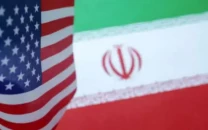
Turkiye’s Foreign Minister Hakan Fidan on Sunday discussed ‘steps to end’ the war with his counterparts from Egypt and Iran, as well as with US and EU officials, after Iran’s Revolutionary Guards said they would completely close the Strait of Hormuz if Trump carried out threats against Iranian energy infrastructure.
Fidan held separate calls with Iranian Foreign Minister Abbas Aragchi, Egyptian Foreign Minister Badr Abdelatty, EU's foreign policy chief Kaja Kallas and officials from the US.
No further information on the calls was provided.
Iran warns to shutdown Hormuz completely
Iran has warned it will completely shut the Strait of Hormuz if US President Donald Trump follows through on threats to target Iranian energy facilities, the country’s Revolutionary Guards said on Sunday.
The warning came a day after Trump said he would “obliterate” Iran’s power plants if Tehran failed to reopen the strategic waterway within 48 hours, signalling a sharp escalation despite earlier remarks about “winding down” the conflict.
In a statement, Iran’s Revolutionary Guards said any attack on its energy infrastructure would trigger sweeping retaliation. Companies with US ties would be “completely destroyed,” it said, adding that energy facilities in countries hosting US bases would be considered “lawful” targets.
Since early March, Iran has effectively closed the Strait of Hormuz, a key oil transit route that normally handles about 20 million barrels per day and roughly 20% of global liquefied natural gas trade, to most ships. The closure has driven up shipping and insurance costs, pushed oil prices higher, and raised global economic concerns.
Regional escalation has continued to flare since the US and Israel launched a joint offensive on Iran on Feb. 28, killing so far over 1,300 people, including then-Supreme Leader Ali Khamenei.
Iran has retaliated with drone and missile strikes targeting Israel, along with Jordan, Iraq, and Gulf countries, which it says are targeting “US military assets,” causing casualties and damage to infrastructure while disrupting global markets and aviation.
Earlier, The US President Donald Trump on threatened to "obliterate" Iran's power plants if Tehran does not fully reopen the Strait of Hormuz within 48 hours, a significant escalation barely a day after he talked about "winding down" the war.
"If Iran doesn't FULLY OPEN, WITHOUT THREAT, the Strait of Hormuz, within 48 HOURS from this exact point in time, the United States of America will hit and obliterate their various POWER PLANTS, STARTING WITH THE BIGGEST ONE FIRST!" Trump said on social media.
🚨 “If Iran doesn’t FULLY OPEN, WITHOUT THREAT, the Strait of Hormuz, within 48 HOURS from this exact point in time, the United States of America will hit and obliterate their various POWER PLANTS, STARTING WITH THE BIGGEST ONE FIRST…” - President DONALD J. TRUMP pic.twitter.com/htLz1A0Mf7
— The White House (@WhiteHouse) March 22, 2026
Trump's ultimatum would expand the scope of US strikes to infrastructure that affects daily civilian life in Iran.
A joint statement has been sent out by the foreign ministries of United Arab Emirates, the United Kingdom, France, Germany, Italy, the Netherlands, Japan, Canada, the Republic of Korea, New Zealand, Denmark, Latvia, Slovenia, Estonia, Norway, Sweden, Finland, Czechia, Romania, Bahrain, Lithuania, and Australia on the Strait of Hormuz
Joint statement from the leaders of the United Arab Emirates, the United Kingdom, France, Germany, Italy, the Netherlands, Japan, Canada, the Republic of Korea, New Zealand, Denmark, Latvia, Slovenia, Estonia, Norway, Sweden, Finland, Czechia, Romania, Bahrain, Lithuania, and… pic.twitter.com/iA1qqVB36t
— ANI (@ANI) March 22, 2026
The threat of Iranian attacks has kept most ships from getting through the strait, a narrow waterway that serves as the conduit for around a fifth of global oil and liquefied natural gas supplies, threatening a global energy shock. Its near-closure sent European gas prices surging as much as 35% last week.
Iran's Khatam al-Anbiya military command headquarters said Sunday that if the US attacks Iran's fuel and energy infrastructure, then Iran would target all US energy, information technology and desalination infrastructure in the region.
Energy prices spiked last week after Iran responded to an Israeli attack on its major gas field by hitting Qatar's Ras Laffan Industrial City, which processes around a fifth of the world's liquefied natural gas, causing damage that will take years to repair.
The threats to Gulf infrastructure came as the conflict entered dangerous new territory.
Israeli officials said Iranian forces had for the first time fired long-range missiles, expanding the risk of attacks beyond the Middle East, even as an Iranian strike injured dozens of people not far from Israel's nuclear site.
Iran launched two ballistic missiles with a range of 4,000 km (2,500 miles) at the US-British military base at Diego Garcia in the Indian Ocean, Israeli military chief Eyal Zamir said. The Israeli military said it was the first time Iran had used long-range missiles since the United States and Israel began attacking Iran on February 28.
"These missiles are not intended to strike Israel. Their range reaches European capitals - Berlin, Paris, and Rome are all within direct threat range," Zamir said in a statement on Saturday.
A source at Britain's defence ministry said the attack had occurred before the government gave specific authorisation on Friday for the US to use British military bases to carry out strikes on Iranian missile sites.
More than 2,000 people have been killed during the war. In Israel, 15 people have been killed in Iranian strikes.
Trump and his administration have sent mixed messages about US goals throughout the war, now in its fourth week, leaving US allies struggling to respond.
Trump's ultimatum on Saturday was the most abrupt shift yet. Trump's rhetoric pivoted from a drawdown to an explicit 48-hour countdown to strike Iran's power infrastructure, even as US Marines and heavy landing craft continue heading to the region.
Iran’s largest power plants include the Damavand power plant near Tehran (2,868 megawatts of capacity), the Kerman plant in southeastern Iran (1,910 MW), and the Ramin steam power plant in Khuzestan province (1,890 MW), according to industry and energy databases.
The country’s sole nuclear plant at Bushehr on Iran's southern coast produces about 1,000 MW.
Earlier this month, Trump raised the idea of destroying Iran's power grid even while downplaying the notion. "We could take apart their electric capacity within one hour, and it would take them 25 years to rebuild," Trump told reporters on March 11. "So ideally, we're not going to be doing that."
US voters appear increasingly concerned that the war could expand. Energy price shocks are fuelling inflation, hitting consumers and businesses hard, a major political liability for Trump as he seeks to justify the war to the public before the November elections in which control of Congress is at stake.
Read: Iran's president says immediate cessation of US-Israeli aggression needed to end war
Trump had also accused NATO allies of cowardice over their reluctance to help open the strait. Some allies have said they will consider it, but most say they are reluctant to join a war that Trump started without consulting them.
The Israeli military said on Sunday that it is conducting strikes in Tehran, hours after attacks on southern Israel.
Late on Saturday, Iranian missiles hit the southern Israeli cities of Dimona and Arad, injuring dozens of people, including children, in separate strikes. Iran's Revolutionary Guards said in a statement early Sunday that they targeted "military installations" and security centres in southern Israel.
Israeli military spokesperson Brigadier General Effie Defrin said in a post on X that the country's air defences were functioning but did not intercept the strikes. "We will investigate the incident and learn from it," he said.
Israel’s secretive nuclear reactor is about 13 km (8 miles) southeast of Dimona. Both cities lie near several military sites, including Nevatim Air Base, one of the country's largest.
"This has been a very difficult evening in the battle for our future," Israeli Prime Minister Benjamin Netanyahu said in a statement released by his office following the strike on Arad.
"We are determined to continue striking our enemies on all fronts," the statement said.
‘Ready to cooperate’
Iran is ready to cooperate with the International Maritime Organisation to improve maritime safety and protect seafarers in the Gulf, the Iranian representative to the UN maritime agency said, the semi-official Mehr news agency reported.
Ali Mousavi said the Strait of Hormuz remains open to all shipping except vessels linked to "Iran's enemies", adding that passage through the narrow waterway was possible by coordinating security and safety arrangements with Tehran.
"Diplomacy remains Iran's priority. However, a complete cessation of aggression as well as mutual trust and confidence are more important," Mousavi said, adding that Israeli and US attacks against Iran were at the "root of current situation in Strait of Hormuz".
One killed in Israel
One person was killed after a fire broke out in two vehicles near Israel's northern Galilee, the Israeli emergency service said on Sunday, after the Israeli military reported strikes from Lebanon toward a community along the north border.
Damage and wounded were reported, the Israeli military said, without further elaborating.
Six killed in Qatar copter crash
Six people were killed in a helicopter crash in Qatar's territorial waters while operations continue to find the last missing person, the interior ministry said on Sunday.
The defence ministry earlier said the helicopter had crashed after suffering a technical malfunction during "routine duty".
Israel destroys bridge linking Lebanon’s South
Israel struck a main bridge linking Lebanon's south to the rest of the country on Sunday after ordering its military to destroy all crossings over Lebanon's Litani River and to step up the demolition of homes near the southern border.
The destruction of bridges and homes marks a significant escalation in Israel's military campaign in Lebanon, which was pulled into the regional war on March 2 when armed group Hezbollah fired into Israeli territory.
International law generally prohibits militaries from attacking civilian infrastructure, and the United Nations human rights chief has criticised Israel's actions in Lebanon, particularly its use of widespread evacuation orders.
Sunday's strike pulverized a crossing on Lebanon's coastal highway that ran through farmland and was one of the main routes linking southern and central Lebanon.
An Israeli military spokesperson had announced the army would strike the bridge earlier on Sunday.
Lama al-Fares, who lives on farmland adjacent to the crossing, said her family packed whatever they could into their car when they saw the warning. They drove about a kilometre north on the highway and waited out the strike on a hilltop overlooking the highway.
"Our house is right next to the bridge. It was destroyed in the last war and we had rebuilt a basic structure to live in - I hope it's still standing," she told Reuters.





This material may not be published, broadcast, rewritten, redistributed or derived from. Unless otherwise stated, all content is copyrighted © 2026 The Express Tribune.










COMMENTS
Comments are moderated and generally will be posted if they are on-topic and not abusive.
For more information, please see our Comments FAQ