Ex-Prince Andrew continues to 'gripe' as royal fallout deepens
Updated 12 hours ago

Documentary 'F1: Drive to Survive' has already popularized motor sport's top discipline, among young women
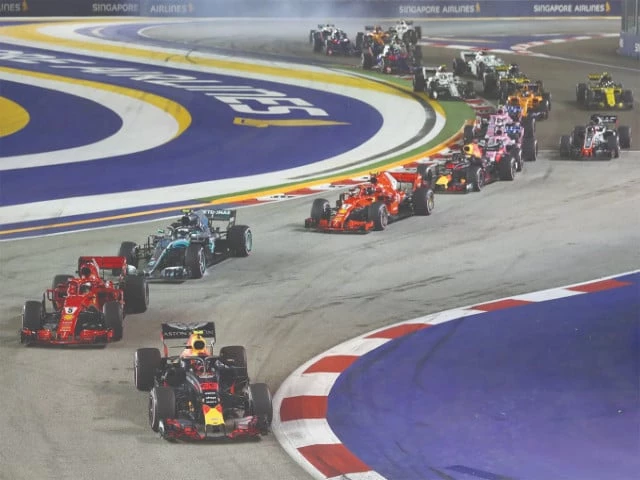
Formula 1 is well anchored in the United States with its American owners and three Grand Prix races, but the sport hopes to push its growing popularity further with the help of Netflix and Apple.
The Netflix documentary "F1: Drive to Survive", which begins its eighth season on Friday, has already taken motor sport's top discipline into a new dimension.
The series provides a behind-the-scenes look at the sport's drivers, managers and team owners.
While critics complain that the series magnifies tensions between drivers and managers for entertainment value, it has introduced a younger audience, particularly women, to F1.
The documentary series and the additional races in the United States have been "seismic changes in terms of where we were as a sport," said Liam Parker, head of communications for F1, which has been a subsidiary of US group Liberty Media since 2016.
Founded in 1991, Nasdaq-listed Liberty Media has spent the last decade pushing hard to boost F1's audience in the United States, where NASCAR and IndyCar dominate.
52 million fans
"Drive to Survive" co-executive producer Tom Rogers believes F1 has enormous potential in the United States thanks to it now hosting three Grand Prix races — in Miami, Austin and Las Vegas.
Out of F1's global audience of some 800 million viewers, only some 52 million are in the United States, according to Parker.
"We're not really scratching the surface in the US in terms of what we can do given the size of that audience," he said recently in Bahrain, where F1 held a series of pre-season tests.
The sport is also still basking in the success of "F1: The Movie" starring Brad Pitt. In addition to box office success last year, the film garnered four Oscar nominations, including for best picture.
This year five of the 24 Grand Prix races will be broadcast live at giant-screen IMAX theatres across the United States.
This year also sees a switch in TV broadcasting rights from Disney's ESPN to Apple TV.
The deal is worth a reported $150 million per year to F1, according to US media.
Enormous Latin America market
"When we are talking about Apple in the US, we are talking about a new partner of Formula 1 that is believing in us with a great plan of being the protagonist of the growth in the US," said F1 chief executive Stefano Domenicali.
But F1 is setting its sights on more than just the United States.
"I think we're all anticipating probably a Latin American boost in Formula One interest... with Franco" Colapinto, the Argentinian driver for Alpine, said Rogers.
"And I think Latin America is an enormous market, especially for Netflix," he added.
Mexican driver Sergio Perez with Cadillac and Brazilian Gabriel Bortoleto with Audi are also draws for Latin American viewers.
Formula One cars are the world's fastest regulated road-course racing cars, owing to high cornering speeds achieved by generating large amounts of aerodynamic downforce, most of which is generated by front and rear wings, as well as underbody tunnels.
The cars depend on electronics, aerodynamics, suspension, and tyres. Traction control, launch control, automatic shifting, and other electronic driving aids were first banned in 1994. They were briefly reintroduced in 2001 but were banned once more in 2004 and later 2008.















This material may not be published, broadcast, rewritten, redistributed or derived from. Unless otherwise stated, all content is copyrighted © 2026 The Express Tribune.






COMMENTS
Comments are moderated and generally will be posted if they are on-topic and not abusive.
For more information, please see our Comments FAQ