PSX jumps nearly 1,400 points on sustained buying interest
Updated 11 hours ago

Industry officials call it 'pick & choose' policy, violation of directive on gas sale to third parties
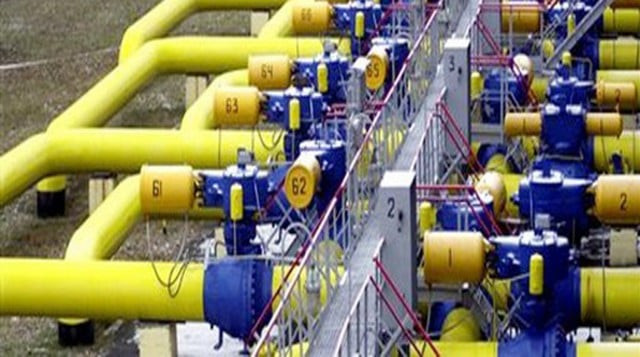
The Petroleum Division is seeking approval of the Economic Coordination Committee (ECC) for gas allocation from a Pakistan Petroleum Limited (PPL) field to power and fertiliser sectors only through competitive bidding.
Under the policy of gas allocation to third parties, all sectors are eligible to participate in competitive bidding. This policy has been approved by the federal government, which allows exploration companies to provide 35% of gas to third parties through bidding.
But the Petroleum Division has approached the ECC to bind PPL to supply gas to the power and fertiliser sectors only. Industry officials call it a "pick and choose policy", which would also hit PPL that may receive lower prices due to limited participation in bidding.
The Petroleum Division is also seeking the go-ahead to allocate gas from the PPL field on a "swing basis", meaning buyers will not need to follow the take-or-pay clause. "It shows the buyers – either power or fertiliser sector – will not be bound to pay damages if they are unable to take gas supply," a source said, adding that PPL was also likely to oppose gas allocation to a third party based on that mechanism.
PPL is set to offer surplus gas from Kandhkot field, over and above the committed 100 million cubic feet per day (mmcfd), to third-party consumers, preferably power and fertiliser sectors, at negotiated prices. Additionally, PPL and Sui Northern Gas Pipelines Ltd (SNGPL) are urging the government to clear their liabilities by selling assets of Genco-II through privatisation. As of June 30, 2025, the receivables of PPL, Mari Energies and SNGPL on account of gas supply to Genco-II had piled up to Rs270 billion.
Sources said that the Petroleum and Power Divisions had agreed that assets of Genco-II may be carved out for privatisation, subject to meeting PPL and SNGPL liabilities before doing anything with privatisation proceeds. Later, the Power Division/Guddu Power conveyed firm allocation of 100 and 38 mmcfd as swing volumes, which PPL could sell to third parties. The Thermal Power Station Guddu (TPSG) under Genco-II comprises 13 gas and steam-based old units as combined-cycle power plants (CCPP) commissioned between 1974 and 1994. A 747-megawatt CCPP was commissioned in 2014. The old units with low efficiency have outlived their useful generation lives and have been gradually phased out. The 747MW CCPP units are the only efficient units with thermal efficiency of 55% and are currently on the active privatisation list.
For gas supply from PPL's Kandhkot field to Genco-II, there are three dedicated pipelines – each with a carrying capacity of up to 90 mmcfd. Gas supply from Mari field was also being made through a dedicated line. Owing to erratic offtake and non-utilisation of gas from the Mari field, supplies were diverted to the fertiliser sector in 2021.
PPL has long reported underutilisation of gas from the Kandhkot field. Genco-II has been involved in sub-optimal and inefficient utilisation of the scarce and cheaper natural resource. The gas field being operated on a dedicated network could not be utilised for any other purposes when Genco-II off-take dropped considerably.
As of June 2025, the remaining recoverable gas reserves from the Kandhkot field were 428 billion cubic feet (bcf) against the original reserves of 2,095 bcf (discovery 1959). The current production potential of the field is 150 mmcfd with a declining profile of 13% per annum.
The Indicative Generation Capacity Expansion Plan (IGCEP) 2025-2035 provides for the annual capacity factor based on the installed capacity from 2027 to 2035 in respect of Guddu 747. The capacity factor for a power plant is the ratio of the actual energy produced in a year to the maximum possible energy it could have produced had it run at full nameplate capacity. Data indicates that there would not be optimum utilisation of Guddu 747 moving forward.
As Guddu 747 is on the active privatisation list, the Power Division has requested separate gas allocation along with revised/addendum to the existing gas sale agreement with PPL, citing both as condition precedents. The Petroleum Division did not respond to a request for comment.










This material may not be published, broadcast, rewritten, redistributed or derived from. Unless otherwise stated, all content is copyrighted © 2026 The Express Tribune.







COMMENTS (1)
Comments are moderated and generally will be posted if they are on-topic and not abusive.
For more information, please see our Comments FAQ