Beyond the war: China's moment?
Updated 23 hours ago

Governance without accountability is Pakistan’s real energy crisis
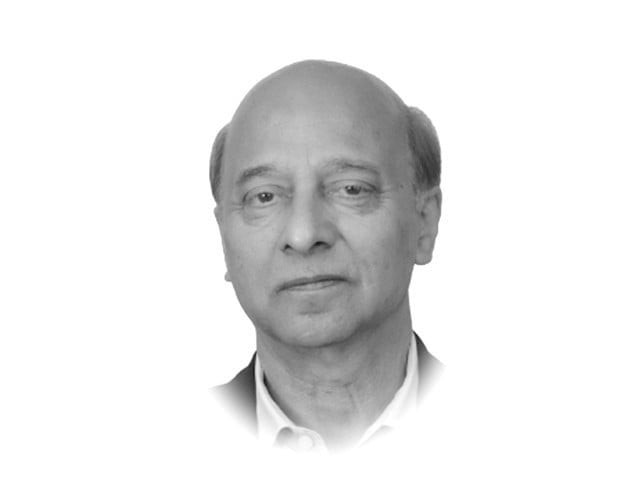
This column is not about the technical woes of the power sector. It is about the quality — or absence — of responsibility among our rulers. At the heart of Pakistan's governance crisis lies a simple problem: rule without accountability. Are Ahsan Iqbal, the minister for planning, and Shahid Khaqaan Abbasi, former prime minister and petroleum minister, responsible for the current mess? Or does responsibility extend to the entire PML-N leadership, including Nawaz and Shehbaz Sharif?
Consider a recent admission by Ahsan Iqbal.
"Pakistan should honour its commitments, and others should not be blamed for our past mistakes," he said at a press conference (reported in this paper on February 10). In one sentence, he captured the essence of Pakistan's current socio-political and economic crisis.
In effect, the minister indicted both himself and his leadership for the ambitious yet inadequately conceived power projects contracted between 2013 and 2018. As a multiple-term planning minister, he helped oversee decisions that exposed a governance system driven more by political expediency than by rigorous, long-term planning. His acknowledgement raises a troubling question: were the celebrated "visions" rooted in sustainable policy — or optics?
Behind this admission lies a deeper failure: indifference to outcomes, a weak sense of responsibility, and the absence of consequences for flawed decisions.
Between 2013 and 2018, the PML-N government commissioned nearly 13,000 MW of mostly coal-fired Chinese power plants. The 1,000-kilometre Lahore-Matiari high-voltage transmission line - still significantly underutilised — formed part of 21 energy projects established with Chinese financing at a total cost of $21 billion. These investments were secured at interest rates tied to the London Interbank Offered Rate (Libor) plus 4.5%.
The 2016 LNG deal, spearheaded by then petroleum minister Shahid Khaqaan Abbasi, involved four major gas-fired plants with a combined capacity exceeding 2,400 MW. It locked Pakistan into a rigid 15-year arrangement that has since become a financial burden, in addition to more than $100 million annually in capacity charges for LNG terminals at Port Qasim.
Collectively, these projects raised Pakistan's installed power capacity to 46,605 MW. Yet even at peak summer demand, less than half of that capacity is utilised. Average annual utilisation hovers around 33 per cent. More strikingly, the national grid itself cannot transmit more than 24,000 MW at any given time — rendering a significant portion of installed capacity functionally redundant.
The financial consequences are staggering. According to socio-economic commentator Zulfiqar Ahmed, consumers pay between Rs2.5 and 2.8 trillion annually in capacity payments to largely idle plants - roughly equivalent to the country's entire defence budget. Distribution losses stand at 18.3 per cent against NEPRA's target of 11.8 per cent. Theft, leakage and billing inefficiencies remain entrenched. An anti-theft campaign recovered just Rs23.6 billion against hundreds of billions in outstanding dues. Circular debt has surged to Rs2.4 trillion.
This structural imbalance did not emerge overnight. Yunus Dagha, former federal secretary for water and power, warned in an April 15, 2020 op-ed that capacity charges, which accounted for roughly one-third of generation costs in FY18, had already risen to two-thirds of new generation capacity added in recent years.
The central question remains: how much serious planning preceded what was promoted as a "transformation from darkness to light"? Were long-term transmission constraints, demand projections, fuel sustainability and fiscal exposure thoroughly examined? Or was the focus on rapid capacity addition for political capital?
This is not a partisan indictment alone. Responsibility extends across governments and institutions — from PPP to PML-N to segments of the civil-military bureaucracy involved in negotiating and approving these deals. But those who designed and championed the policies must answer first.
Will the principal architects acknowledge the scale of miscalculation? Will they accept consequences? Or will citizens continue to "pay through the nose" via crushing electricity and gas bills, alongside controversial policy shifts affecting solar power users?
Comparative examples from other political cultures are instructive. In Japan, resignation is a deeply embedded response to scandal or administrative failure. Since 1945, numerous ministers and lawmakers have stepped down after being implicated in corruption or ethical misconduct. In rare historical instances, extreme acts followed public disgrace.
In Germany, when confronted with evidence of public deception, Uwe Barschel, chief minister of Schleswig-Holstein, was found dead in a Geneva hotel bathtub in 1987 — a case widely viewed as suicide amid scandal.
No one expects Japanese-style ritual accountability. But the contrast underscores a principle: political office carries moral weight. Failure demands consequence.
In Pakistan, however, the pattern is different. "The people bear the cost through soaring bills and taxes. Those who negotiated and signed these terms demand public sacrifice, yet face no accountability themselves," observes economist Syed Javed Hassan.
The burden falls squarely on ordinary citizens. Electricity tariffs rise, gas prices escalate, circular debt expands, and fiscal space shrinks. Meanwhile, those who shaped the agreements remain insulated.
A sincere admission of responsibility — accompanied by institutional reform — would be a meaningful start. Transparent audits, renegotiation strategies, transmission upgrades and demand-side rationalisation could help restore credibility. But without accountability at the top, structural reform risks becoming another slogan.
This is ultimately a story of governance failure — of how the ambitions of a few can mortgage the future of millions. The damage was not inflicted by external enemies alone, but by domestic decision-makers who prioritised speed over sustainability and optics over prudence.
If the state is to regain credibility, it must answer a simple question: when elites fail, who pays — and who resigns?












This material may not be published, broadcast, rewritten, redistributed or derived from. Unless otherwise stated, all content is copyrighted © 2026 The Express Tribune.



COMMENTS (1)
Comments are moderated and generally will be posted if they are on-topic and not abusive.
For more information, please see our Comments FAQ