Azerbaijan ready to supply LNG to Pakistan
Updated 8 hours ago

Weighing only a few grams, the Bimaculata Larks play a crucial role in maintaining ecological balance
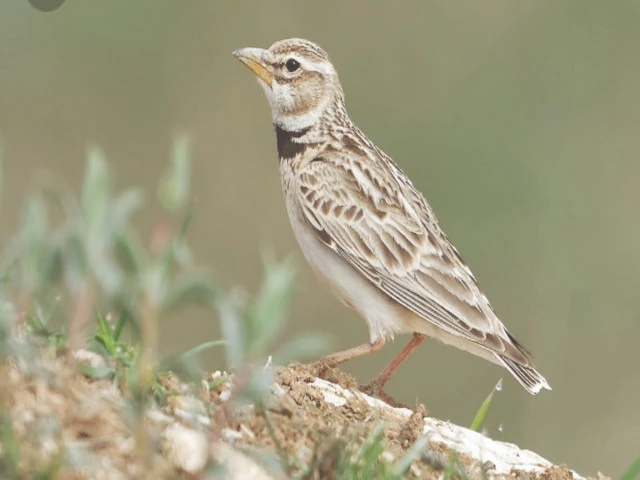
High above Pakistan's deserts and river plains, unnoticed by most eyes, thousands of tiny birds cross continents each winter. Weighing barely a few grams, they travel 4,000 to 6,000 kilometres from the frozen heart of Central Asia, defying altitude, exhaustion, and storms. They are not cranes or geese, nor do they follow the famed Indus Flyway. These are the Bimaculata Larks - small, unnamed heroes of the ecosystem whose epic journey ends in the fields of Sindh, Thar, and Cholistan.
Unlike most migratory birds that enter Pakistan through the Indus Flyway, the Bimaculata Lark - locally known as 'dhabbay walay chundol', 'chundail', or simply 'lark' - chooses a far more perilous route. Flying at great heights from Turkestan and other Central Asian regions, these birds enter Pakistan through Iran and Afghanistan, crossing Balochistan before descending into the plains of the Indus River, the Thar Desert, and Cholistan to spend the winter.
Despite their fragile appearance, Bimaculata Larks are considered among the most resilient migratory birds. When thousands of them take to the skies together, their swirling formations resemble locust swarms drifting across the horizon.
Physically, the bird closely resembles Pakistan's common house sparrow, but its endurance sets it apart. According to Sindh Wildlife officials, the lark's compact yet exceptionally strong body structure enables it to sustain long, uninterrupted flights. Research suggests these birds travel at altitudes stretching across thousands of kilometres, relying not on landmarks alone but on an extraordinary internal navigation system.
Wildlife biologists explain that the Bimaculata Lark is guided by a biological clock linked to its hormonal system. During migration season, this natural mechanism activates during daylight hours, compelling the bird to prepare for flight in a specific direction. Another instinct-believed to be linked to Earth's magnetic fields - helps it identify resting points, feeding zones, and safe routes along the journey.
It is only after reaching their destination that they gather in large numbers, settling not near water bodies but in lush grasslands, open fields, and semi-arid landscapes.
Their presence, though largely unnoticed, plays a crucial role in maintaining ecological balance. Feeding primarily on insects, the larks help control pest populations, protecting crops naturally and reducing the need for chemical interventions. After completing their seasonal role, they quietly return north once conditions improve.
However, experts warn that these tiny travellers are highly vulnerable to climate change. Because their migration depends on precise biological timing, shifting weather patterns, unseasonal storms, changing wind currents, and the disappearance of traditional resting sites are making their journey increasingly dangerous. Altered ecosystems are also reducing the availability of natural food sources along migration routes.
Human activity has further intensified the threat. Rapid urban expansion, loss of natural grasslands, excessive use of pesticides, air pollution, and the spread of high-voltage electrical infrastructure are steadily erasing the geographical cues these birds rely on for survival.
Sindh Wildlife officials caution that without conservation-focused planning, these silent migrants could disappear without ever being truly known. Their loss would not just be a tragedy for biodiversity, but a blow to natural pest control systems and environmental balance.















This material may not be published, broadcast, rewritten, redistributed or derived from. Unless otherwise stated, all content is copyrighted © 2026 The Express Tribune.











COMMENTS (1)
Comments are moderated and generally will be posted if they are on-topic and not abusive.
For more information, please see our Comments FAQ