Despite US–Iran deadlock, Trump again praises ‘great’ PM Shehbaz and ‘fantastic’ CDF Munir
Updated 3 hours ago

Court rules 2024 law unconstitutional, restores police autonomy and curbs political control over postings
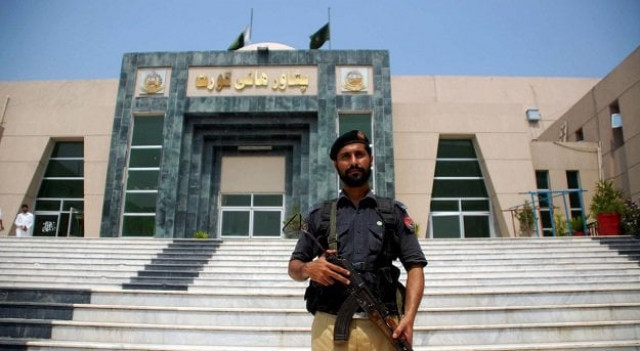
In a landmark decision with far-reaching implications for institutional independence, the Peshawar High Court (PHC) has declared the Khyber-Pakhtunkhwa Police (Amendment) Act, 2024, unconstitutional, striking down key provisions that curtailed the police force's operational autonomy and subjected senior appointments to political approval.
A division bench comprising Chief Justice SM Atiq Shah and Justice Muhammad Ijaz Khan issued the detailed 28-page judgment while hearing a writ petition filed by Barrister Muhammad Yousaf Khan. The court invalidated amendments to the Khyber-Pakhtunkhwa Police Act, 2017, which had made postings and transfers of Grade-18 and higher officers contingent on the Chief Minister's approval and stripped the Inspector General of Police of authority to appoint field officers.
The bench held that these changes effectively dismantled the professional independence of the police, turning it into an instrument subservient to political interests rather than the rule of law. "Bringing the police under political influence is not only contrary to the spirit of the Constitution but also poses a grave threat to citizens' fundamental rights," the judgment stated.
The court emphasized that under Pakistan's constitutional framework, the executive's role is limited to "superintendence" over the police, encompassing general policy and oversight, rather than interference in day-to-day administration, transfers, postings, or field command. Such meddling, the judges ruled, undermines the command structure and conditions officers' careers on political loyalty.
Drawing on constitutional principles, the bench invoked Articles 9 (right to life), 10-A (fair trial), and 25 (equality before law), warning that politically controlled field commanders jeopardize these protections. The court applied the "reading down" doctrine to confine the Chief Minister's directive powers strictly to policy matters, prohibiting their extension to individual decisions or personnel matters.
Referencing the well-known Blackburn principles on police constitutional status, the judgment affirmed that law enforcement responsibility lies with the police chief, who is accountable only to the law, not to any political authority. "An apolitical, empowered, and autonomous police force is not merely an administrative convenience but a constitutional necessity," the court declared.
Legal experts hailed the ruling as a milestone in police reforms in Khyber-Pakhtunkhwa and a strong precedent nationwide for institutional autonomy, constitutional supremacy, and safeguarding fundamental rights. The amendments, passed in October 2024 after cabinet approval and assembly adoption in a diluted form, had sparked criticism for eroding police impartiality and effectiveness.
The decision comes amid broader debates on executive overreach in provincial governance. No immediate response from the Khyber-Pakhtunkhwa government was available, but the ruling restores the pre-amendment status quo, reinforcing the IGP's authority over operational command.














This material may not be published, broadcast, rewritten, redistributed or derived from. Unless otherwise stated, all content is copyrighted © 2026 The Express Tribune.






COMMENTS
Comments are moderated and generally will be posted if they are on-topic and not abusive.
For more information, please see our Comments FAQ