A masquerade of love and lace
Updated 12 hours ago

A film festival blends creative competition with geopolitical advocacy
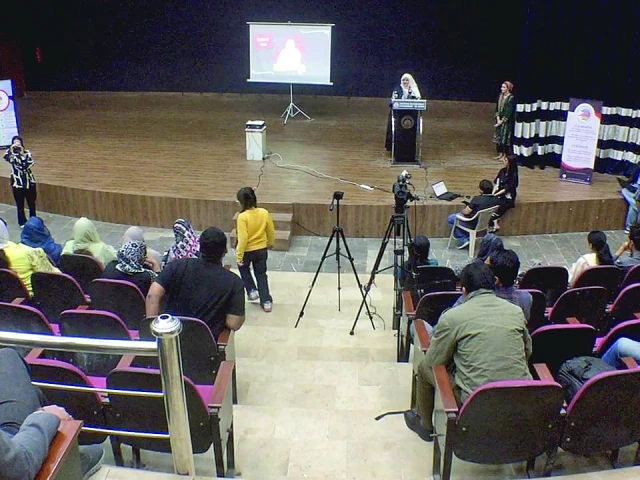
In an auditorium where the hum of projectors replaced the typical buzz of smartphone notifications, a different kind of digital native took centre stage.
The Gen Z Short Film, Documentary and Animated Video Challenge 2026, held at the Liaquat Memorial Library, was more than a competition; it was a statement of intent from a generation often dismissed as perpetually online but politically disengaged.
Organised by the Centre for Alternative Perspectives (CAP) in collaboration with government media bodies, the event fused artistic expression with solemn remembrance.
Its first act was dedicated to Kashmir Solidarity Day, framing the subsequent showcase of youth creativity within a context of national consciousness. Over 50 entries — 16 documentaries, 10 short films, and eight animated videos — from universities demonstrated a keen focus on social issues, historical identity, and pressing geopolitical narratives.
"This festival has been organised by Generation X for Generation Z, to provide young people with a positive avenue of expression," said Dr Samreen Bari, Founder and Chairperson of CAP.
She directly challenged the cliche of the distractible youth. "The common perception is that Generation Z wastes time on social media; however, with proper guidance, these same platforms can become tools for education, constructive dialogue and the promotion of meaningful narratives."
Her words underscored the core philosophy of the event: to harness the innate digital fluency of Gen Z for purposeful storytelling. In an age she described as one of "information warfare," where "fabricated narratives can influence global public opinion," Dr Bari argued that equipping young creators with platform and purpose is a national imperative.
This sentiment was echoed by Irum Tanveer, representing the Press Information Department. While reaffirming Pakistan's stance on Kashmir, she drew a direct line between the event's medium and its message.
"Kashmir is not merely a territorial dispute but a story of generational struggle that needs to be presented effectively before the international community," she stated. "Filmmaking is a powerful medium for shaping narratives."
The submitted works proved the point. Beyond Kashmir-themed documentaries highlighting human rights violations and historical pieces like one on the Chaukhandi graveyard, the films tackled a spectrum of themes — identity, justice, and contemporary social issues.
Participants described the creations as "impactful," reflecting the generation's "intellectual maturity and social awareness."
For Syed Huzaifa, another speaker, the value lay in the process itself. He urged young people to "speak the truth, raise questions and promote dialogue instead of mere competition."
This shift from competition to conversation was embodied in the festival's structure, which blended ceremonial addresses with curated screenings and host-led discussions.
The event also highlighted an evolving synergy between state institutions and independent think tanks. Dr Sundas Basharat Ahmed, CAP General Secretary, noted that over 1,400 students across Pakistan are affiliated with CAP, illustrating a grassroots network for "informed dialogue and meaningful youth engagement."
Irum Tanveer called this collaboration between government, academia, and think tanks "the need of the hour."
As the final credits rolled, the message was clear: Pakistan's Gen Z is actively reframing its role from passive consumer to active author. They are leveraging the visual language of their time not for escapism, but for engagement — transforming digital platforms from spaces of scrolling into studios of substance.
The festival, in blending the solemnity of Kashmir Day with the vibrant energy of a creator's challenge, successfully argued that the nation's future narratives are being written, shot, and edited by its youngest citizens.









This material may not be published, broadcast, rewritten, redistributed or derived from. Unless otherwise stated, all content is copyrighted © 2026 The Express Tribune.



COMMENTS
Comments are moderated and generally will be posted if they are on-topic and not abusive.
For more information, please see our Comments FAQ