Pakistan clears $3.45b loan to UAE after final $1b payment: SBP
Updated 1 hour ago

No more concessions, on or off the field
In February 1987, Pakistan's cricket team was touring India amid one of the most serious military stand-offs between the two countries. Under the pretext of the "Brasstacks" military exercises, India had amassed tens of thousands of troops along Pakistan's borders, a move Islamabad viewed as a direct threat.
Against this backdrop, President General Zia-ul-Haq's aircraft made a surprise landing in New Delhi on February 21. Officially, the military ruler claimed he was in India to watch a Test match between Pakistan and India in Jaipur.
The statement, "cricket is for peace," was meant for public consumption. Privately, however, Gen Zia conveyed a far more serious message to Indian Prime Minister Rajiv Gandhi: any military misadventure risked escalation, possibly even nuclear confrontation.
The visit worked. Border tensions eased, and both sides agreed to a phased withdrawal of troops.
Two decades later, cricket again played a quiet but important role in defusing hostility. Following the 1999 Kargil conflict, Pakistan and India resumed bilateral cricket despite fierce opposition from Indian hardliners. Between 2004 and 2007 - the most sustained peace process the two countries have experienced - reciprocal cricket tours were treated as key confidence-building measures between the nuclear-armed neighbours.
In 2011, Indian Prime Minister Manmohan Singh invited his Pakistani counterpart Yousaf Raza Gillani to Mohali to watch the World Cup semi-final between the arch-rivals. The match was merely the backdrop; the real objective was to restart dialogue stalled after the November 2008 Mumbai attacks.
Fast forward to the present. Pakistan's decision not to play the high-voltage T20 World Cup match against India on February 15 in Colombo marks a historic low in bilateral relations. For decades, cricket served as a diplomatic safety valve - a rare channel of engagement when formal dialogue was frozen. That window now appears firmly shut.
Discussions with relevant officials suggest the decision was driven by a convergence of factors. The immediate trigger, officials say, was the International Cricket Council's decision - widely seen as influenced by the BCCI - to remove Bangladesh from the T20 World Cup. Dhaka had refused to travel to India citing legitimate security concerns and requested its matches be relocated to Sri Lanka, a co-host.
Instead, the matter was put to a vote at the ICC Board, where Bangladesh was expelled by a 142 margin and replaced with Scotland.
Pakistan openly questioned the decision, calling out the glaring double standards. But officials insist this was only part of a larger pattern.
Since Prime Minister Narendra Modi came to power in 2014, Pakistan believes there has been a deliberate effort to marginalise it, including through sport. In 2023, despite tense relations, Pakistan travelled to India for the 50-over World Cup, hoping New Delhi would reciprocate by visiting Pakistan for the 2025 Champions Trophy.
India refused, citing security concerns, despite Pakistan's offer of presidential-level security.
With the BCCI's influence over the ICC, there was little chance India would face consequences similar to Bangladesh. Pakistan was ultimately forced into a hybrid model, allowing India to play its Champions Trophy matches at neutral venues.
The trend continued. After last May's four-day military escalation, the two teams met during the Asia Cup.
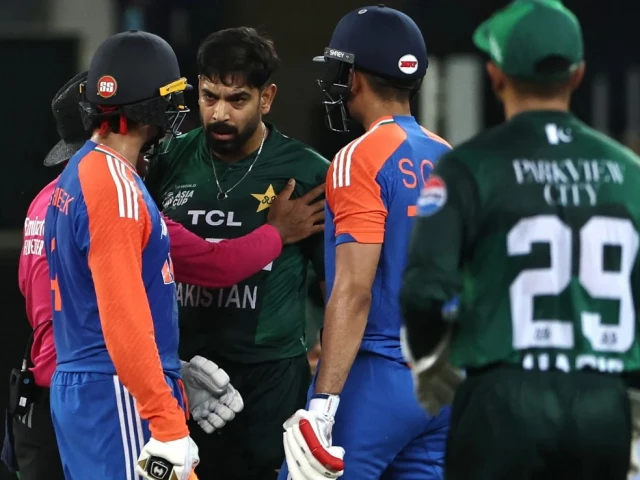
Acting on instructions from their government, Indian players refused to shake hands with their Pakistani counterparts. Later, after winning the tournament, Indian officials declined to receive the trophy from Mohsin Naqvi, the president of the Asian Cricket Council.
It was this accumulation of events that finally compelled Pakistan to abandon its long-held position of keeping sport separate from politics. For years, Islamabad maintained cricketing ties in the hope of preserving a semblance of normalcy. That approach is now seen as untenable.
"As for cricket diplomacy, I always considered the very notion delusional," said Abdul Basit, former Pakistan ambassador to India. He described bilateral relations as stuck in a "seemingly intractable gridlock."
"The primary onus lies on India," Basit told The Express Tribune, "which refuses to engage in meaningful dialogue, particularly on the Jammu and Kashmir dispute."
For Pakistan, the message is clear: if cricket once served as a bridge, that bridge has now collapsed under the weight of politics - and only India is to blame for this.









This material may not be published, broadcast, rewritten, redistributed or derived from. Unless otherwise stated, all content is copyrighted © 2026 The Express Tribune.







COMMENTS (2)
Comments are moderated and generally will be posted if they are on-topic and not abusive.
For more information, please see our Comments FAQ