Pakistan key to Iran-US talks, says Vali Nasr
Updated 1 hour ago

Bias undermines justice, says SC judge
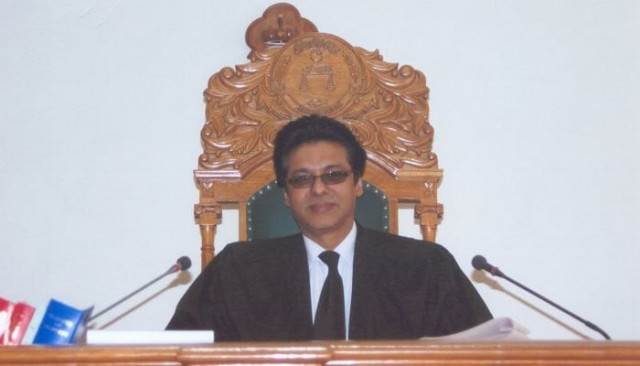
In an additional note on the presidential reference regarding the execution of former prime minister Zulfikar Ali Bhutto, Supreme Court Justice Muhammad Ali Mazhar mentioned that Bhutto’s trial failed to meet the standards of a fair trial guaranteed under Articles 4 and 9 of the Constitution.
The Supreme Court had earlier delivered its advisory opinion on the Bhutto reference on March 6, 2024.
In his detailed additional note, Justice Mazhar observed that the trial proceedings against Zulfikar Ali Bhutto lacked transparency and did not comply with the legally prescribed procedure.
Justice Mazhar maintained that it was difficult to comprehend why the Bhutto reference remained pending for such a long period. He noted that the Supreme Court issued its opinion on the reference after a delay of 13 years, remarking, “It is better to late than never.” However, he reiterated that the trial did not meet constitutional standards of fairness.
According to the additional note, Bhutto was sentenced to death primarily on the basis of the testimony of a single approver, a decision that Justice Mazhar described as contrary to the fundamental principles of law and justice. He further wrote that the record showed personal bias and a preconceived mindset on the part of the judges, which undermined the foundation of a fair verdict.
Justice Mazhar pointed out that a case previously closed by the police was reopened during the martial law era without any lawful justification. He added that the decision to transfer the case from the sessions court to the high court was made hastily, without issuing notices to the accused and without fulfilling legal requirements.
The judge also noted that Bhutto had expressed a lack of confidence in the head of the trial bench, and that failure to address the concern violated the principles of justice. He emphasised that the Supreme Court’s advisory jurisdiction carries significant legal weight for all state institutions.
Justice Mazhar observed that harsh language and sarcastic remarks used during the trial adversely affected judicial dignity and impartiality. He wrote that judicial bias rendered the judges incapable of delivering an independent and fair decision in such a critical case.
Raising a fundamental question, Justice Mazhar asked why the Supreme Court framed a question related to the principle of repentance. He questioned who was expected to repent for an unfair and biased trial — whether it was the deceased judges who heard the case in the high court, the judges who heard the appeal and review petitions, the bench that framed the question, or the judges who issued opinions years after the reference was filed.
He wrote that while the opinion does not explicitly express remorse, it does reflect a degree of regret and acknowledges a failure to ensure a fair trial and due process. Justice Mazhar noted that no final determination has yet been made on Question No. 4 of the presidential reference.
In a powerful reflection on judicial integrity and the meaning of impartial justice, Supreme Court judge Muhammad Ali Mazhar observed that where there was an actual probability of bias, a judge must step aside, not as an admission of prejudice, but to protect public confidence in the justice system.
The 24-page opinion revisited the historic verdict through the lens of due process, natural justice and institutional credibility, while stressing that even the appearance of bias can corrode the foundations of justice.
"When there is an actual probability of bias, the judge ought to recuse themselves, not because they are necessarily biased or incapable of dispensing justice impartially, but because the circumstances might engender a certain restlessness or fear of bias influencing the outcome of a case in the mind of others," the opinion stated.
In March 2024, a nine-member larger bench led by then Chief Justice of Pakistan Qazi Faez Isa, while answering a presidential reference, unanimously ruled that Zulfiqar Ali Bhutto did not receive a fair trial or due process.
Justice Mazhar noted that Bhutto was awarded the maximum sentence solely on the testimony of an approver, without any concrete incriminating or corroborative or circumstantial evidence.
"The bench's approach was unique and, even without considering any mitigating circumstances, appeared predetermined or prejudiced to impose the maximum punishment in a highly dubious case."














This material may not be published, broadcast, rewritten, redistributed or derived from. Unless otherwise stated, all content is copyrighted © 2026 The Express Tribune.







COMMENTS
Comments are moderated and generally will be posted if they are on-topic and not abusive.
For more information, please see our Comments FAQ