Azerbaijan ready to supply LNG to Pakistan
Updated 5 hours ago

Vendors struggle for permits, police contradict ministers
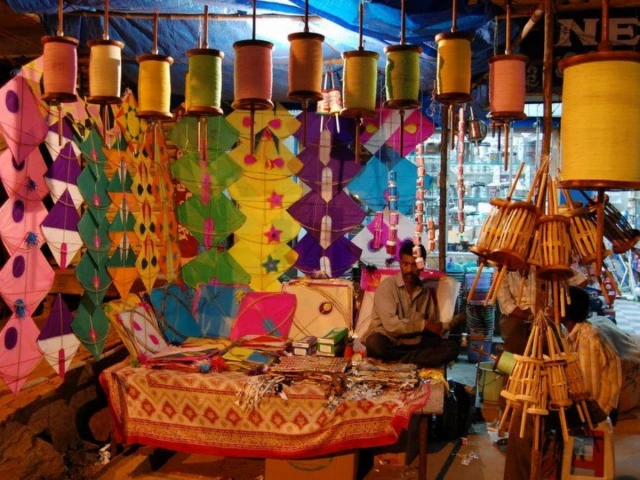
As the city counts down to Basant, the sky may soon fill with colour, but on the ground, shortages of kites and string, delays in vendor permits and mixed official signals are converging into a controversy that threatens to define the festival's return more than the celebration itself.
Concerns have emerged over a potential shortage of kite-flying supplies, which could dampen Basant festivities. Sources said the supply of kites, spools and strings remains limited, while the online permit system for licensed vendors has yet to become operational.
Despite the administration allowing the import of kite-flying equipment from other cities, license holders are reportedly facing difficulties due to delays in the issuance of online permits.
Industry representatives have warned that further delays could lead to price hikes and reduced festivities. The Kite Flying Association has urged the administration to immediately activate the permit system, warning that Basant celebrations could lose their charm if supplies are not made available on time.
Meanwhile, the Punjab government has refuted claims of banning any songs for Basant, clarifying that the ban applies only to stage performances, as the event that was supposed to bring good publicity for the government continues to sink into controversy.
A day after a notification regarding a ban on 132 songs, including a song associated with PTI, went viral, the government clarified that the notification issued on January 23 by the Punjab Art Council had nothing to do with Basant.
Information Minister Azma Bokhari, speaking at a press conference in Lahore, said that the ban on songs during stage drama performances had no connection with Basant and applied strictly to stage performances involving dance, aimed at maintaining ethics and quality.
She added that regulated Basant guidelines focus on public safety, with full registration and monitoring of kites, strings and manufacturers, strict size controls and price regulation.
Strangely, senior police officials of the city, even after the press conference, claimed when contacted that those playing songs from the banned list would instantly be booked under Section 188.
Later, when these officials were informed of Azma Bokhari's clarification, they requested anonymity, saying the minister was the ultimate authority in the matter and asked that their earlier position be disregarded.
Information Minister Azma Bokhari was requested to respond to this apparent confusion, but she chose not to respond.
The event that was supposed to bring good publicity for the government has thus far only sunk deeper into controversy.
From stringent safety measures and registration compulsions that have driven the prices of kite string manifold, to banning citizens from using kite colours to express their political affiliation, to exorbitant fines for violation — everything has made a lack of proper planning and a disconnect with common citizens increasingly evident.
Implementation of Basant regulations has also remained a pressing issue, as authorities privately concede that it is next to impossible to determine from which rooftop a kite is being flown.
A government official from a concerned department, who requested that even his department remain off the record, said there was no conceivable way to zero in on the violating roof.
He added that it was now for the district government to frame rules so that police did not use the regulations as a license to act on their own whims.
A sitting PML-N parliamentarian also expressed apprehension about reviving what he called a deadly festival, particularly by restricting it only to Lahore. He questioned why other cities and towns were being deprived of the festival and said this would leave a bad taste among people in other major cities of the province.
However, a former federal minister, though also against Basant, said the event was quintessentially Lahore-centric, and therefore, celebrating it only in Lahore made sense.
He added that the festival would effectively belong to the rich, given the high cost of kites, strings and participation. He said he hoped and prayed that Basant would not claim lives and maintained that it should not have been revived.
Former caretaker chief minister Hasan Askari Rizvi said holding the event only in Lahore, while it remained banned elsewhere, would have a negative impact on people in other cities, calling its application discriminatory and unlikely to benefit the PML-N government in any way.
He said banning party colours was not unconstitutional but an administrative decision afforded to the government, adding that, given the current court situation, the option of legal recourse was not even available.
Information Minister Azma Bokhari was again contacted for comment on the growing controversy surrounding Basant, but she was not available.
Meanwhile, the tightly regulated and government-sponsored revival of Basant is fast becoming a test of the Punjab administration's ability to manage safety, politics and public expectations, as the Lahore district administration issued a strict 12-point code of conduct for the three-day kite-flying festival.
The development came after directives from Punjab Chief Minister Maryam Nawaz for the festival scheduled from February 6 to 8.
Emphasising public safety and zero tolerance, the deputy commissioner Lahore announced that the code of conduct would be enforced across the city, including all rooftops and premises, to ensure compliance with the Kite Flying Act, 2025, and other safety regulations.
District administration, police and relevant departments have been instructed to strictly implement the guidelines, with officials authorised to inspect rooftops and impose immediate bans on kite flying at unsafe sites.
Under the code, the use, sale or display of metallic, chemical, glass-coated, nylon or otherwise hazardous kite strings has been strictly prohibited, while aerial firing and the use of loud sound systems causing public disturbance have also been banned.
Authorities have also made it mandatory to install safety rods on all motorcycles in Lahore to protect riders from dangerous kite strings.
Kite flying near airports and sensitive installations will not be allowed under any circumstances. Property owners have been directed to ensure adequate safety arrangements on rooftops and will be held personally responsible for any accident or loss occurring during the festival.
The sale and purchase of kites and related accessories will be permitted only from February 1 to 8 and exclusively through vendors registered with the deputy commissioner's Office. Purchasing supplies from unauthorised sellers will result in strict legal action.
Earlier, CM Maryam Nawaz said all departments were actively working to make the government-sponsored Basant Festival safe and well-organised.
Chairing a review meeting, she said a comprehensive traffic management plan had been finalised, under which Lahore would be divided into multiple zones, and motorcycles would not be allowed to enter the Red Zone without a security wire.
Free transport plan
Meanwhile, the Punjab government has also finalised a comprehensive free transport plan for the Basant celebrations. The Lahore division commissioner approved the plan, under which citizens will be able to travel free of cost on Metro Bus services and the Orange Line Metro Train throughout the festival.
According to officials, free transport will be available on 24 routes across Lahore, with 228 buses operating on feeder routes, 64 Metro Bus vehicles, 54 buses from government colleges and 73 buses from universities.
The Orange Line Metro Train is expected to carry around 250,000 passengers daily, while Metro Bus and feeder routes will collectively facilitate over 340,000 commuters per day. In addition, 5,000 branded private rickshaws will also provide free transport services.








This material may not be published, broadcast, rewritten, redistributed or derived from. Unless otherwise stated, all content is copyrighted © 2026 The Express Tribune.




COMMENTS
Comments are moderated and generally will be posted if they are on-topic and not abusive.
For more information, please see our Comments FAQ