Endangered vultures rebound in Punjab habitats
Updated 1 hour ago

Justice (retd) Syed Mansoor Ali Shah announces starting legal practice amid praise, criticism
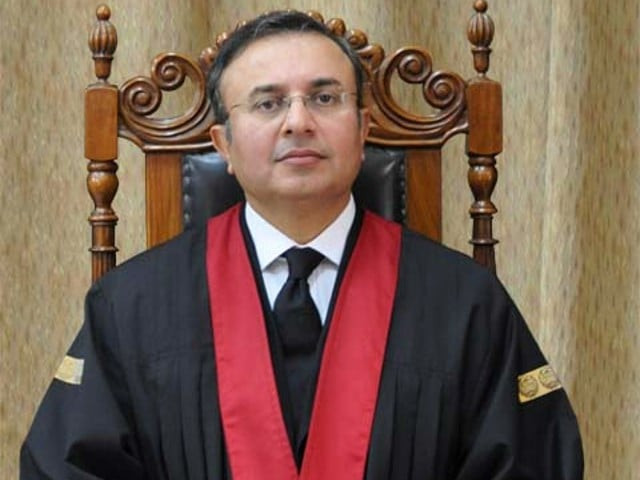
Former Supreme Court judge Syed Mansoor Ali Shah has formally announced the start of his legal practice, with a focus on international and domestic arbitration, mediation, and strategic legal consultancy, alongside continued engagement in teaching.
According to his LinkedIn profile, Justice Shah resigned from the Supreme Court of Pakistan on November 13, 2025, on a matter of constitutional principle, in fidelity to the Constitution and the rule of law.
"My resignation reflects a commitment to independent decision-making, institutional integrity, and constitutional supremacyvalues that continue to guide my work as an arbitrator, mediator, adviser, and academic," the profile statement reads.
In his resignation letter, Justice Shah observed that continuing to serve in a court deprived of its constitutional jurisdiction would amount to acquiescence in a constitutional wrong, and that stepping aside was the only honest and effective way of honouring his judicial oath.
His decision, he wrote, was a principled act to uphold constitutional supremacy and preserve judicial independence.
His profile further states that Justice Shah was in line to assume office as the 45th Chief Justice of Pakistan, but was excluded through the controversial 26th Constitutional Amendment, which altered the seniority structure of the Supreme Court. The constitutionality of that amendment remains under judicial challenge.
It is also mentioned that Justice Shah is currently serving as a Distinguished Professor of Practice at LUMS, with upcoming teaching roles at Yale Law School (2026) and as Bok Professor at the University of Pennsylvania Carey Law School (2027).
"I am available for appointment as an arbitrator and mediator, and remain committed to the rule of law, constitutionalism, integrity, and transparency," the statement adds.
During his tenure on the Supreme Court, Justice Shah authored over 450 reported judgments and decided more than 5,000 cases, significantly shaping commercial, constitutional, and rights-based jurisprudence.
Alongside his judicial work, he emerged as a leading voice on arbitration, mediation, judicial innovation, and the principled use of technology and artificial intelligence in legal systems.
Over more than sixteen years on the bench, Justice Shah delivered several landmark judgments.
As chief justice of the Lahore High Court, he initiated reforms in the district judiciary and openly questioned frequent lawyers' strikes.
Following a clash with one section of lawyers, the then chief justice recommended his elevation to the Supreme Court.
His relationship with then chief justice Mian Saqib Nisar was not cordial. He had also raised objections to the exclusion of Justice Qazi Faez Isa from a Supreme Court bench without his consent at the Peshawar Registry.
During the tenure of former chief justice Asif Saeed Khosa, Justice Shah was a signatory to the judgment holding that the treason trial of former military ruler Pervez Musharraf could proceed without recording his statement under Section 342 of the CrPC.
Justice Shah was also among the judges who secured Justice Qazi Faez Isa's continuation in office, quashing the presidential reference seeking his removal during the PTI rule.
He was also part of the bench that overturned the ruling on lifetime disqualification of lawmakers under Article 62(1)(f) of the Constitution.
Justice Shah further authored the majority opinion holding that the PTI was entitled to reserved seats following the February 8, 2024 general elections, a decision that displeased the present regime.
Although in line to become chief justice of Pakistan, he was superseded through the 26th Constitutional Amendment.
Despite this, he continued to serve as the senior puisne judge of the Supreme Court but was excluded from constitutional benches. He continued to raise his voice for judicial independence after the amendment.
Following the passage of the 27th Constitutional Amendment, Justice Shah opted to resign. After his resignation, he did not address bar associations.
Lawyers have expressed divergent views on his decision to begin legal practice.
Newly elected Pakistan Bar Council member Barrister Salahuddin Ahmed said that after his resignation, Justice Shah was free to pursue any professional path he chose.
"But what a misfortune that a man whose legal wisdom is sought by top American Ivy League institutions such as Yale and the University of Pennsylvania should be lost to our judicial system due to political expediency and the avarice of some colleagues," he added.
However, another section of lawyers believes that Justice Shah should have demonstrated resistance for judicial independence through engagement with bar associations.
At the same time, there is a sharp division within the legal fraternity. One faction of lawyers, led by the Independent Group, fully supports the 26th and 27th Constitutional Amendments, under which the Federal Constitutional Court (FCC) was created.
Former additional attorney general Tariq Mahmood Khokhar, commenting on Justice Shah's decision, said that the ascendancy of the state over the nation had been catastrophic.
"Our democratic order is defunct; the constitutional order has collapsed with it. In times such as these, to exchange constitutional guardianship for remunerated consultancy is to mistake skill for purpose. Teaching and arbitration, however noble, in isolation, cannot substitute resistance to tyranny," he said.
Khokhar added that the rule of law and democracy are not shaped from the bench alone.
"This is not the time to choose quiet comfort over a civic contest. Silence by the learned is never neutral; it emboldens the tyrant. "Judicial office creates a residue of obligation that survives retirement. Justice Shah's moral and intellectual stature makes him best equipped to help recover what has been lost again and again," he said.












This material may not be published, broadcast, rewritten, redistributed or derived from. Unless otherwise stated, all content is copyrighted © 2026 The Express Tribune.



COMMENTS (8)
Comments are moderated and generally will be posted if they are on-topic and not abusive.
For more information, please see our Comments FAQ