Tehran ready to reach ‘balanced' deal that guarantees lasting regional peace: President
Updated 2 hours ago

US tariffs, strained ties and regional instability may test Modi government’s balancing act
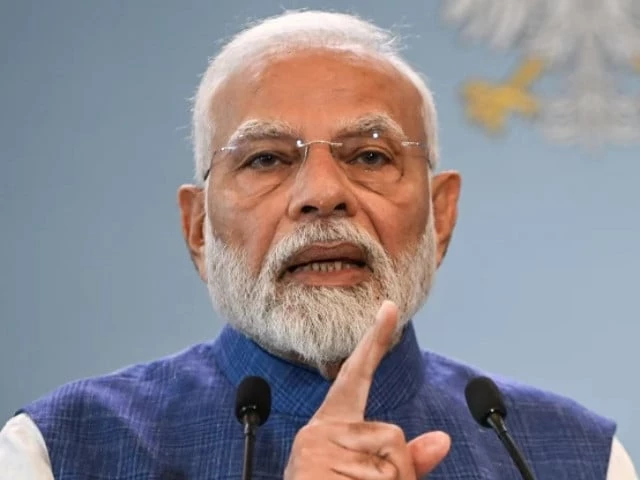
India is likely to face a year in which the lines between foreign policy, domestic politics and the economy become increasingly blurred, making it harder for Prime Minister Narendra Modi’s government to offset diplomatic setbacks with domestic successes, according to an analysis by Chatham House.
The report said 2025 was anging foreign policy year, marked by a four-day conflict with Pakistan in May and a surguably India’s most challebsequent downturn in relations with the United States.
The Trump administration imposed 50% tariffs on India over its purchase of Russian crude and the failure to conclude a trade deal by an agreed deadline. Adding to New Delhi’s concerns, Washington also stepped up its outreach to Islamabad.
India also faced instability in its neighbourhood, including so-called Gen Z protests in Nepal and a deterioration in relations with Bangladesh after former prime minister Sheikh Hasina was removed from power and fled to India in 2024.
According to the Chatham House article, the Modi government sought to play down these setbacks by highlighting domestic achievements, including electoral wins for the Bharatiya Janata Party in state polls, economic reforms such as changes to the goods and services tax and new labour codes, and free trade agreements with the United Kingdom, Oman and New Zealand.
Read: India's double game with US
Despite the impact of US tariffs, India remained the world’s fastest-growing major economy in 2025, posting growth of 8.2% between July and September, supported by its large domestic market.
However, the report said the latest growth data came before the full force of US tariffs took effect, warning that the longer they remain in place, the more sustained their impact on the economy is likely to be in 2026.
Washington is also considering additional sanctions on countries doing business with Russia, a move that could further affect India’s economy. Analysts said this could have political consequences, as India is due to hold elections in four states and one Union Territory in 2026.
The Modi government is hoping trade diversion and new agreements will ease some of the pressure, with a key focus on concluding a long-pending trade deal with the European Union, India’s largest trade partner. Negotiations, however, have been on and off since 2007, and a deadline to finalise the deal by the end of last year was missed. Both sides are now aiming to make progress ahead of European Commission President Ursula von der Leyen’s visit to India later this month.
India is also set to host a series of high-profile summits in 2026, including the AI Impact Summit in February, the BRICS summit and possibly the Quad summit, which was postponed last year amid strained India-US relations.
Several world leaders are expected to visit India. Following Russian President Vladimir Putin’s visit in December, Ursula von der Leyen and European Council President António Costa will be chief guests at India’s Republic Day parade later this month. Chinese President Xi Jinping may also attend the BRICS summit, while US President Donald Trump could visit if the Quad summit goes ahead and bilateral differences are resolved.
Read More: Bangladesh-India ties hit new low
While New Delhi is likely to present these developments as proof of its multi-aligned foreign policy, the Chatham House analysis said cracks are emerging in India’s long-standing commitment to strategic autonomy.
India’s exclusion from the inaugural summit of the Trump administration’s Pax Silica initiative in December was cited as a key signal. Although India has often been portrayed as a beneficiary of efforts to diversify supply chains away from China, its absence from a major initiative on critical and emerging technologies suggested a weakening of that narrative.
The report said India is increasingly being seen as a secondary player in some advanced technology sectors. While US tech giants such as Google, Amazon and Microsoft have announced investments in India, much of this has focused on data centres rather than advanced manufacturing.
India’s ambitions in semiconductor manufacturing also face constraints. While Modi announced last year that India would produce its first domestically made chips, these are expected to be less advanced, trailing-edge chips. Analysts pointed to shortages of water and electricity as key challenges.
The report said India’s careful balancing act was also evident in its muted response to global crises, including the US attack on Venezuela. Among BRICS members, India issued only a brief statement expressing “deep concern”, while focusing on the safety of Indian nationals.
Similar restraint has been seen in New Delhi’s responses to conflicts in Gaza and Ukraine, reflecting a desire to maintain relations with Israel, Russia and the United States.
Read Also: India and the United States
As a result, Indian foreign policy often appears aloof, the report said, noting a gap between its stated support for a rules-based international order and its reluctance to speak out forcefully during major crises.
In 2026, India will seek to bolster its Global South credentials during its BRICS chairmanship by promoting a non-Western, but not overtly anti-Western, worldview. This may involve softening contentious proposals such as de-dollarisation by reframing them as efforts to settle trade in national currencies.
Closer to home, India will aim to reset ties with Nepal and Bangladesh after elections in both countries early next year. Relations with Pakistan, however, are expected to remain fragile.
While both sides have shown restraint in recent months, analysts warned that hyper-nationalist rhetoric, the risk posed by non-state armed groups and the possibility of another high-profile attack mean the danger of accidental escalation will remain high in 2026.





This material may not be published, broadcast, rewritten, redistributed or derived from. Unless otherwise stated, all content is copyrighted © 2026 The Express Tribune.




COMMENTS (4)
Comments are moderated and generally will be posted if they are on-topic and not abusive.
For more information, please see our Comments FAQ