
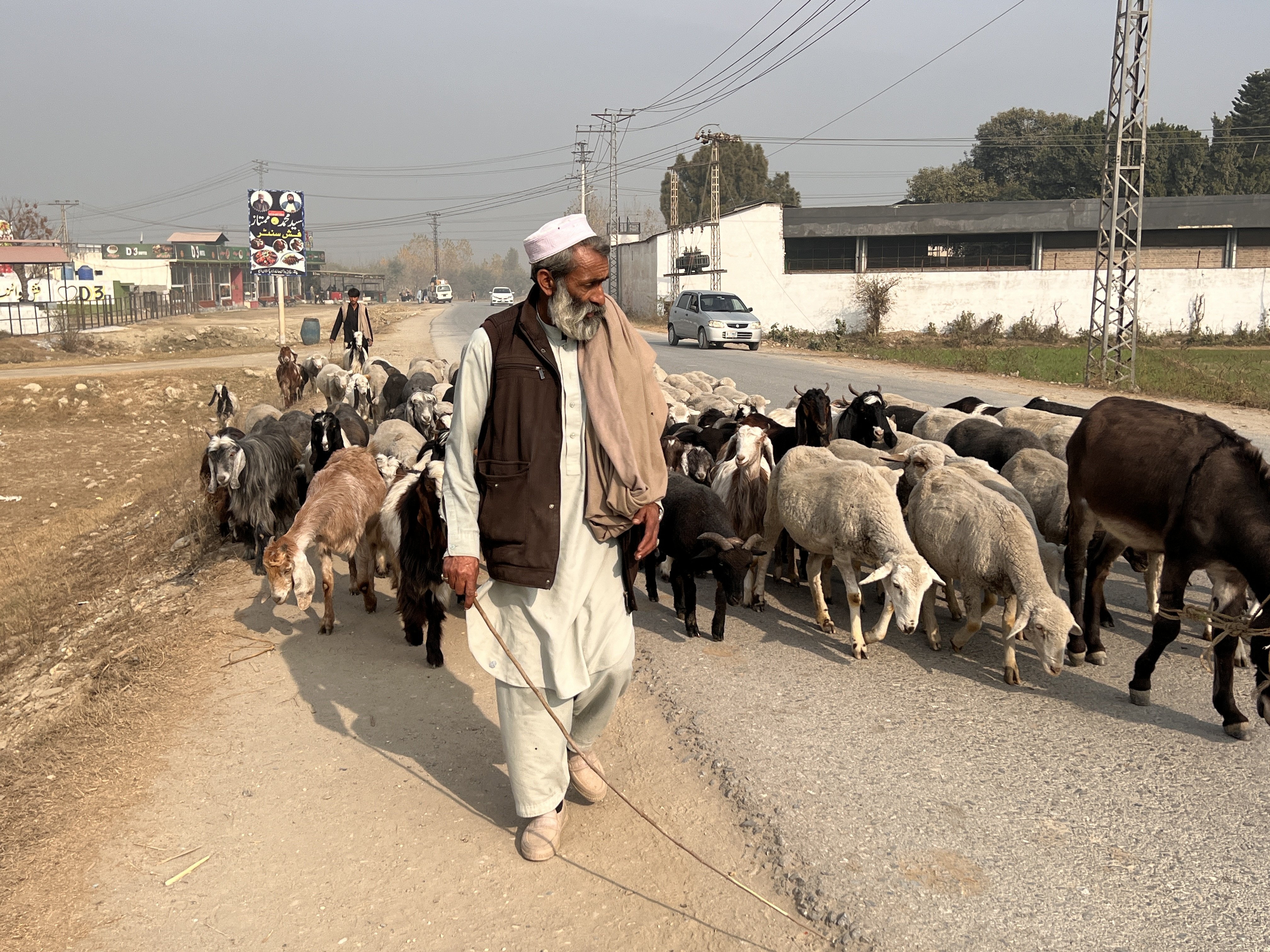
Bakhtawar Khan, 35, a member of a Gujjar family, migrated with his family from Usharay Valley in Upper Dir to the Takht Bhai area of Mardan district in search of grazing land for their flock of sheep.
Speaking to The Express Tribune, he explained that it was because of heavy snowfall in winter and harsh weather conditions that many Gujjar families having herds migrate from mountainous areas including Dir, Swat, Kohistan, and from other hilly areas to lower districts in search of food, water and grazing land.
“In mountainous area, we can hardly spend more than three to four months each year because of snowfall and chilly weather,” he says. “We migrate to Mardan, Charsadda, Nowshera, Peshawar and other parts of the province where we can easily find pasture and grazing land for herds in winter season.”
Those who already had contacts in the lowland districts were able to arrange shelter, while most were not allowed to stay on the properties of the local community. As a result, families with women and children had to live in tents in cold weather, while searching for suitable places.
“Sometimes sheep and goats are stolen by local thieves,” Bakhtawar adds, as he highlights their issues. “So protecting them is also a challenge for us. Our children cannot continue their education due to migration that is why most of boys and girls of the tribe are illiterate. Women and girls who travel with us on foot also face serious health and social problems. Local people often showed strange and disrespectful behaviour toward us and these problems have forced many members of the Gujjar tribe to sell their herds and adopt other professions or start odd jobs in nearby areas and cities.”
Bakhtawar also pointed out that they also face issues related to pasture and grazing in these areas. He added that local farmers often vacate their fields earlier than agreed time, even when the cultivated land was rented for a specific period.
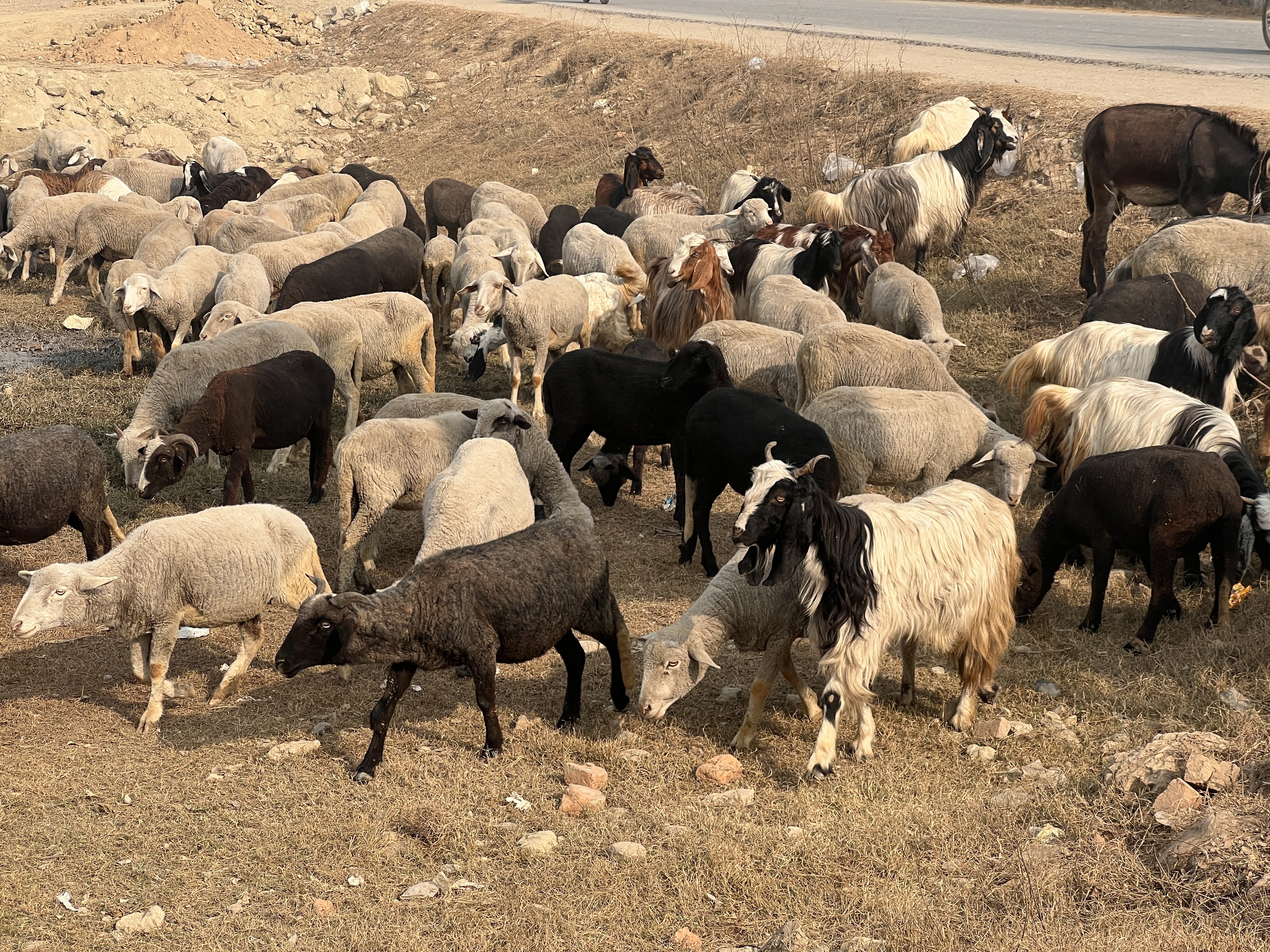
Sheep and their wool are their only source of income now as the weather has changed because of climate change and global warming. For this reason, the price of wool has gone down, and traders now buy it for less price than they did previously.
Experts revealed that although transhumance and pasture nomads sometimes create problems such as overgrazing, social conflicts, and deforestation, but they also contribute to the economy through healthy meat, dairy products, wool, and the sale of young disease-free animals, that provide meat rich in micronutrients, and low in fat.
Pastoralist nomads and transhumance move to cold regions from April to the end of June, stay on the higher plateaus from the end of June to late September, and remain in the lowland plains from December to the end of March.
According to environmental experts, there are an estimated 30 to 40 million nomads in the world in which almost 10 percent are living in Pakistan and Afghanistan.
Sahib Jan, 55, told The Express Tribune that he, along with his family and flock, had moved a few weeks ago from Matta Tehsil in Swat district. “Due to snowfall in our area, we do not have grass for our animals, which is why we migrate to the plains every year,” says Sahib. In recent years, the months of November and December have been dry, causing grazing issues here as well.”
He mentioned that the prices of grazing lands have also increased. “Fields that we used to rent for Rs 15,000 for three to four months are now being charged at Rs 45,000 by local farmers in the plains,” explains Sahib. “Transportation costs and other rents have also risen, which has multiplied our problems.”
Muhammad Fahim, deputy director at the Pakistan Meteorological Department in Peshawar revealed that winter rainfall patterns have changed. “Rain usually fell from November to February, but in the past five years there has been little or no rain in November and December,” he explained. “These rains have shifted to January, February, and March. The 30-year average December rainfall in the Chitral area is 25.8mm, but over the past five years, a maximum of only 5.1mm has been recorded. In Dera Ismail Khan, the long term average December rainfall is 4.3mm, yet the last five years have been almost dry.”
According to him, in Peshawar, the 30-year average December rainfall is 17mm, while only 8mm was recorded in December 2022, and the Decembers of 2023, 2024, and 2025 were nearly dry. This shows that rainfall has not only shifted away from December but its quantity has also significantly decreased.
About the adverse impacts of climate change and global warming, Fahim said that the phenomenon has also disrupted snowfall patterns and quantities in the hilly areas of the province.
“In the past, the first snowfall usually began in November and gradually increased, but now snow is rarely seen in villages even in December, with most of it limited to the mountain peaks,” he elaborates.
Although the life of transhumance and nomads is extremely difficult, yet for some reason, it has appeared highly attractive to sedentary people, especially poets. Their seasonal movement from one area to another in search of pasture for their animals and a suitable environment is portrayed in a number of Pashto songs. For instance:
Ma ye tamasha kara, khafa kege mori sala, Kada da kuchyanu wa pa lara teredala
[Don't be annoyed with me mother, it was the luggage of the nomads in the way that I was spectating] Da ghara lamana ke shponkia, shapilai ghagawa
[Oh shepherd! Play on your flute in the foot of the mountain]
Talking to The Express Tribune, Professor Muhammad Nafees, a faculty member of the department of Environmental Sciences at the University of Peshawar, said that Pakistan in general and Khyber Pakhtunkhwa (KP) in particular faces serious threats from climate change. Since the province has both plain and hilly areas, its vulnerability to climate-related threats is higher. “Though mountains add to its beauty, glaciers, streams, and rivers in these areas increase the risk of climate change events, particularly floods,” he says.
To mitigate the intensity of heatwaves and flash floods, he recommends expanding forest cover and reducing greenhouse gas emissions and solid waste —both of which contribute to soil, air, and water pollution, as well as the accumulation of GHGs.
“Climate change is affecting our water reservoirs and reducing underground water levels, so we must reduce water misuse in daily life,” he adds. “This way, we can conserve water for future generations. Currently, we are mainly dependent on river water, so we need to shift to rainwater harvesting and preserve it instead of letting it flow into the oceans.”
About the provincial climate change policy, he commented that the policy is better than those of other provinces, but some areas still need improvement.
“The climate change policy must be designed in a way that highlights business activities, and mitigation measures should be based on those activities,” says the professor. “In the current KP climate change policy, there is no income generation programme or project for local communities,” he highlighted.
Regarding the representation of transhumance and pastoral nomads in KP’s climate change policy and action plan, Professor Nafees said that their core issues were not included in the policy formulated by the KP government.
“Transportation facilities for transhumance and pastoral nomads,” he said. “This must be accompanied by respectful conduct from law enforcement, a forest policy flexible to their needs, the resolution of health and education challenges, adequate animal health services, and the establishment of designated markets for wool and livestock — all of which should be embedded in the climate change policy and action plan. The climate change policy must address transhumance and pastoral nomads.”
Afsar Khan, deputy director at the Environmental Protection Agency (EPA) KP, emphasised that the province is highly vulnerable because it has 10 of the 11 ecosystems found across the globe, all of which are negatively affected by the abnormal impacts of climate change.
“The environment has changed and for better crop yields and food production, farmers need to seek advice from agricultural extension officials for adopting climate resilient seeds,” he says. “Under the provincial policy, the EPA had conducted 41 awareness workshops over the past two years and green climate clubs had also been established at the school level to promote environmental awareness among youth. A total of 417 projects have been launched since 2017, with Rs 675 billion allocated so far, of which more than Rs 3 billion has been spent.”
“The provincial climate change policy includes clause and recommendations addressing transhumance related issues as well,” says Afsar.
Almost every year, climate change induced impacts directly affect KP in the form of heat waves, glacial lake outbursts, and floods, causing both human and financial losses to local communities.
According to a report compiled by the Provincial Disaster Management Authority (PDMA) KP, from August 15 to November 2025, heavy rains and flash floods claimed the lives of 430 people, including 175 women and 115 children. A total of 127 people was injured, 5,492 cattle perished, 625 houses fully destroyed and 2109 were partially damaged.
As climate change reshapes weather patterns across KP, transhumance and pastoral nomads find themselves on the front lines of an unfolding crisis. Shifting rainfall, harsher winters, rising costs, and shrinking grazing lands are steadily eroding a way of life that has sustained generations. While experts acknowledge the ecological and economic contributions of nomadic communities, their needs remain largely absent from policy frameworks, highlighting the urgent need for inclusive, climate-responsive planning that recognises mobility not as a problem, but as a form of resilience.
Abdur Razzaq is a Peshawar-based multimedia journalist. He tweets @TheAbdurRazzaq
All facts and information are the sole responsibility of the writer