“One year on, India failed to present evidence on Pahalgam attack', says Tarar
Updated 1 hour ago

Nasir Bagh parking plaza plan has ignited clashes between officials and conservationists
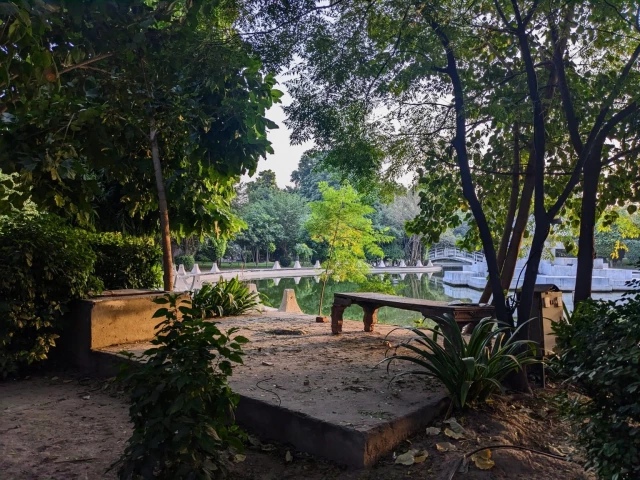
At a time when Lahore ranks among the world’s most polluted cities and public health is at a serious risk, the underground parking project at Nasir Bagh has been temporarily halted following objections from civil society and environmental activists.
Imrana Tiwana, President of the Lahore Conservation Society, criticized the project on the grounds that it was against basic environmental and urban planning principles. “In a city where residents are forced to breathe toxic air, sustainable solutions for parking and transport have become imperative. There are hundreds of alternative locations in the city where parking plazas can be built, therefore sacrificing a park for a parking plaza is unnecessary and unacceptable.” said Tiwana.
In light of the backlash, work on the Nasir Bagh project has been stopped due to various legal and environmental objections, as ordered by the Lahore High Court. Justice Shahid Karim emphasized that environmental laws must be followed before any development at public or historic sites. Karim instructed the relevant departments to present all legal requirements, environmental impact assessments, and details regarding tree protection to the court. Until these requirements are fulfilled, the project cannot proceed.
Before the Nasir Bagh project began, National Engineering Services Pakistan (NESPAK) prepared a feasibility report listing 123 trees, including neem, peepal, bohar, sheesham, safeda, and date palms, that would be safely relocated within Nasir Bagh. Similarly, during the 2015 Jail Road conservation and beautification project, hundreds of trees were affected. Progress on the electric tram project along the Lahore Canal has also been delayed because hundreds of trees would have to be cut.
Dr Obaidullah Nadeem, Chairperson of the Department of City and Regional Planning at the University of Engineering and Technology Lahore, informed that environmental impact assessments were essential before starting development projects in major cities. “In the short term, at least four new trees should be planted for every tree cut, while in the long term, designated areas should be planted with trees well in advance. The LDA has prepared Lahore’s master plan until 2050, and trees should be planted in areas where projects are planned 5–10 years in the future,” urged Dr Nadeem.
Meanwhile, Traffic Engineering and Transport Planning Agency (TEPA) Project Director Hammad Ul Hassan stated that no trees could be cut during any development project, which was a clear policy. The Parks and Horticulture Authority (PHA) does not permit it, nor does the Environment Protection Agency issue a No Objection Certificate (NOC) for such actions. Hassan explained that in Nasir Bagh, no trees would be cut; they would be safely relocated, and an additional thousand saplings will be planted.
“When a project reaches the court, judicial instructions are strictly followed. Meetings have also been held with the Lahore Bachao Tehreek and the Conservation Society to hear their concerns. Halting projects due to court orders increases costs, sometimes by as much as 50 per cent. For example, the Akbar Chowk flyover project, initially estimated at Rs4 billion, rose to Rs11 billion after temporary work stoppage and design changes following court instructions,” claimed Hassan.
On the other hand, Dr Nadeem emphasized the importance of consulting local communities, citizens, and environmental experts. “Projects should comply with municipal regulations and environmental laws.
Long-term urban planning must include green spaces, shade, water supply, and environmentally sustainable solutions. In historic and metropolitan cities, environmental, legal, and community considerations must be incorporated from the start to ensure that both development and environmental protection are achieved,” concluded Dr Nadeem.










This material may not be published, broadcast, rewritten, redistributed or derived from. Unless otherwise stated, all content is copyrighted © 2026 The Express Tribune.



COMMENTS
Comments are moderated and generally will be posted if they are on-topic and not abusive.
For more information, please see our Comments FAQ