Ishaq Dar, Egyptian FM discuss regional developments in call
Updated 2 hours ago

Petition to be filed in LHC over suspended province's land law remarks
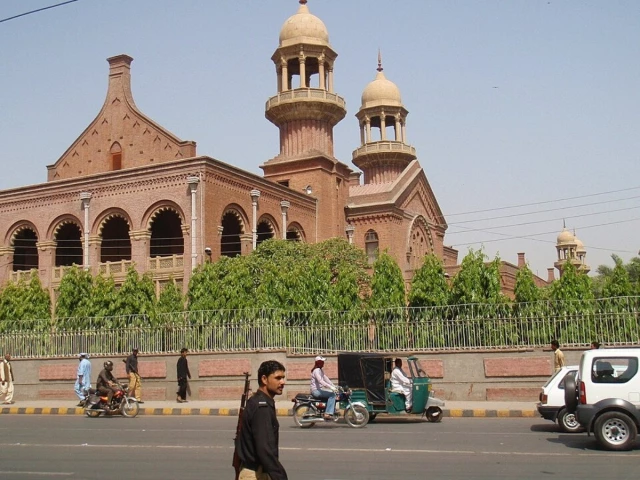
With the prospect of a contempt of court petition hanging over the Punjab government after its recent outburst against the Lahore High Court (LHC) earlier this week, cooler heads appeared to prevail, as the administration softened its tone and expressed a willingness to work with the court to address any shortcomings in the law.
Punjab Information Minister Azma Bukhari said the government would not hold the courts responsible for the controversy, suggesting that its position may not have been adequately presented during proceedings.
"We would not blame the courts. Maybe it was a shortcoming on our end that we failed to explain our position to the court in the proper manner," she said during an interview with a private television channel.
Earlier this week, following the suspension of the Punjab Protection of Ownership of Immovable Property Act, 2025, Punjab Chief Minister Maryam Nawaz had publicly criticised the court's decision, saying it ran contrary to settled principles laid down by the superior judiciary.
She had also alleged that the ruling would benefit the encroachment mafia and be perceived by the public as support for land grabbers.
The remarks, made despite the case having been referred to a larger bench by the LHC chief justice, drew sharp reactions from the legal fraternity. Lawyers objected both to the tone adopted by the government and to the ordinance itself, arguing that it encroached upon the judiciary's domain.
Explaining the government's position, Azma Bukhari said land grabbing and property disputes were long-standing problems in Punjab, disproportionately affecting widows, women and underprivileged segments of society. She said the newly enacted law, which has been passed by the provincial assembly, was intended to curb illegal occupation of property.
She said land-related cases often dragged on in courts for generations, imposing a heavy burden on victims. Responding to criticism of the chief minister's remarks, she said there was no intention to undermine the dignity or sanctity of the courts. "We have nothing but respect for the courts," she said.
The information minister said the chief minister had taken a strong position on the ruling, noting that once a decision is issued, it becomes public property and is open to criticism. She maintained that the retrospective restoration of possession in some cases, following the court's order, had emboldened encroachment mafias.
However, she reiterated that the government would not attribute blame to the judiciary, adding that the issue may have stemmed from the government's failure to properly apprise the court of its stance. She said the Punjab government would contest the matter before the larger bench.
Bukhari said the government was prepared to work with the court to address any technical flaws in the law, while emphasising that the authority to legislate rested with the provincial assembly. She added that judges had taken an oath to work for the betterment and well-being of the common people.
'Scandalising court'
On the other hand, a contempt of court petition is expected to be filed on Friday against the chief minister and the provincial information minister, accusing them of undermining judicial authority through public criticism of an interim LHC order suspending the Punjab Protection of Ownership of Immovable Property Ordinance, 2025.
The draft petition, shared with The Express Tribune by advocate Azhar Sadique, invokes Article 204 of the Constitution read with Sections 3 and 5 of the Contempt of Court Ordinance, 2003. It argues that statements issued by the two senior provincial office-holders amount to "scandalising the court" and eroding public confidence in the judiciary while the matter remains sub judice.
The petition contends that the remarks were attacking, disparaging and undermining an interim judicial order passed by the chief justice of the high court on December 22, 2025, in a writ petition, while the political office-holders chose to publicly assail, mischaracterise and discredit the said judicial order, including by asserting that the suspension of the law will "benefit land mafias/encroachment mafias".
The controversy stems from an order passed on December 22, 2025, by the LHC CJ in a writ petition, Mumtaz Hussain versus Government of Punjab. The court suspended the operation of the newly promulgated ordinance and directed restoration of the status quo ante with respect to properties affected by proceedings initiated under the law.
During the proceedings, the court observed that executive-constituted Dispute Resolution Committees had exceeded their statutory mandate by restoring or granting possession of land - powers that, under the ordinance, were vested in a tribunal that had yet to be constituted.
Citing the involvement of valuable property rights under Articles 23 and 24 of the Constitution, the CJ referred the matter to a full bench for a comprehensive examination of the law's vires.
Following the order, the chief minister issued public statements asserting that the suspension of the ordinance would "benefit land mafias and encroachers" and that the court's intervention was "not in accordance with the principles laid down by the superior judiciary".
She further stated that the decision would harm the poor, widows and oppressed segments of society and frustrate efforts to curb long-standing land disputes.
Azma also spoke to the media, indicating that "options" were under consideration in response to the court's order in remarks which the petitioner contends diminished the binding and authoritative nature of a subsisting judicial directive.
According to the draft petition, these statements were widely disseminated through print, electronic and digital media, and were framed in a manner that portrayed the court's interim order as morally suspect, legally unsound and effectively aligned with criminal land-grabbing interests.
The petitioner maintains that such commentary crosses the permissible limits of fair criticism and enters the realm of criminal contempt.
The petition argues that while a robust critique of judicial decisions may be permissible if advanced in temperate language and through appropriate legal forums, no public office-holder is entitled to publicly attribute partisan motives or institutional complicity to a constitutional court, particularly when the matter is pending adjudication before a larger bench.


















This material may not be published, broadcast, rewritten, redistributed or derived from. Unless otherwise stated, all content is copyrighted © 2026 The Express Tribune.






COMMENTS (3)
Comments are moderated and generally will be posted if they are on-topic and not abusive.
For more information, please see our Comments FAQ