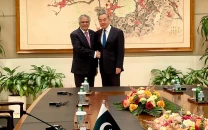
China's FM Wang Yi reiterates appreciation for Pakistan’s constructive role amid US-Iran talks in meeting with Dar
Updated 4 hours ago

Relations between Punjab judiciary, govt have been exemplary during term of CJ Aalia Neelum

After the suspension of the Punjab Protection of Ownership of Immovable Property Act 2025 by the Lahore High Court (LHC), and the subsequent reaction of Chief Minister Maryam Nawaz, speculation has begun over whether winds of change are starting to blow through the Punjab judiciary.
Some experts believe that so far the judiciary in Punjab has been "very accommodating" toward the Punjab government during the tenure of incumbent Chief Justice Aalia Nelum.
The Punjab government and powerful circles were visibly upset with former LHC chief justice Malik Shahzad Ahmad Khan regarding his handling of appointments in the Anti-Terrorism Courts (ATCs), election tribunal nominations, and case allocations.
Even representatives from the bar were expressing dissatisfaction with Shahzad's decision.
Upon assuming his role, then CJ Khan had swiftly marked cases with political implications, assigning them to particular judges within the high court. These moves often resulted in outcomes unfavourable to the executive branch.
Notably, the PTI also received relief in several cases, particularly those pertaining to election disputes.
Furthermore, then CJ Khan nominated five additional LHC judges to preside over election tribunals. Tension also persisted between the LHC chief justice and executive authorities regarding the appointment of five judges to ATCs in Punjab.
Meanwhile, the executive, with the support of then chief justice of Pakistan Qazi Faez Isa, succeeded in elevating Khan to the Supreme Court in June last year.
Later, the Judicial Commission of Pakistan (JCP) suggested the appointment of Justice Aalia Nelum as the LHC chief justice. Justice Aalia was third in seniority among high court judges at that time.
PTI lawmakers disagreed with her appointment on the grounds of ignoring the principle of seniority during a meeting of the Parliamentary Committee on Judges' Appointments.
Unlike her predecessor's tenure, the relationship between the provincial government and the Punjab judiciary has remained very cordial.
First, issues related to the appointment of election tribunals were resolved in line with the wishes of the Election Commission of Pakistan (ECP) and executive authorities. The PML-N had been visibly upset over the nomination of judges for election tribunals by then CJ Malik Shahzad Ahmad Khan.
Secondly, Justice Aalia Nelum also transferred the ATC judges who were not in the good books of the executive but had been appointed by her predecessor.
Subsequently, dozens of PTI leaders and workers were convicted by ATCs in May 9 cases. Their appeals against convictions are still pending. Even their sentences were not suspended, and the majority of them remain behind bars.
Once when judicial members of the JCP suggested the elevation of Justice Aalia Nelum to the apex court during a meeting, members associated with the government vetoed the suggestion because the executive authorities were comfortable with her presence at the LHC.
Even the Punjab Assembly did not pass a resolution for the establishment of constitutional benches in the LHC. The executive authorities have so far been expressing satisfaction over the allocation of important cases before certain benches for hearing.
It is a fact that the PTI has so far failed to secure any kind of substantive relief during the tenure of Justice Aalia Nelum.
On the other hand, despite hue and cry over the activities of the Crime Control Department (CCD) in the province, the LHC has not passed any adverse order on the issue. Similarly, unlike in the past, provincial authorities did not face a tough time on issues related to maladministration and bad governance.
However, a controversy has now started after the LHC chief justice's Monday order suspending the Punjab Protection of Ownership of Immovable Property Act 2025.
Subsequently, CM Punjab Maryam Nawaz reacted to the LHC order by stating that the court's decision was not in line with the principles laid down by the higher judiciary.
Meanwhile, a social media campaign has also been launched against LHC CJ Aalia Nelum. However, the legal community is fully backing Justice Nelum. Even the Independent Group, which is known as pro-government, is also defending the LHC chief justice's interim order.
It is to be noted that the JCP is likely to meet in the second week of January to consider the confirmation of additional judges of the LHC.
Confirmation of these additional judges is very crucial for active members of the Independent Group. Likewise, the relationship between the Independent Group and the Punjab judiciary is also very cordial.
Even representatives of the superior bar belonging to the Independent Group have appreciated the performance of CJ Nelum on different occasions.
Some experts said powerful circles are fully aware of the importance of the Punjab judiciary in the context of the PTI. They said their role is still essential in this matter. "There is a need to know where powerful circles stand in the prevailing situation," said a lawyer.
If all executive authorities and the Independent Group are on the same page, then they have various options to manage the situation by elevating the LHC chief justice to the SC or by establishing constitutional benches in the LHC.
It is expected that some executive functionaries, especially Minister for Law Azam Nazeer Tarar, will play a role in ending the tension between the provincial government and the Punjab judiciary.












This material may not be published, broadcast, rewritten, redistributed or derived from. Unless otherwise stated, all content is copyrighted © 2026 The Express Tribune.






COMMENTS
Comments are moderated and generally will be posted if they are on-topic and not abusive.
For more information, please see our Comments FAQ