Hill Park row erupts as MQM-P accuses authorities of land grabbing; mayor denies claim
Updated 48 minutes ago

Dogar-led bench declares LLB degree 'invalid'; President approves de-notification on PM's advice
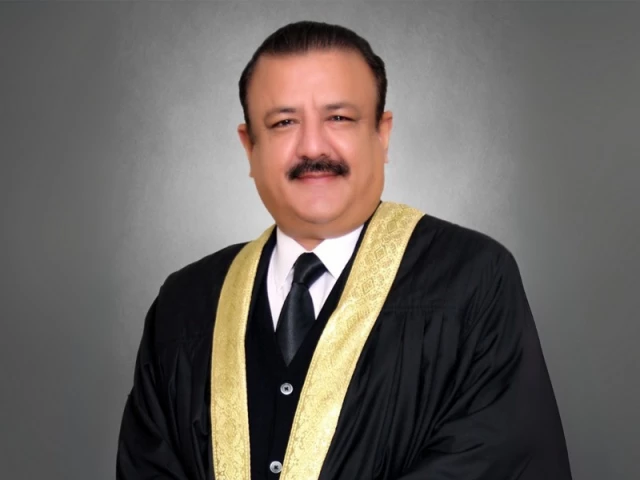
The Islamabad High Court on Thursday set a precedent by removing one of its own judges, namely Tariq Mehmood Jahangiri, on the charge of holding invalid LLB degree.
A division bench led by Chief Justice Sardar Muhammad Sarfraz Dogar and comprising Justice Muhammad Azam Khan issued a three-page short order on a plea that challenged the legitimacy of Justice Jahangiri's law degree and his appointment as a judge.
The order issued after hearing quo warranto petition filed by Mian Daud advocate against Jahangiri, whose five-year tenure as a judge is going to end on December 31, said that at the time of Jahangiri's appointment as an additional judge of the IHC, "as well as at the time of his confirmation as a judge of the Islamabad High Court, he was not holding a valid LLB degree, which is a prerequisite for enrolment as an advocate".
"When he could not be considered as an advocate then, consequently, he was not eligible for elevation as a judge of a high court in terms of the requirements of Article 175-A of the Constitution. Thus, he seized to hold the office of judge of the Islamabad High Court forthwith," the order added.
The court directed that the copy of this order be sent to the law ministry to de-notify him as the judge of this court."
The court also rejected all objections on the bench as well as the manner in which quo warranto proceedings went in the case. Senior lawyer Akram Sheikh and Barrister Salahuddin Ahmed appeared on behalf of Jahangiri.
Sheikh raised strong objections on CJ Dogar to hear the matter. Likewise, Barrister Salahuddin Ahmed wondered as how the IHC could proceed into the matter in the presence of stay on the Karachi University's proceedings in Tariq Jahangiri's case by the Sindh High Court.
The court said that objections raised by the IHC Registrar Office are sustained for the reasons to be recorded in detailed judgment.
The IHC order further noted that they gave ample opportunity to Jahangiri to submit his reply along with disputed education credentials but he failed to do so for the reasons best known to him. "As such, this court has left with no other option but to proceed further in the matter," reads the order.
It added that the qualification to hold the office of a judge of a high court is personal to the individual and has no nexus with the performance of duties as a court or as a member of the court. The qualifications for appointment of judges of the Superior Courts are duly provided in the Constitution.
"Possession of the qualifications prescribed under the Constitution is sine qua non for an individual to hold the office of a judge of a Superior Court."
Meanwhile, in a late night development, President Asif Ali Zardari approved the de-notification of Justice Tariq Mehmood Jahangiri as a judge of the Islamabad High Court, on the advice of the prime minister.
The de-notification has been issued in compliance with the decision of the Islamabad High Court, which declared his appointment as a judge to be illegal and ordered him to vacate office.
Barrister Salahuddin Ahmed who was appearing on behalf of Jahangiri, while commenting on order, said that a judge who dared to complain against being pressured by the government and intelligence agencies to decide cases in a particular manner; from whose bedroom a secret video camera/transmitter was discovered - has been successfully removed without any investigation into his complaints.
"After the 26th and 27th amendments, we have entered a new phase of judicial activism; where judges are used to conduct witch-hunts against fellow judges and remove them from office on flimsy grounds, through blatantly unlawful proceedings and without concern for even the most basic norms of fair trial and impartiality. However, this "activism" is conducted under direction of outsiders and only against judges who dare to resist external influence," he adds.
Barrister Salahuddin Ahmed also lamented that it is a day of shame for all judges who have, through complicity or through acquiescence, facilitated the destruction of the judicial institution.
Barrister Asad Rahim Khan says that this is a shameful episode in our judicial history, and it is still unfolding. Justice Jahangiri's persecution has nothing to do with his law degree, and everything to do with the fact that he would try and do justice to a stolen election.
"The charges against Iftikhar Chaudhry and Qazi Faez Isa were far more substantive andin particularstemmed from misconduct while in office, yet the principle still won out: that these judges were in the deep state's crosshairs over their judicial orders, and not over the allegations against them. Both were thus lent the benefit of context, and allowed to retain their office," he adds.
Barrister Asad Rahim Khan further states that in Justice Jahangiri's case, however, we see a retrospective fishing expedition. This Dogar Court will meet the same historical verdict the previous Dogar Court did," he adds.
Former additional attorney general Tariq Mahmood Khokhar says that Justice Jahangiri's ouster transcends his personal tragedy: it can be read as a precursor to a deeper judicial purge."
Khokhar states that once a template is established for removing superior court judges through evaluative pretexts, contested authority and procedural haste, the process can be replicated to target other independent judges.
"Over time, such selective actions are bound to systematically alter the composition of the judiciary. A more pliant judiciary will be the unfortunate outcome."
Khokhar also said that the chief justice owes his transfer and appointment to the contested 26th Constitutional Amendment. Jahangiri was one of the Islamabad High Court judges who had challenged his transfer and appointment as chief justice, Islamabad High Court.
Justice Muhammad Azam Khan is an additional judge. His confirmation will be determined by the executive. A clear case of conflict of interest of the two-member bench.
"Our judiciary's long tradition of security of tenure was always vulnerable to the threat from the extra constitutionalists. Now it can also be circumvented by the executive."
At the end, former additional attorney general Khokhar says that to most observers, Jahangiri's impartial scrutiny of the electoral process was the root cause of his ouster.
Jahangiri's nemesis included an executive overreach, lack of due process and a less than fair bench, he adds.














This material may not be published, broadcast, rewritten, redistributed or derived from. Unless otherwise stated, all content is copyrighted © 2026 The Express Tribune.




COMMENTS
Comments are moderated and generally will be posted if they are on-topic and not abusive.
For more information, please see our Comments FAQ