
Landslides kill at least 58 in Bangladesh
Landslides triggered by heavy rain in southeast Bangladesh buried dozens of houses and an army camp on Tuesday.
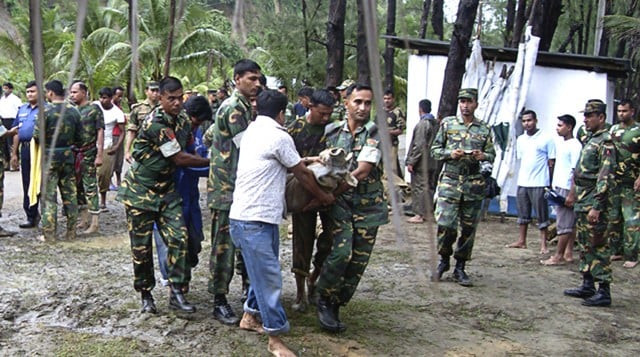
The landslides hit villages in the Cox’s Bazar hill and resort district, where officials said they recorded 25 cm of rainfall in 24 hours to 9 am on Tuesday.
“Among the dead were at least six army soldiers camping on a hillside at Himchhari, and four are missing,” one senior Cox’s Bazar official said. “The death toll may go further up as rescuers are searching for bodies.”
Police officer Mohammad Shahjahan confirmed that they had recovered two bodies of soldiers from mud and that four were still buried. An army barracks at the foot of a hill was destroyed by a landslide, with all the soldiers on duty and at least 20 army vehicles buried in the mud.
Local police chief Nibhas Chandra Majhi said that the rescue effort was progressing slowly as landslides had blocked key roads across the Cox’s Bazaar and Bandarban districts. “We could not start rescue efforts yet as landslides triggered by the rains have clogged up the main highways,” he said, adding that rescue workers expected the death toll to rise as rain continued. A further four people – all members of the same family – were killed by a landslide in the remote Ghumdhum area, in the Bandarban hill district, local police chief Kamrul Ahsan said. Heavy rain was still pounding Cox’s Bazar and nearby districts as well as offshore islands in the Bay of Bengal, officials said. Low-lying areas have been flooded and communications disrupted, witnesses said.
REFUGEES
In the worst affected area of Teknaf – which is on the border with Myanmar and home to hundreds of thousands of ethnic Rohingya refugees – at least 25 people were killed and six were missing, local official A N M Nazim Uddin said. “All the roads are under water. We can’t reach areas where thousands of people are trapped by the floods,” he said by phone.
Around 15,000 Rohingya refugees living in camps – both legal and illegal – around Teknaf have been affected by the floods, Firoz Salauddin, the government’s spokesperson on Rohingya issues, said.
Bangladesh recognises 28,000 Rohingya as registered refugees, who live and receive aid at an official UN camp in Kutupalong. This figure is a fraction of the 200,000 to 300,000 unofficial refugees, according to government estimates. The refugee camps are often set up on newly cleared forest land and are vulnerable to landslides in heavy rain.
“Hundreds of bamboo shacks have been washed away by the rains,” Mojibur Rahman, a Rohingya refugee who lives in an official refugee camp, said.
Conditions are dire in the unofficial camps where people have been without food for two days since the heavy rain began, said Manzural Islam, an unregistered Rohingya refugee.
“Flash floods are the worst thing that could have happened to us,” said Islam, who fled Myanmar’s northern Rakhine state last year. “People are living under the sky and we haven’t had food for two days as we can’t cook in the rain with no shelter,” he said by telephone.
Published in the Express Tribune, June 16th, 2010.
LATEST

Second day of Ukraine-Russia peace talks in Geneva, pressure on Kyiv

No secret nuclear tests by Russia or China, Kremlin says

Indian professor's robot dog claim at AI summit sparks uproar

New Bangladesh PM Tarique Rehman names cabinet after election win

Poland bars Chinese-made cars from military sites over data security fears

Data leak at Abu Dhabi finance summit exposes hundreds of global figures
MOST READ
Rs1500 prize bond draw winners for February 16, 2026 announced

Local gold, silver rates drop after declines in international markets

Political undertones mark CM's varsity visit

Sri Lanka removes Pakistan from negative visa lists after Naqvi meeting

'The cheater has finally been exposed': Sannia Ashfaq fires back at Imad Wasim










COMMENTS
Comments are moderated and generally will be posted if they are on-topic and not abusive.
For more information, please see our Comments FAQ