
Flood damage could have been minimised: Researchers
US researchers say disaster could have been minimised had European weather monitors shared and processed their data.
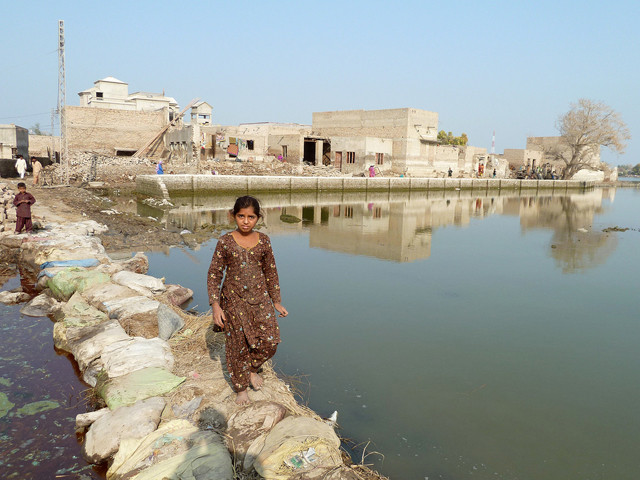
Damage from last year’s disastrous floods could have been minimised if European weather monitors had shared their data, US researchers said on Monday.
The catastrophic monsoon rains that swept through the country in July and August killed thousands, affected 20 million people, destroyed 1.7 million homes and damaged 5.4 million acres of arable land, experts have said.
“This disaster could have been minimised and even the flooding could have been minimised,” said lead author Peter Webster, a professor of earth and atmospheric science at the Georgia Institute of Technology in Atlanta. “If we were working with Pakistan, they would have known eight to 10 days in advance that the floods were coming,” he said.
Using data from the European centre for medium-range weather forecasting (ECMWF), Webster and his colleagues found the floods could have been predicted if the data “had been processed and fed into a hydrological model, which takes terrain into account.”
Webster’s research has been accepted for publication in a future edition of the journal Geophysical Research Letters, the American Geophysical Union (AGU) said in a statement.
However, the London-based ECMWF, which includes 33 participating European countries, defended itself saying it “does not give out weather forecasts and weather warnings to the general public or media.”
“ECMWF provides numerical forecasts to its member and cooperating states and they are responsible to prepare forecasts for the public and advise the authorities in their own countries,” ECMWF scientist Anna Ghelli said.
The AGU said the information did not reach the Pakistani people because of a “lack of a cooperating agreement between the forecasting centre and Pakistan.”
“The major result of the study is that the heavy rainfall pulses throughout July and early August were predictable with a high probability six-eight days in advance,” said an early release version of the paper. “If these forecasts had been available to the regions of northern Pakistan, government institutions and water resource managers could have anticipated rapid filling of dams, releasing water ahead of the deluges. A high probability of flooding could have been anticipated,” it added.
Pakistan’s own meteorological agency also did not forecast the flooding, the AGU said, of the research funded by the National Science Foundation.
Published in The Express Tribune, February 2nd, 2011.




1724319076-0/Untitled-design-(5)1724319076-0-208x130.webp "medical board says imran s vision improving")

MOST READ
Rs1500 prize bond draw winners for February 16, 2026 announced

Local gold, silver rates drop after declines in international markets

Cost of commuting rises as government hikes fuel prices

Europe's wake-up call — and Pakistan

Reregistration of vehicles begins in Punjab










COMMENTS
Comments are moderated and generally will be posted if they are on-topic and not abusive.
For more information, please see our Comments FAQ