
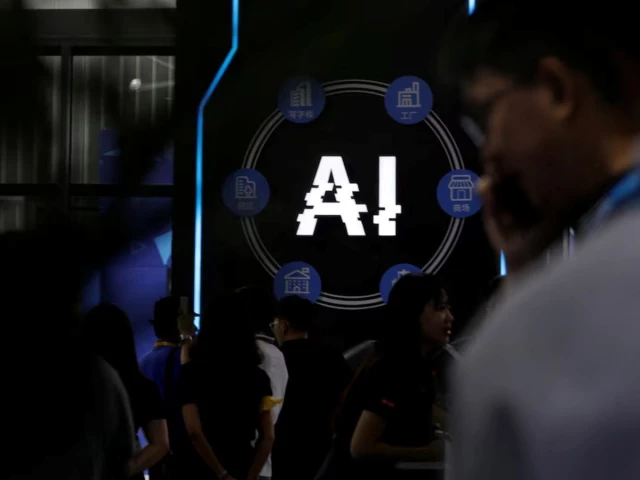
Artificial intelligence is rapidly becoming one of the defining technologies of our time. Yet amid the excitement about algorithms, automation, and intelligent agents, we risk asking the wrong question. The question is not simply, “What will AI be capable of?” The more important question is: “What will we be capable of doing with AI?”
For Pakistan, this distinction matters enormously. We have a young population with ambition, entrepreneurial energy and an appetite for technology. But technology alone will not determine whether Pakistan benefits from the AI revolution. The choices we make now in our schools, universities, businesses, public institutions and individual careers will.
AI is already moving beyond tools that simply generate text, images or summaries towards systems that can support increasingly complex tasks and workflows. AI depends on wider digital foundations, including trusted data, technology infrastructure, governance, skills and people. Pakistan should therefore avoid treating AI as another technology that can simply be purchased. The real opportunity is to build the institutional and human capability to use it effectively.
That requires us to rethink education. Preparing for AI does not mean turning everyone into a programmer or data scientist. We certainly need excellent engineers, researchers, cybersecurity specialists and data professionals, but we also need something more fundamental: curiosity, critical thinking, creativity, communication and judgement. As information becomes easier to generate, knowing which questions to ask, testing assumptions and determining whether an answer can be trusted become increasingly valuable. These human capabilities are central to our future success.
We therefore need to move beyond AI literacy towards thinking literacy. We should not produce a generation that knows how to ask machines for answers but cannot challenge those answers. Students need to learn how to formulate problems, question evidence, recognise bias, communicate ideas and exercise judgement.
Having grown up in Gilgit-Baltistan and subsequently had the opportunity to work internationally across different sectors and institutions, I have seen how profoundly education, technology and mentorship can change an individual’s trajectory. Geography can shape opportunity, but it should not determine destiny. Digital technology and AI offer the possibility of reducing some of those barriers, but access to technology must be accompanied by education, skills and aspiration.
Pakistan should also be more ambitious about its role in the global digital economy. Our goal should not simply be to supply technology labour to other countries. We should develop people capable of identifying problems, creating products, building intellectual property, establishing businesses and competing internationally. AI can give an entrepreneur, researcher or professional access to capabilities that once required significantly larger organisations. But technology amplifies human capability; it does not replace ambition, expertise or leadership.
For our institutions, the priority should be practical: strengthen digital foundations, make AI literacy relevant across disciplines, teach critical thinking alongside technology, create safe environments for experimentation and connect universities more closely with industry and government. Success should not be measured by how many AI projects are launched, but by whether technology improves services, decisions, productivity, and people's lives.
For professionals, my advice is equally straightforward: do not wait for AI to arrive in your profession. Learn to use it responsibly, but invest equally in the qualities that differentiate you: expertise, relationships, leadership, communication and judgement. Instead of asking, “Will AI replace my job?”, ask: “How can AI make me significantly better at my job?”
And to Pakistan’s young people, I would say, learn AI, but do not let AI do your learning. Develop deep expertise in something. Learn to communicate. Remain curious. Question what technology tells you rather than accepting it automatically. Think globally while understanding the needs of your own communities. Your advantage in the future will increasingly come not simply from knowing answers, but from asking better questions and turning knowledge into meaningful action.
Above all, human accountability must remain at the centre. AI proposes, humans decide. Technology may help us analyse, generate and optimise, but people must determine what is appropriate, ethical and valuable.
Pakistan does not need to predict every development in AI before it starts preparing. We can strengthen education, build better digital foundations, connect universities with industry, encourage entrepreneurship and develop responsible approaches to AI today. Most importantly, we can prepare people not merely to use intelligent machines, but to exercise intelligence, judgement and responsibility themselves.
Perhaps the greatest mistake would be to prepare the next generation to compete with machines at what machines increasingly do well. Our ambition should be greater: we do not have to compete with machines at being machines. We can use machines to become better humans.
That is not simply an AI strategy. It is a talent strategy, an education strategy and, ultimately, an economic strategy for Pakistan.




COMMENTS
Comments are moderated and generally will be posted if they are on-topic and not abusive.
For more information, please see our Comments FAQ