
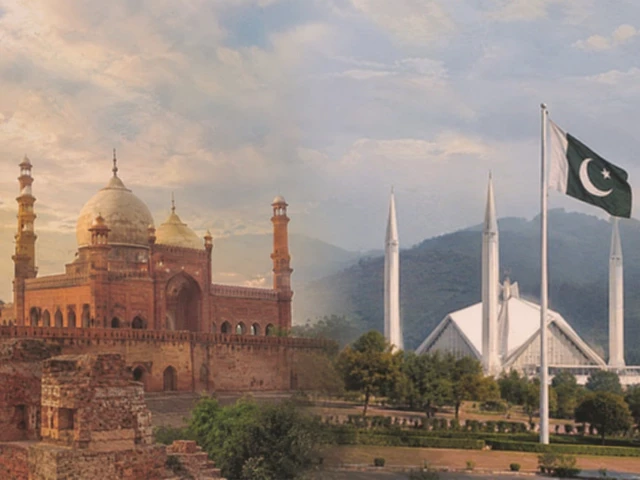
History is not simply a record of dates, battles and the rise and fall of dynasties. It is a mirror through which nations can examine their political choices, institutional strengths and weaknesses, and the consequences of their leadership.
The decline of the Mughal Empire and Pakistan's political journey since independence belong to two fundamentally different historical settings. One was an imperial monarchy dependent on hereditary succession and personal authority; the other is a modern sovereign state founded on constitutional principles and popular representation.
Nevertheless, certain recurring patterns invite comparison, including the concentration of power, privileged ruling elites, political instability, institutional weakness, provincial alienation and the widening gulf between rulers and the governed.
The Mughal Empire — Decline After Greatness
The death of Emperor Aurangzeb in 1707 marked a decisive turning point in Mughal history. Although the empire had reached extraordinary geographical dimensions, its political and administrative foundations were increasingly strained.
The Mughal system depended heavily on the authority and personality of the emperor. Successive struggles for the throne, court intrigues and factional rivalries weakened central authority. Provincial governors and regional powers increasingly asserted their independence, while the empire's military and financial strength deteriorated.
The invasion of Nadir Shah of Persia in 1739 exposed this weakness dramatically. Following the Mughal defeat at Karnal, Delhi suffered devastating violence and plunder. The Peacock Throne and immense treasures were carried away. Although the invasion did not bring Mughal rule to an end, it revealed how vulnerable the once-mighty empire had become.
Meanwhile, the British East India Company was transforming itself from a commercial enterprise into a territorial power. Its victories at Plassey (1757) and Buxar (1764), followed by the acquisition of revenue-collection rights in Bengal, Bihar and Orissa in 1765, laid the foundations of British political supremacy.
By 1803, the British controlled Delhi, and the Mughal emperor had become little more than a symbolic figure. The uprising of 1857 marked the final chapter. Bahadur Shah Zafar, the last Mughal emperor, was exiled to Rangoon following the suppression of the rebellion. In 1858, the British Crown formally brought Mughal rule to an end.
The empire did not collapse because of a single invasion or a weak ruler. Its decline was the cumulative consequence of political fragmentation, administrative decay, financial weakness, military deterioration and the failure of its ruling establishment to adapt to changing circumstances.
Pakistan — A New State, Enduring Political Challenges
Pakistan emerged in 1947 following a historic political struggle, accompanied by extraordinary hopes and sacrifices. However, it inherited immense challenges, including mass migration, administrative disruption, economic difficulties and the responsibility of building institutions almost from scratch.
The deaths of Quaid-e-Azam Muhammad Ali Jinnah in 1948 and Liaquat Ali Khan in 1951 deprived the young state of two of its most important founding leaders. Political instability and delays in constitution-making further complicated its development.
Over time, the balance of power gradually shifted away from representative institutions. In 1958, President Iskander Mirza abrogated the Constitution and imposed martial law, after which General Ayub Khan assumed power. Subsequent periods of military rule under Yahya Khan, Zia-ul-Haq and Pervez Musharraf interrupted constitutional development and weakened democratic continuity.
The separation of East Pakistan in 1971 remains the greatest tragedy in the country's history. It resulted from a complex combination of political exclusion, constitutional failure, economic grievances, the refusal to transfer power following the 1970 election, military action, external intervention and war. Attributing this tragedy to a single individual or institution would be historically simplistic.
The experience demonstrated the devastating consequences of disregarding political representation, provincial aspirations and the democratic mandate.
The Ruling Elite — From the Mughal Court to Modern Political Corridors
One recurring feature of declining political systems is the growing distance between rulers and the people.
During the later Mughal period, the imperial court became increasingly consumed by privilege, factional rivalries and personal interests. The welfare of the empire gradually became secondary to the ambitions of competing groups.
Modern Pakistan is a constitutional state, not an imperial monarchy. Nevertheless, concerns about entrenched political and economic elites remain relevant. Dynastic politics, influential families, patronage networks and unequal access to opportunities have frequently shaped the country's political landscape.
This is not to suggest that every political leader is motivated by personal gain, nor should sincere public service be overlooked. However, a healthy political system requires more than elections and changes of government. It demands accountability, equality before the law and meaningful opportunities for capable citizens.
The fundamental question is whether public office is regarded as a responsibility entrusted by the people or as a privilege to be inherited, protected and exploited.
No nation can progress when power, wealth and influence remain concentrated within a limited circle.
Provincial Autonomy and National Unity
As Mughal central authority weakened, provincial governors and regional powers increasingly asserted their independence. Pakistan's federal structure, however, is fundamentally different: its provinces are constitutionally recognised partners in a sovereign federation, not subordinate territories governed by an emperor.
Nevertheless, provincial autonomy, political representation and the equitable distribution of resources remain essential to national unity.
The separation of East Pakistan serves as an enduring warning that national cohesion cannot be sustained merely through administrative authority or centralised power. A federation is strengthened when its constituent units have a meaningful voice, their rights and resources are respected, and their people are treated as equal partners.
National unity cannot be imposed indefinitely. It must be nurtured through justice, mutual respect, constitutional guarantees and a genuine sense of belonging.
External Powers and Internal Weaknesses
The Mughal Empire did not decline simply because foreign powers were stronger. Its internal weaknesses made external intervention increasingly possible. Nadir Shah and the British East India Company exploited an empire already weakened by political divisions and military deterioration.
The lesson is clear: external pressure becomes particularly dangerous when a state is internally divided, institutionally fragile and politically distracted.
Pakistan, too, operates in a challenging international environment. Its strategic location, security concerns, economic vulnerabilities and relations with major powers influence its political and foreign-policy choices.
External pressures are real, but they should not become convenient explanations for every domestic failure. A strong state is one whose political stability, economic resilience, institutional credibility and national cohesion enable it to withstand external challenges.
The greatest danger arises when internal weaknesses create opportunities for external influence.
Institutions — The Difference Between Existence and Strength
The Mughal Empire depended heavily on the emperor's personal authority. Its political structure failed to develop sufficiently robust institutions capable of ensuring continuity when leadership weakened.
Pakistan, by contrast, possesses a written Constitution, Parliament, judiciary, provincial governments, political parties and permanent civil and military administrations. This represents a fundamental distinction between the two systems.
However, institutions cannot be judged merely by their existence on paper. Their real strength depends on constitutional functioning, independence, public credibility and the ability to operate without undue interference.
Repeated interruptions of constitutional government, institutional imbalances, political confrontation and the inconsistent application of the law have weakened public confidence.
A country cannot build a stable future if its institutions are repeatedly subordinated to personalities or temporary political interests. Governments may change and leaders may come and go, but the Constitution and the rule of law must endure.
Pakistan's progress depends on a balanced constitutional order in which every institution performs its defined role.
The Verdict of History — Who Bears Responsibility?
The decline of the Mughal Empire resulted from interconnected failures, including weak succession arrangements, court rivalries, administrative inefficiency, economic pressures, military decline and external intervention.
Similarly, Pakistan's difficulties cannot honestly be attributed to one government, institution, political party or period of military rule.
Responsibility for national progress is shared, although not equally. Those entrusted with greater power carry greater responsibility. Political leaders must be accountable, institutions must respect constitutional limits, and citizens must demand transparency, justice and responsible government.
A society cannot indefinitely blame its rulers while remaining indifferent to the standards by which they are chosen and held accountable. Equally, citizens cannot bear the entire burden of national failure when institutions entrusted with protecting their rights do not function effectively.
The destiny of a nation is shaped by the integrity of its leadership, the strength of its institutions and the political maturity of its people.
Conclusion
The comparison between the declining Mughal Empire and Pakistan's political journey is not a prediction of doom. It is an invitation to reflection.
Pakistan is a sovereign modern state with a Constitution, an established national identity, functioning institutions and considerable human and material potential. Its circumstances are fundamentally different from those of an 18th- or 19th-century empire. There is no historical inevitability that Pakistan must repeat the fate of the Mughals.
Nevertheless, history offers unmistakable warnings. Political instability, institutional weakness, privileged ruling circles, provincial alienation, economic mismanagement and the absence of accountability can undermine even the most promising state.
The real questions are whether public office serves the people, whether institutions uphold the Constitution, and whether national interests take precedence over individual and group ambitions.
Pakistan needs a political culture in which public office is treated as a trust, not personal property; the law applies equally to the powerful and the powerless; merit takes precedence over patronage; and national resources serve the people rather than the preservation of privilege.
Nations do not perish merely because of external invasions. Sometimes, political self-interest, institutional weakness and collective indifference within their own ranks inflict far greater damage on their future. The Mughal decline should therefore be remembered not merely as the story of a vanished dynasty, but also as a warning against political complacency and institutional failure.
Pakistan's future will not be determined by the grandeur of its past, the rhetoric of its leaders or the power of its ruling classes. It will be determined by the strength of its institutions, the quality of its governance and the willingness of its people to demand a just and accountable state.
Pakistan needs not merely rulers, but genuine architects of the state.
And perhaps the most important question we must ask ourselves is this: Can we learn from the lessons of history and build a state in which power is not anyone's inheritance, the law is not anyone's private property, and Pakistan's resources and authority are not monopolised by any particular class or group?
That is the challenge before us. And that is the responsibility we owe to future generations.




COMMENTS
Comments are moderated and generally will be posted if they are on-topic and not abusive.
For more information, please see our Comments FAQ