
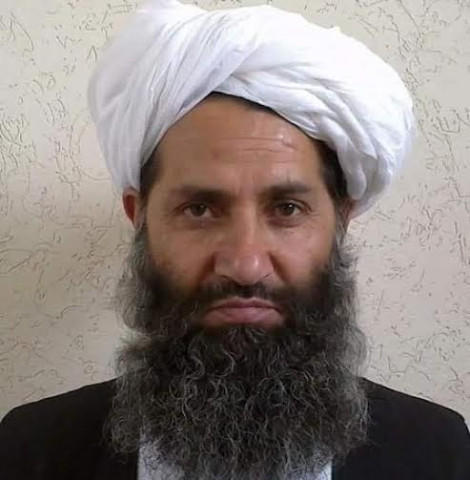
Over the weekend, I had the opportunity to read a rather fascinating work, Da Ahl al-Sunnah wal-Jama’ah Aqeedah, authored by Hibatullah Akhundzada, the supreme leader of the Afghan Taliban. For anyone seeking to understand the ideological and religious foundations underpinning the Afghan Taliban’s worldview, this book offers a valuable insight and deserves to be read alongside other important works, particularly Al-Emarat al-Islamiya wa Nidhamuha by Mawlawi Abdul Hakim Haqqani, the current Chief Justice of Afghanistan.
Yet, beyond its theological and doctrinal arguments, Hibatullah’s book raises some rather consequential questions about the apparent disconnect between the Afghan Taliban’s professed religious principles and their conduct towards the Tehreek-e-Taliban Pakistan (TTP), particularly its persistent campaign of violence against the Pakistani state and society. A closer examination of the book’s central arguments on obedience to the Emir, the prohibition of rebellion, the sanctity of Muslim life, and the imperative of Muslim unity brings into sharper focus the contradictions that merit serious scrutiny.
Before examining these apparent contradictions, however, it is essential to establish the nature of the relationship between the Afghan Taliban and the TTP. The Afghan Taliban leadership has repeatedly denied having any organisational or operational ties with the Pakistani militant group, maintaining that the TTP is an independent entity whose activities are not controlled by Kabul. Nevertheless, this official position sits uneasily with the findings of international organisations, particularly the United Nations, and independent scholars who have documented the close ideological, historical and operational connections between the two groups. Their assessments point not merely to shared ideological convictions but also to a relationship characterised by allegiance, mutual affinity and, according to UN reporting, an environment in Afghanistan that enables the TTP to sustain its campaign against Pakistan.
A United Nations Security Council report released in February 2026 confirmed that Tehreek-e-Taliban Pakistan (TTP) is operating from Afghanistan with significant backing from the Taliban administration in Kabul. The 37th report of the UN Security Council’s Analytical Support and Sanctions Monitoring Team said in explicit terms that Afghanistan’s de facto authorities continued to provide a “permissive environment” for several armed groups, notably TTP.
Further evidence of the close relationship between the two groups emerges from a study by Abdul Sayed and Tore Hamming. The authors note that the TTP was among the first militant organisations to celebrate the Afghan Taliban’s return to power in August 2021. In a statement issued on 17 August 2021, the TTP described the Taliban’s takeover of Kabul as a major victory for the global jihadi project. More significantly, the TTP emir, Mufti Noor Wali Mehsud, publicly renewed his group’s pledge of allegiance to Afghan Taliban supreme leader Hibatullah Akhundzada and reaffirmed its unconditional support for the Afghan Taliban.
Such an expression of allegiance is difficult to reconcile with the portrayal of the TTP as an entirely unrelated militant organisation. At the very least, it demonstrates the ideological affinity and enduring relationship between the two movements, making it all the more pertinent to examine the Afghan Taliban leadership’s religious obligations and responsibilities towards a group that publicly pledges allegiance to its supreme leader.
Returning to the ideological contradictions within the Afghan Taliban’s worldview, two particularly significant themes in Hibatullah Akhundzada’s Da Ahl al-Sunnah wal-Jama’ah Aqeedah warrant closer examination: the religious obligation of obedience to the Emir and the imperative of preserving Muslim unity by avoiding discord and sectarian division. Both principles, which occupy a prominent place in his book, raise important questions about the Afghan Taliban leadership’s position on the TTP’s armed campaign against Pakistan and the religious justifications, if any, it offers for its continued tolerance.
In the book, particularly on pages 132–133, the Afghan Taliban Emir discusses at length the obligation to obey the Emir, drawing upon relevant Islamic traditions and their interpretations to substantiate his argument. Taken together, these passages present obedience to the ruler as a religious obligation. He goes a step further by asserting that disapproval of the ruler’s conduct or disagreement with a particular decision does not, in itself, constitute sufficient grounds for disobedience or the withdrawal of allegiance.
One could argue that by framing obedience to the Emir as a religious duty, Mullah Hibatullah is effectively invoking religion as a means of consolidating his rule. However, this position also exposes him and the group he leads to difficult questions regarding their relationship with the Tehreek-e-Taliban Pakistan (TTP) and their stance towards Pakistan. Some of these pertinent questions are: Does the Afghan Taliban leadership consider the TTP's armed struggle against the Pakistani state justified under its own interpretation of Shariah, particularly when Hibatullah himself emphasises the religious obligation to obey the ruler? If so, what is the jurisprudential basis for reconciling this position with the very principle of obedience that he advocates?
Conversely, if it does not consider the TTP's campaign religiously justified, why has the Afghan Taliban leadership refrained from openly condemning the group or taking decisive measures to prevent it from using Afghan territory to organise and carry out its activities against Pakistan? This apparent contradiction raises questions not only about the consistency of the Afghan Taliban's religious and political positions but also about the extent to which its professed principles of obedience and allegiance are applied in practice.
Another key theme emphasised in Hibatullah’s book is religious unity and the avoidance of discord. In this regard, he cites the Quranic verse (Aal-e-Imran 3:103): “And hold firmly to the rope of Allah all together and do not become divided.” Through this and other religious references, he underscores the importance of Muslim unity, collective cohesion, and the prohibition of sectarian division, presenting the preservation of unity and the avoidance of discord as fundamental religious obligations.
This emphasis, however, raises an important question regarding the Afghan Taliban leadership’s interpretation and practical application of these principles in the context of the TTP’s sustained campaign of violence against Pakistan. If Muslim unity is a religious imperative, does this principle extend to ordinary Pakistani civilians, members of the armed forces, police personnel, and other state institutions, or is its application confined to groups sharing the Afghan Taliban’s ideological and political outlook?
More importantly, does the Afghan Taliban leadership explicitly reject religious narratives that are invoked to legitimise violence against fellow Muslims and portray them as legitimate targets? If it regards such attacks as contrary to the principles of Islamic unity and religiously impermissible, what concrete and verifiable measures has it taken to prevent the TTP from using Afghan territory to plan, facilitate, or carry out attacks against Pakistan?
Reflecting on the above discussion, the Afghan Taliban leadership must answer a fundamental question: are the religious principles articulated by Hibatullah Akhundzada binding obligations or merely doctrines to be invoked when politically convenient? Religious principles cannot be selective, and ideological affinity cannot supersede religious obligations. The true test of Hibatullah’s doctrine, therefore, lies not in what he has written, but in whether he is prepared to uphold it when it comes to the TTP.
Azhar Zeeshan is a researcher at the Centre for Aerospace and Security Studies (CASS), Lahore.




COMMENTS
Comments are moderated and generally will be posted if they are on-topic and not abusive.
For more information, please see our Comments FAQ