
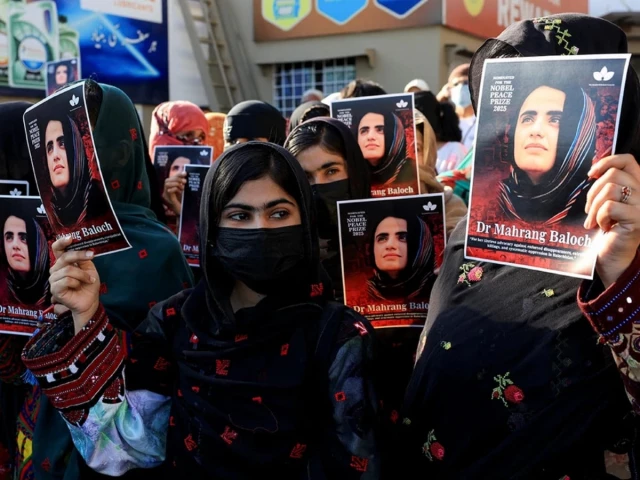
In late July 2024, as a march calling itself the "Baloch Raji Muchi" converged on Gwadar, the army issued an unusual warning. Alongside news that a soldier had been martyred and 16 others injured by a mob, it cautioned that "fake and doctored pictures and videos" were being circulated on social media to win sympathy for the march.
I have thought about that warning often since. The soldier, Sepoy Shabbir Baloch, was 30 years old. Yet in much of what has been written about Gwadar, he barely appears. What appears instead is a vocabulary: peaceful protest, rights defenders, dissent. In Balochistan, those words are increasingly being used to cover something else.
This raises two questions. How does violence come to speak the language of rights? And who pays when the world believes it?
The vocabulary of a sit-in
Consider how the Gwadar episode has been told. Prosecutors say the leaders of the Baloch Yakjehti Committee (BYC) incited a crowd that attacked a security vehicle, seized the soldier and beat him to death. In June, an anti-terrorism court convicted two of them. Within weeks, a group of UN special rapporteurs, whose opinions are non-binding, called the verdict a "travesty of justice" and warned against silencing "peaceful dissent". A man was beaten to death, and the word that travelled furthest was "peaceful".
The pattern did not end there. In March 2025, days after terrorists of the banned Balochistan Liberation Army (BLA) seized the Jaffar Express, BYC supporters gathered at Quetta's Civil Hospital. The provincial government said they had come for the bodies of the attackers. The BYC called it a rights protest.
This is the thin line Pakistan keeps pointing to. Balochistan faces a campaign of terrorism that targets civilians, security forces and development projects alike. Networks that advance the agenda of a banned terrorist group, or spread ethnic hatred that ends in bloodshed, do not become peaceful demonstrators because they carry placards.
Missing, and then found
No part of this vocabulary has been used more effectively than "missing persons". It is an emotive phrase, and that is precisely why it has become so useful to those who wish to discredit the state.
The Balochistan government has stated that some people on missing persons' lists were found to be involved in terror incidents, and that some cases were fake. One example came from the militants themselves. Salim Baloch, a postgraduate from Turbat, went missing in 2023; activists, including the BYC, accused the state of making him disappear. In February, the BLA reportedly claimed him as its own operative, trained in the mountains and involved in planning its attacks.
The case shows how the cycle works. A young man joins a banned group; his name appears on a list; the state is blamed. By the time the truth emerges, the campaign has moved on to the next name. A campaign that repeats this cycle is no longer a rights campaign. It is part of the terrorists' propaganda.
Who amplifies the story
A vocabulary needs an audience, and this one has found a ready one abroad. Pakistan has long pointed to the foreign hand behind the violence, notably Indian efforts to fuel militancy and sabotage CPEC. After the Jaffar Express attack, the Foreign Office said it had been "orchestrated and directed by terrorist ringleaders operating from abroad".
The UN Security Council, which speaks for the international community on terrorism, condemned the Jaffar Express attack "in the strongest terms". The rapporteurs' opinion carries no such authority, yet it is their words that have travelled furthest.
Last week, a Washington think tank's terrorism journal described the BYC as a "non-violent humanitarian organisation". The BLA, the group behind the Jaffar Express attack and one Washington itself designated a terrorist organisation last year, does not appear once in the article. This is how the vocabulary works: remove the terrorism from the picture, and every protest looks peaceful.
A selective conscience
Had a soldier been beaten to death by a crowd in London or Paris, and those who incited it been convicted, no UN rapporteur would call it a travesty of justice. They would call it the rule of law. Pakistan asks for nothing more than the standard others apply to themselves.
Selective outrage has a cost. It tells the terrorists' facilitators that they will find a sympathetic audience abroad, and it tells the families of the dead that their loss counts for less.
The victims the vocabulary forgets
Every story told in this vocabulary has someone missing from it: the Jaffar Express passengers, 21 of whom were martyred along with four Frontier Corps personnel; the soldiers and policemen at checkposts across the province, many of them Baloch themselves; and Sepoy Shabbir Baloch, reduced in so much commentary to the backdrop of someone else's story. A vocabulary used this selectively stops describing reality and starts concealing it.
I would ask those who write about Balochistan from abroad to look at all the facts, including the victims, before reaching for the language of rights. Pakistan remains committed to human rights and due process while carrying out its duty to protect its citizens from terror. Engagement with it should rest on verified realities, not selective ones.
Separating protected freedoms from the incitement of hatred and bloodshed is not a threat to rights. It is the only way to keep them meaningful. A right that can be used as a shield for those who kill is no longer a right. It is a weapon.




COMMENTS
Comments are moderated and generally will be posted if they are on-topic and not abusive.
For more information, please see our Comments FAQ