
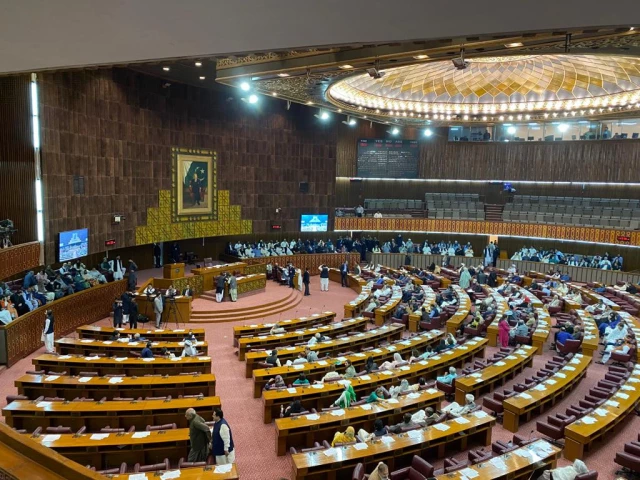
The art of acquiring political power and the science of governing a country are two different things.
A ‘politician’, by definition, seeks political power, public support and the authority to govern. A ‘political scientist’, on the other hand, studies the nature, purpose, limitations and responsibilities of political power. One is primarily concerned with ‘how to acquire power’; the other examines ‘why power exists’.
Unfortunately, what Pakistan has repeatedly suffered from is a shortage of political vision, intellectual honesty, institutional wisdom and an understanding of the very purpose of the state. And therein lies the crux of our predicament.
1. Pakistan's fundamental political dilemma: Power without political philosophy
Since independence in 1947, Pakistan has witnessed:
- Civilian governments and military administrations.
- Parliamentary democracy and authoritarian rule.
- Constitutional experiments and constitutional suspensions.
- Political alliances, defections and ideological compromises.
- Repeated promises of accountability, reform and economic transformation.
Yet, after nearly eight decades, we still continue to grapple with fundamental questions:
- What kind of state do we want to build?
- What should be the relationship between the state and its citizens?
- Where should the limits of political, military and bureaucratic authority lie?
- Should institutions serve individuals, or should individuals remain subordinate to institutions?
These are not merely political questions. They are questions of political philosophy, constitutionalism, political sociology and statecraft.
2. Politicians pursue power… Political scientists examine its consequences
A politician may promise immediate relief to secure public support. A political scientist examines whether the proposed policy is economically sustainable, socially equitable and institutionally workable.
A politician may seek to strengthen his or her political position by weakening an institution. A political scientist understands that weakening institutions ultimately weakens the state itself.
A politician may exploit ethnic, linguistic, sectarian or regional divisions to consolidate his or her constituency and further the family's or clan's hold over national interests and beliefs. A political scientist examines how such divisions undermine national cohesion and social stability.
A politician may regard criticism as a threat to his authority, wealth and family's control over the destinies of the masses. A political scientist recognises dissent, intellectual disagreement and freedom of expression as essential ingredients of a healthy political order.
The distinction is crucial.
3. The tragedy of personality-driven politics
One of the most persistent weaknesses of Pakistan's political culture is its excessive dependence on personalities.
Political loyalties are frequently built around individuals rather than political ideas, institutional principles or clearly articulated policy programmes.
Consequently, the fortunes of political parties often rise and fall with the fortunes of their leaders.
Consider the consequences:
- Political parties become personal political estates rather than democratic institutions.
- Leadership succession becomes a family or factional matter rather than a merit-based process.
- Political opponents are treated as enemies rather than legitimate competitors.
- Governments frequently reverse the policies of their predecessors, even when those policies serve the national interest.
- National development becomes hostage to electoral cycles and political rivalries.
A political scientist would approach this problem of ‘personality-driven politics’ differently.
He would therefore urgently address the following fundamental questions regarding political parties in Pakistan:
- Why have they failed to develop internal democracy?
- Why do their manifestos so rarely translate into enduring national policies?
- Why do political institutions remain weaker than the personalities controlling them?
The objective would therefore not be to replace one political personality with another, but to create a political culture in which institutions are stronger than individuals.
This is precisely where Pakistan needs intellectual intervention.
4. The unresolved question of civil-military relations
No serious examination of Pakistan's political evolution can ignore the relationship between civilian political authority and the military establishment.
Pakistan's political history has witnessed prolonged periods of direct military rule, as well as different forms of military influence over civilian political processes.
This has had profound implications for constitutional development, parliamentary sovereignty, institutional autonomy and democratic continuity.
But merely condemning one institution or glorifying another does not solve the problem.
A political scientist would examine the historical, constitutional, geopolitical and institutional circumstances that have produced this imbalance.
He would investigate:
a) Why have civilian political institutions struggled to establish durable constitutional authority?
b) Why have political parties sometimes sought institutional intervention against their political opponents?
c) Why has the principle of civilian supremacy remained difficult to consolidate?
d) How can national security requirements coexist with parliamentary accountability?
e) What institutional arrangements can ensure that every state institution operates within its constitutional mandate?
These questions require scholarship, historical understanding and constitutional expertise, not merely political slogans.
The ultimate objective must be a constitutional order in which every institution, civilian or military, derives its authority from the Constitution and remains accountable within its prescribed jurisdiction.
5. Pakistan needs policymakers, not merely power-seekers
Let us consider some of Pakistan's most persistent national challenges:
| National challenge | How political scientists can contribute |
| Economic instability | Long-term economic governance and policy continuity |
| Weak democracy | Institutional reform and democratic accountability |
| Corruption | Transparency, oversight and institutional checks |
| Provincial tensions | Federalism and equitable resource distribution |
| Weak local government | Decentralisation and grassroots democracy |
| Educational decline | Evidence-based education policy |
| Population pressures | Demographic policy and social planning |
| Institutional and administrative governance weaknesses | Institutional independence and governance reform |
| Political polarisation | Democratic pluralism |
We need political scientists working alongside economists, constitutional lawyers, sociologists, historians, administrators and development specialists.
They should not simply write academic papers and deliver lectures to university students. Their knowledge must reach Parliament, provincial assemblies, political parties, government departments and institutions responsible for national planning.
This brings us to a rather uncomfortable question.
Pakistan has universities, departments of political science, scholars of constitutional law, historians, economists and public policy experts. We have intellectual resources. But why has their collective contribution remained so limited in shaping the country's political direction?
The possible explanations are:
- The ‘disconnect’ between academia and political power.
- The lack of independent policy institutions with sufficient influence.
- Political intolerance and intellectual conformity.
- The politicisation of knowledge.
- The absence of a long-term national vision.
What can Pakistan do?
- Establish an independent National Institute of Political and Constitutional Studies.
- Introduce compulsory political and civic education.
- Strengthen political parties through internal democracy.
- Create permanent parliamentary research services.
- Institutionalise national policy continuity.
- Protect academic freedom and intellectual independence.
- Make local government meaningful.
These are not revolutionary demands. They are the foundations of a functional constitutional state.
6. An important distinction: Political scientists cannot replace politicians
There is, however, one qualification that must be made. A state shall be governed by elected representatives only, and under no circumstances can political scientists replace them. In other words, that would risk replacing political accountability with technocracy.
Political scientists are not necessarily better administrators, nor does an academic qualification automatically confer political wisdom, integrity or leadership qualities. A country needs elected politicians because political legitimacy ultimately comes from the people.
But it also needs politicians who understand constitutional government, institutional responsibilities, economics, international relations and the long-term consequences of their decisions.
In other words, political scientists should not occupy the throne. They should help ensure that whoever occupies it understands the limits and responsibilities of power.
Perhaps this is the most important dimension. We have political parties that aspire to govern Pakistan. But where are the institutions that systematically educate their future legislators, ministers and political leadership in constitutionalism, political philosophy, public administration, international relations and the economics of governance?
Why should a person be considered qualified to govern millions merely because he enjoys electoral popularity, possesses political influence or inherits a political constituency? Political leadership requires much more than the ability to win elections. It requires intellectual maturity, historical consciousness, constitutional understanding, administrative competence and, above all, a sense of public responsibility.
A politician without political education may acquire power but remain incapable of understanding its consequences. And a political system that repeatedly rewards political expediency over intellectual competence eventually pays a heavy national price.
Pakistan needs political scientists not to manufacture politicians, but to cultivate political wisdom; not to acquire power, but to understand its limits; not to serve those who govern, but to serve the constitutional state and the people. Because, ultimately, the purpose of politics is not to keep politicians in power. The purpose of politics is to make the lives of the people better.
The writer is a mariner and researcher by profession.




COMMENTS
Comments are moderated and generally will be posted if they are on-topic and not abusive.
For more information, please see our Comments FAQ