
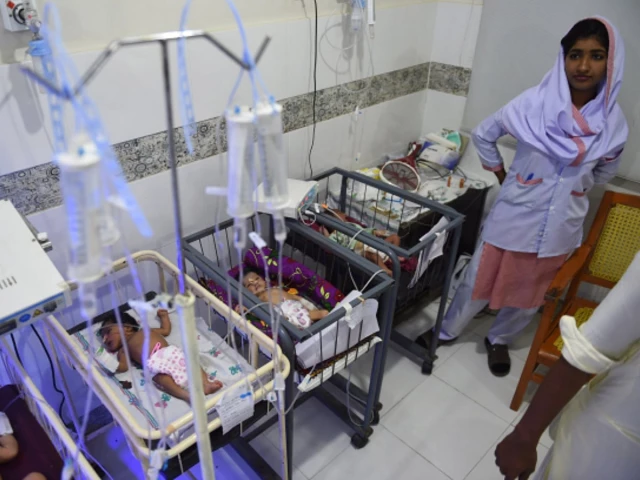
Fourteen newborn babies died in a recent hospital fire in Islamabad. The tragedy is devastating not only because of the lives lost, but because of who those patients were: newborns in a place that should be among the safest places in a hospital. Unable to walk, call for help, or escape when something goes wrong. They are entirely dependent on the systems we put around them.
And when those systems fail, the consequences can be irreversible.
The precise cause of the fire is still being investigated, but what has already emerged is troubling. Fire safety deficiencies had previously been identified at the hospital, yet the necessary corrective actions were not adequately implemented. In June 2024, something similar happened at another hospital, where 11 newborns died after an air-conditioning failure triggered a fire. Two years later, we are still paying for mistakes we failed to correct the first time.
It can be deduced that Pakistan does not suffer from a lack of standards; rather, we suffer from a lack of adherence to them. We have building codes, fire safety regulations, licensing requirements, policies, standard operating procedures, committees, and inspection mechanisms. In health care, we also talk frequently about quality, accreditation, and patient safety. On paper, much of what should happen is already written down. But what happens after the policy is written, the inspection is completed, the deficiency is documented, and the committee meeting is concluded? We rarely see any change implemented.
This gap between standards and practice is not unique to hospitals. We saw the same problem earlier this year at a famous local shopping plaza in Karachi, where more than 70 people lost their lives in a devastating fire. Subsequent investigations described the absence of proper fire exits, blocked or locked escape routes, inadequate fire protection, and serious deviations from approved building plans. The risks were not unknown to engineering or fire safety, yet across our cities, corridors become storage areas, exits are blocked, electrical loads grow while wiring ages, and fire extinguishers hang on walls without anyone knowing whether they work. The problem is not that we do not know what safe buildings should look like. It is that we too often fail to act on what we already know.
Hospitals make this problem even more consequential. Fire safety in a hospital is not simply a facilities issue; it is a patient safety issue. But patient safety extends far beyond fire safety. It is about preventing avoidable harm by ensuring that the systems patients depend on are safe and reliable, especially when they cannot protect themselves. A premature infant in an incubator, a ventilated patient in an ICU, or an anaesthetised patient in an operating room cannot simply follow an exit sign and leave the building. A faulty fire alarm, unavailable essential medicines, or faulty equipment can all compromise patient safety.
Identifying these risks is only the first step. What matters is whether identified problems are assigned responsibility, given the necessary resources, and followed through to resolution. The standard therefore must be higher, not lower.
None of these problems is particularly glamorous, and perhaps that is part of the difficulty. Pakistan’s healthcare sector is making important strides, with new and increasingly sophisticated treatments and services being introduced across the country. These advances are important and should be encouraged, but there is an uncomfortable contrast here. We are becoming capable of delivering highly specialised care, while still struggling to ensure that the wiring, alarms, exits, and emergency procedures in a major public hospital can protect patients from fire incidents. If we are capable of providing highly specialised services such as heart and lung transplantation, we should also be able to get the basic foundations of patient safety right.
This dichotomy between sophisticated medical care and basic standards of safety and building maintenance raises an important question about what progress in healthcare should look like. This is not an argument against progress. It is a reminder that the basics must travel with the breakthroughs. Ensuring those basics requires more than enforcement. Knowing what to do and doing it are two different things. A strong patient safety culture is what helps bridge that gap.
In simple terms, patient safety culture is what an organisation does when nobody is specifically checking. It is whether a nurse feels able to say that a piece of equipment is unsafe, whether repeated electrical faults are treated as warning signs rather than inconveniences, and whether a near miss leads to curiosity and learning rather than relief that nobody was harmed. It is also about a junior member of staff being able to challenge an unsafe decision and leaders wanting to hear bad news early rather than only after something has gone terribly wrong.
This is why patient safety cannot be reduced to accreditation, inspection, or compliance. Those are necessary, but they are not sufficient. Safe organisations have a learning culture: they examine what went wrong, but also what nearly went wrong. They ask why systems allowed a hazard to persist, and act to prevent it from happening again. Serious events therefore should not end with assigning blame. Accountability matters, particularly when known deficiencies have been ignored. But a system that only asks, “Who was responsible?” may miss the more useful questions: “What allowed this to happen, and where else could the same thing happen tomorrow?” When one hospital identifies a risk or finds a better way of working, others should be able to learn from it rather than having to discover it through their own tragedy.
Moreover, learning has limited value if it stays within the institution where an event occurred. Lessons need to travel across the health system. One practical way forward could be a national patient safety learning collaboration, bringing together public and private hospitals to share problems, solutions, and lessons.
The Centre for Patient Safety at Aga Khan University, through our role as a WHO Collaborating Centre with a focus on implementation research in patient safety, could help facilitate such an effort. The objective should not be for one institution to prescribe solutions to everyone else, but to help create a learning community in which hospitals solve their own problems, measure their progress and share what works.
There will always be the probability of accidents that no system can completely prevent. But predictable hazards that have been identified, documented and then ignored are something different. They are labelled as failures of implementation, accountability and learning.
The goal must be to move from standards on paper to safety in practice: identifying risks, acting on them, and learning from what goes wrong. Standards need implementation, and implementation requires more than imposition. It requires a strong patient safety culture in which problems are raised, addressed, and learned from before they become tragedies. That culture must provide the foundation for learning and sharing lessons across organisations, so that we do not keep repeating the same mistakes and learning them the hard way.
The writer is Chair of the Department of Anaesthesiology at Aga Khan University




COMMENTS (1)
Comments are moderated and generally will be posted if they are on-topic and not abusive.
For more information, please see our Comments FAQ