
The suffering of people in Pakistan’s former tribal areas is undeniable. Terrorism destroyed families, livelihoods and communities. Counterterrorism operations displaced people. Unexploded munitions and IEDs continued to threaten lives. Homes, schools and businesses were damaged. An entire generation grew up surrounded by violence.
But suffering does not interpret itself. Someone tells society what it means, who caused it and where responsibility should be placed.
In my book, Narratology for Policymakers, I describe narratives as frameworks through which people understand complicated issues. A narrative arranges disconnected events into a cause-and-effect sequence. It selects characters, establishes conflict and suggests a resolution. Facts provide information. Stories give those facts meaning.
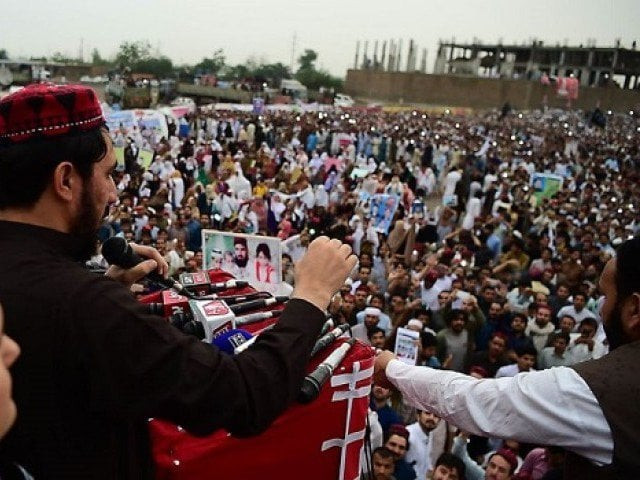
The Pashtun Tahafuz Movement understood this distinction. PTM transformed a complex conflict involving terrorist organisations, foreign fighters, local facilitators, communities and state institutions into a simple and emotionally powerful story. State and security forces were presented as the principal authors of Pashtun suffering. The role of Pakistani Taliban and other terrorist networks was pushed to the margins.
The suffering was real. The lens through which it was interpreted was changed.
PTM emerged with demands that resonated across the former tribal areas. These included removal of landmines, recovery of missing persons, accountability for alleged extrajudicial actions and dignified treatment at checkpoints. Such concerns deserved serious institutional responses.
The movement then placed these grievances inside a wider narrative of collective victimhood. Personal testimonies, speeches, poetry, public gatherings and social media gave the story emotional force. Influential voices helped articulate aspects of this account.
Its anthem, “Da Sanga Azadi Da?”, or “What kind of freedom is this”, became a powerful narrative anchor. In Narratology for Policymakers, I explain that an anchor gives audiences a starting point from which later information is interpreted. Once this question became an anchor, every loss or encounter with the state could be presented as evidence that freedom itself was fraudulent.
The slogan was brief, emotional and adaptable. A damaged home, missing relative, delayed compensation claim or difficult encounter at a checkpoint could all be attached to it. PTM reduced a complicated war to a question that could be repeated at rallies, turned into poetry and circulated through social media.
The narrative also assigned familiar character roles. Pashtuns were positioned as collective victims. PTM leaders appeared as truth-tellers. State and security forces became villains. Terrorists whose presence had made security operations necessary became secondary characters or disappeared from the plot.
This was selective framing.
Framing does not always require inventing facts. It can work by selecting which facts receive attention and which are excluded. Consequences of counterterrorism operations were highlighted, while terrorism that preceded those operations received no narrative space.
The central questions were rarely asked. Who were the Pakistani Taliban? Where did they establish their networks? Who murdered tribal elders, attacked schools, imposed parallel systems of authority and challenged the writ of the state?
Tehreek-e-Taliban Pakistan emerged from tribal areas along the Pakistan-Afghanistan border. Its terrorist networks operated within the same geography in which counterterrorism operations later became necessary. Almost all of its members came from tribal areas or adjoining regions. They spoke local languages and understood tribal structures through which they developed influence.
This produced startling divisions within tribal society. In some families, one brother served in the military, FC, police or another law-enforcement institution while another joined a Taliban terrorist network. Both could return to the same home. One defended citizens and the constitutional state. The other supported an organisation seeking to impose its authority through intimidation and terrorism.
Conflict was therefore not a war between the state and Pashtuns. It was a struggle between constitutional order and terrorist organisations operating within native tribal regions. It was also an internal struggle over law, ideology and the future of the area.
Pashtuns were among the principal victims of terrorism. They were also among Pakistan’s bravest soldiers, police officers, tribal elders and citizens resisting it.
A one-sided narrative concealed this complexity. Terrorists were repositioned as local men, misguided relatives or products of state policy. Security forces became the most visible actor and therefore, the convenient villain. Terrorism that made deployment of security forces necessary was removed from the causal chain.
The question should have been addressed directly. If terrorists challenged the writ of the state in Miranshah, South Waziristan, Bajaur, or Swat, where should the government have responded?
An operation cannot be conducted in an area unrelated to the threat. When the Chhotu Gang established an armed stronghold in the riverine belt of Southern Punjab, operations took place in the Kacha area. When dacoit cartels establish sanctuaries in some areas of Sindh, law-enforcement operations were conducted in the same areas.
The geography of a military operation is determined by the geography of the threat. It is not evidence of hostility towards people living there.
This does not place every state action beyond criticism. Counterterrorism operations caused displacement, economic losses and hardship. Compensation and reconstruction were often slow. Individual allegations of abuse required investigation.
A pro-state position should not deny these realities. Denial damages the state’s credibility. Narratology for Policymakers places accuracy, transparency, fairness and empathy at the heart of ethical storytelling. A credible state narrative must acknowledge the suffering of the local population while explaining the context in which it occurred.
The operations became necessary because terrorist organisations had captured space, attacked citizens and challenged constitutional order. The state is obliged to restore its writ. It is also responsible for protecting civilians, investigating wrongdoing and rebuilding communities.
PTM’s account prevailed among a sizeable segment of the population because the state did not explain this distinction due to considerations of political sensitivity and political correctness.
Yet silence created another danger. By avoiding an uncomfortable conversation, the state ceded the narrative field.
Politicians in Khyber-Pakhtunkhwa found it easier to join the chorus against security forces than to discuss the conditions in which terrorism grew. Politicians in Islamabad lacked the will or courage to explain why counterterrorism operations became necessary.
The state relied on press releases, security terminology and statistics. Anarchists used grief, poetry and personal testimony. One side presented information. The other presented meaning.
As I argue in my book, established narratives cannot be dismantled through facts alone. Effective counter-narratives must combine evidence with empathy, human stories and values that matter to the audience.
The state should begin with common ground. Lives, dignity and constitutional rights of innocent civilians, even in terrorism infested areas, are sacrosanct and must be protected. Their sacrifices must be recognised. The stories of victims of terrorism and those who bravely stand against terrorists must be told to the whole nation and these heroes must be acknowledged. From that foundation, the missing parts of the story can be restored.
The strongest answer to PTM is not that Pashtuns did not suffer. They did. The answer is that terrorist organisations turned their communities into battlefields and compelled the state to restore peace.
Pashtuns were not merely victims of that struggle. They were central to defeating terrorism and preserving Pakistan. The state must tell this story with facts, empathy and confidence.




COMMENTS
Comments are moderated and generally will be posted if they are on-topic and not abusive.
For more information, please see our Comments FAQ