
The recent European heatwave broke multiple historical temperature records and made Western Europe experience its warmest June on record, sitting 3.05°C above the 1991–2020 average.
Far to the south, in the South Atlantic, the world's largest and oldest tracked iceberg, A23a, finally broke apart, fragmented and melted away in warmer waters after a nearly 40-year journey. When it calved in 1986, it was roughly the size of Karachi's metropolitan area. Between these two extremes lies the Middle East, where the ongoing conflict has exposed another dimension of our vulnerability beyond its devastating human toll, disrupting critical shipping routes, threatening global energy supplies and triggering sharp price volatility across international markets.
At first glance, these three events seem unrelated. They are not. One highlights the growing impacts of a warming planet. Another reminds us that climate change is transforming Earth's natural systems in ways that are often irreversible. The third exposes how vulnerable our economies remain to resource dependence and geopolitical shocks.
Together, they point to a common conclusion: the future must be more resource-efficient, more circular and fundamentally less wasteful.
Humanity currently consumes about 1.7 to 1.8 Earths' worth of natural resources every year. This means we use up a full year's supply of Earth's renewable resources in roughly seven months, while only 6.9% of used materials are cycled back into the economy.
This is simply not sustainable. By drawing down natural resources faster than the planet can renew them, we permanently degrade soils, deplete fisheries, shrink forests and release ever greater amounts of carbon dioxide into the atmosphere.
Fossil fuels—oil, coal and gas—still supply more than 80% of global energy consumption across transport, industry and power generation. Global oil production is, in fact, at a record high today. The recent tensions in the Middle East have only reinforced how vulnerable this dependence leaves us.
The world also generates more than 2 billion tonnes of municipal solid waste every year. If piled together into a single mass, this waste would cover an area and rise to a height far exceeding Mount Everest. At the same time, total global greenhouse gas emissions continue to rise, reaching new record highs and driving global warming even further.
Solutions already exist and are used globally by communities, cities, businesses, and governments to build a resource-efficient, circular world. The challenge now is not invention, but implementation and scale. Just as nature wastes nothing, we must embrace a truly circular path where every resource returns to the earth and nothing is lost.
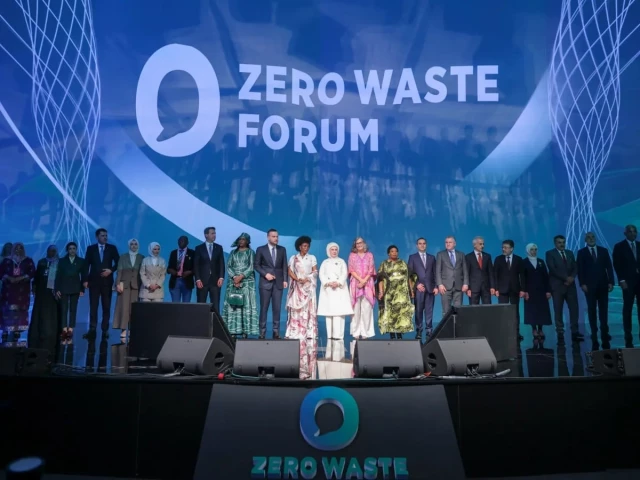
What began as a national initiative in Türkiye in 2017, Zero Waste has evolved into a global movement shaping conversations on production, consumption and sustainable development around the world. Today, Zero Waste is recognised not only as an environmental necessity, but also as a pathway for climate action, sustainable urban development, resource efficiency and resilient communities.
Zero Waste is not just about waste management. In fact, waste management is the last intervention in the Zero Waste hierarchy. At its core, Zero Waste prevents waste generation at the source, keeps materials and products in use for as long as possible, and reimagines what we consider “waste.”
It drives resource efficiency, reducing the fossil fuels burned to extract, process and transport virgin materials, while cutting pollution, protecting forests and biodiversity, and reducing methane emissions through composting and better management of organic waste.
Zero Waste also creates healthier, more resilient communities. It reduces flooding and pollution, creates local jobs in repair, reuse and recycling, supports circular economies, and encourages sustainable habits that tackle water scarcity, hunger and growing energy demands.
Take food loss and waste as one example. Humanity wastes over one billion tonnes of food every year, while food waste alone accounts for around 8–10 per cent of global greenhouse gas emissions. Beyond emissions, it wastes the land, water, energy and labour used to produce that food.
A Zero Waste approach addresses the entire agrifood system—from preventing losses on farms through better storage, handling and transport, to reducing household waste through smarter consumption, food redistribution, composting and repurposing. Along the way, it also creates jobs, improves livelihoods and strengthens food security.
The same principle extends to plastics, textiles, electronics and materials across the economy. Zero Waste reminds us that meaningful climate progress will not come from negotiations alone. It depends on practical solutions that people and communities can own and act upon, bridging high-level policy with everyday action and demonstrating that sustainable development and climate action must go hand in hand.
Global challenges like record ice melt, extreme summer heat, and energy shocks since 2021 highlight a shifting world. To build lasting resilience against these pressures, tackling waste at the source remains one of the most effective and equitable environmental strategies.
About Climate High-Level Champions
The Climate High-Level Champions (HLCs) work to mobilise ambitious climate action from businesses, cities, regions, and financial institutions to support governments in achieving the goals of the Paris Agreement.
By driving partnerships, showcasing transformative solutions, and prioritising support for vulnerable communities, the HLCs help turn ideas into impact – cleaner air, better jobs, safer homes, and a healthier world for all.
Appointed by successive COP Presidencies, the Champions work to strengthen collaboration between governments and the “real economy,” helping to translate climate commitments into practical, scalable solutions.




COMMENTS
Comments are moderated and generally will be posted if they are on-topic and not abusive.
For more information, please see our Comments FAQ