
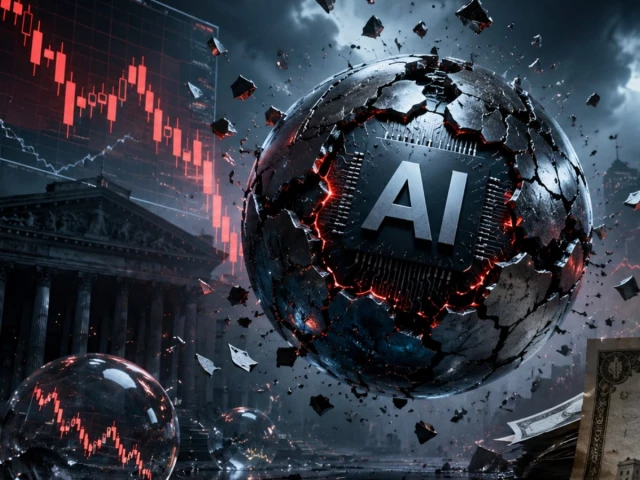
Global capital markets came under intense pressure towards the end of June, with a sell-off spree reflecting a mix of geopolitical tensions, inflation concerns, and investor uncertainty.
The turbulence observed around June 23 showed that equities, currencies, and bonds all lost appeal as investors pulled back from risk amid persistent instability and growing doubts about the US central bank's policy direction.
Globally, market sentiment remained fragile. Asia-Pacific markets, per CNBC, were poised for a mixed open, as optimism over a potential Iran-related diplomatic breakthrough was offset by scepticism about its durability. The development highlighted how geopolitical developments continued to influence investor confidence, driving market volatility.
Apart from immediate triggers, analysts have flagged bigger structural risks. A Reuters analysis warned that “momentum crash” signals were flashing red across asset classes. It further stated that valuations in several markets had become “detached from economic reality,” raising the risk of a sharp correction if investor sentiment shifts.
Financial analyst Jamie McGeever pointed out that crowded trades, excessive leverage, and widespread belief in sustained gains could amplify any downturn. Such conditions, he stressed, have historically preceded market reversals, with the severity determined by how abruptly investors exit these positions.
A key focus of current risk assessments is the bewildering expansion of artificial intelligence-related investments. An internal US Treasury analysis has warned of “serious financial stability risks” linked to the buildup of AI-related investments. It highlighted issues such as inflated valuations, concentrated capital flows, and interconnected exposures within financial markets.
Further research reinforces these concerns. The Institute for New Economic Thinking argues that AI-related equity valuations exceed levels justified by realistic cash-flow projections. Such overvaluation, the study warns, could lead to a correction, particularly if earnings fail to meet expectations.
Similarly, an MIT Sloan School of Management analysis also notes that AI-driven optimism is contributing to economic uncertainty. Strong demand linked to AI investment has complicated inflation dynamics, while also creating challenges for policymakers trying to balance growth and price stability.
The AI boom could have macroeconomic consequences. The concentration of investment among a small number of major firms increases the risk of an “investment hangover,” potentially echoing patterns seen during the dot-com era.
Underlying these developments are broader concerns about the resilience of the US economy. The American Enterprise Institute describes the American economy as vulnerable, citing high debt levels, persistent inflation in key sectors, and weakening productivity growth outside technology.
It indicates that while headline indicators may appear stable, underlying conditions are more fragile. Rising financial pressures on households and structural imbalances across sectors could be potential sources of instability.
The Institute for New Economic Thinking also links the risks of an AI bubble to broader economic vulnerabilities. It warns that a correction in AI-related investment could have spillover effects across credit markets and real economic activity, particularly given the scale and concentration of capital involved.
Another major concern is the evolving situation in the US Treasury market. Internal Treasury analyses underscore fears about declining confidence in US government debt. Rising deficits, political uncertainty, and shifting investor behaviour are contributing to instability.
Analysts also point to changes in investor behaviour, with some market participants reducing direct exposure to Treasuries and instead using derivatives for hedging. This shift may reduce the stability of demand for US bonds, potentially increasing volatility during periods of stress.
Higher yields in the Treasury market have added to these concerns. As borrowing costs rise, financial conditions tighten across the economy, affecting everything from corporate investment to consumer credit. Analysts warn that this dynamic could exacerbate existing vulnerabilities, particularly if growth slows simultaneously.
Taken together, the June 23 market turmoil reflects a “convergence of risks.” The initial market decline could be attributed to geopolitical tensions, inflation concerns, and monetary policy uncertainty. At the same time, researchers highlight deeper structural issues, including the buildup of an AI investment bubble and increasing economic uncertainty, while underlying weaknesses in the US economy could amplify these risks.
The interaction of these factors creates a complex and potentially unstable environment. Analysts suggest that the combination of elevated valuations, concentrated investment, and policy constraints increases the likelihood of further volatility.
While nobody can definitively predict a full-scale financial crisis, growing risks within the global financial system are pronounced. Some analysts emphasise that the unwinding of momentum-driven markets could lead to corrections, but others suggest that the trajectory of the AI sector will be critical in determining future market stability.
Concerns about the US Treasury market add another layer of uncertainty. Declining confidence in what has traditionally been considered a risk-free asset could have far-reaching implications for global finance.
Overall, the June 23 market collapse points to a financial environment characterised by growing uncertainty and interconnected risks. The combination of geopolitical shocks, market dynamics, technological investment trends, and structural economic challenges suggests that global markets may face continued turbulence in the months ahead.




COMMENTS
Comments are moderated and generally will be posted if they are on-topic and not abusive.
For more information, please see our Comments FAQ