
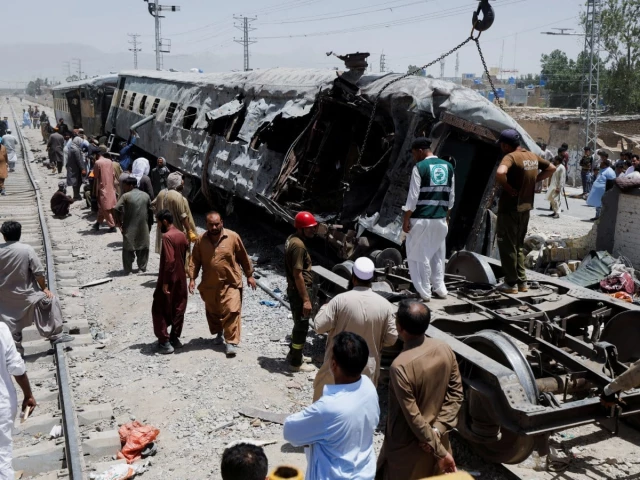
The recent Quetta Chaman Phatak attack by the Balochistan Liberation Army (BLA) resulting in innocent fatalities has once again exposed the true face of the so-called 'well-wishers' of the Baloch populace. The intensity of the terror threat posed to the country could be well understood by the Global Terrorism Index 2026 report published by the Institute for Economics and Peace (IEP), which ranked Pakistan as the country most affected by terrorist incidents.
The report ranked Tehreek-e-Taliban Pakistan (TTP) as the deadliest group in Pakistan, followed by BLA. The growing nexus between the two is a matter of grave concern due to serious security implications for Pakistan. There is no ideological link between these two groups: TTP is an Islamist militant organisation aiming to impose its misinterpreted version of Shariah, while BLA is an ethno-nationalist insurgent group that ostensibly claims to fight for Baloch rights.
However, considering potential operational gains through cooperation, both groups have compromised on their ideologies. Reports indicate that Al-Qaeda not only played a key role in building trust between these ideologically distinct organisations but also provided them advanced training.
A detailed study on BLA has made it clear that BLA has constructed a narrative to present Baloch women as symbols of resistance, which is in reality based on coercion, blackmail, and sexual exploitation. Evidence shows these women are psychological slaves forced through blackmail and sexual exploitation.
BLA and Baloch Yakjehti Committee (BYC) have established close coordination; as a result, the BYC platform has become a major source of Baloch women exploitation. It is on record that before BYC’s formation in 2020, no Baloch woman had ever carried out a suicide attack in decades of terrorism. BLA targets educated, employed women, teachers, nurses, law students, WHO workers, and incites them to perpetrate terrorism through blackmail and psychological coercion.
BLA’s recruitment of women does not begin with ideology; it begins with a fake social media account, weeks of grooming, and creation of explicit material. Adeela Baloch, a nurse and WHO worker, in a press conference, revealed that “terrorists seduce Baloch women by blackmail, of which I am an eyewitness.”
Another example is Sumaiya Qalandrani, born into a BLA family. Her father was a BLA commander. Both sides of her family belonged to BLA and Balochistan Liberation Front (BLF). She was raised with anti-state sentiment from birth and got herself killed as a suicide bomber at the age of 25.
Another example is Mahal Baloch, a 23-year-old law student from a politically prominent family with no prior link to militancy. She was radicalised without any human recruiter ever meeting her in person. TikTok’s algorithm introduced her to BLA recruiter content on her feed. Facebook and Instagram were also used for contact.
A teenage girl detained in Karachi in December 2025 had been in contact for months with handlers abroad via social media platforms and encrypted apps. The Associated Press reported her case globally.
When BLA deploys a female bomber, the operation has two phases: the physical attack and the narrative attack. Hakkal Media releases propaganda simultaneously. Indian media — NDTV, News18, Times Now, Firstpost — amplify it internationally, portraying coerced, blackmailed, or brainwashed women as symbols of resistance. It is a coordinated amplification of a designated terrorist organisation’s narrative about its own victims. Every time an international journalist calls a BLA female bomber a “fighter”, they are repeating a line written by the organisation that destroyed her.
Additionally, the cooperation between Baloch militants and TTP has also given insurgents unrestricted access to a massive cache of weapons left behind by US forces in Afghanistan, boosting the groups’ firepower. As of June 2025, security forces recovered 272 US-made rifles and 33 night vision devices from BLA militants. Reports say militants pair night vision and thermal equipment with small drones to attack troops more precisely.
Besides TTP, BLA is also reportedly collaborating with IS-K and the East Turkestan Islamic Movement. The emerging tactics of militants and the alliance between Al-Qaeda, TTP, BLA and other militant actors marks a dangerous phase in Pakistan’s security landscape. Hence, it calls for documented evidence of BLA’s exploitation of women and terrorism, which must be presented by the government before the United Nations and human rights organisations so that efforts can be made to rein them in.




COMMENTS
Comments are moderated and generally will be posted if they are on-topic and not abusive.
For more information, please see our Comments FAQ