
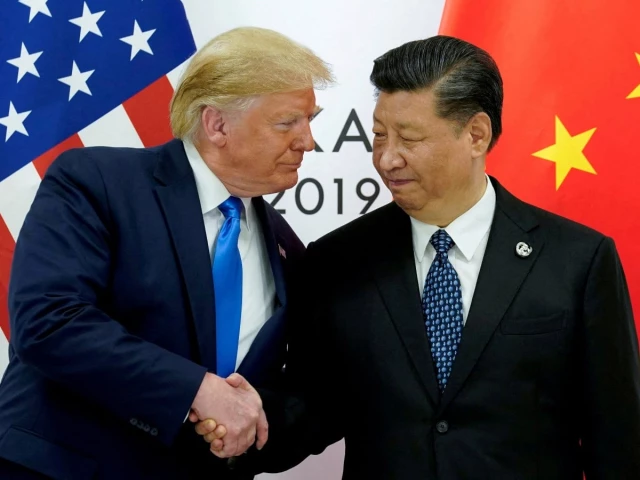
China and the US are global giants. What happens between them shapes global stability. For years, Washington has viewed China’s rise as a challenge to the “rules-based” order that sustains America’s global preeminence. As a result, the United States has sought to stymie China’s ascent across geopolitical, diplomatic, economic, and strategic fronts, straining bilateral ties. Yet their economic interdependence never allowed a complete diplomatic breakdown. Neither can afford decoupling without first inflicting harm on itself.
China-US ties may not return to the past, but they can still move toward a more stable future. Amid a rapidly changing geopolitical landscape, Beijing has consistently reaffirmed a commitment to building a stable and sustainable relationship with Washington grounded in its core principles of mutual respect, peaceful coexistence, and win-win cooperation.
Beijing has also reiterated its resolve to protect its sovereignty, security, and development interests, while expressing continued support for people-to-people exchanges between the two peoples. At the same time, China has sought to present itself as a responsible global actor, arguing that growing economic interdependence between the world’s two largest economies makes confrontation costly and cooperation beneficial.
Read: Trump lands in Beijing for high-stakes China visit
Chinese officials and media increasingly frame the China-US economic relationship as win-win, pointing to massive trade and investment flows and employment linkages that bind the two juggernauts together. More than 7,000 Chinese-invested firms operate in the United States, while tens of thousands of American companies remain active in China, collectively supporting millions of jobs on both sides.
President Donald Trump has landed in Beijing for a trip that analysts believe could become one of the most consequential diplomatic moments of his presidency. The visit, the first by an American leader in a decade, comes at a time when geopolitical transformation is happening, with Washington increasingly engaging Beijing from a position shaped not only by strategic rivalry but also by economic necessity and geopolitical constraints.
Trump’s foreign policy team has consistently framed China as America’s primary strategic competitor, with Secretary of State Marco Rubio calling it “adversary No. 1” in the past. Washington’s approach has focused on limiting China’s economic expansion, challenging the gigantic Belt and Road Initiative, and cobbling together blocs and alliances to blunt Chinese influence. Yet the international environment in which this strategy is unfolding has changed radically in recent years.
The Iran war has strained the US military and industrial capacity, raising questions about the sustainability of America’s prolonged global military commitments. Intelligence assessments and media reports have already highlighted the depletion of advanced missile systems and the long timelines required to replenish stockpiles. While the US retains overwhelming military superiority in many domains, concerns over strategic overstretch and industrial bottlenecks have become increasingly visible in domestic debates.
Despite deriving close to 40% of its energy from the Gulf, China has weathered the Iran war better than most Asian economies — thanks to deliberate strategic foresight. For years, Beijing has pursued policies aimed at reducing external vulnerabilities, including building strategic reserves, expanding renewable energy infrastructure, diversifying supply chains, and accelerating technological self-reliance. Moreover, China’s edge in rare earth processing remains an important factor in its economic leverage, especially as global demand for advanced manufacturing inputs continues to grow.
Also Read: Trump vows to push Xi to 'open up' China at superpower summit
Against this backdrop, the Trump-Xi summit is expected to focus on a wide range of issues, including trade stabilisation, rare earth exports, AI, maritime security, Taiwan, and broader geopolitical tensions. Washington is also seeking mechanisms to stabilise economic relations and secure more predictable access to Chinese industrial inputs, while encouraging increased Chinese purchases of American agricultural and industrial goods.
However, underlying these discussions is a broader structural reality: both countries now find themselves in a relationship defined less by hierarchy and more by mutual dependence. The US requires Chinese participation to stabilise key supply chains, while China continues to rely on access to global markets, technology flows, and financial systems in which America remains influential.
The impact of the Iran war on the global economy has further complicated this dynamic. Disruptions to shipping routes, energy flows, and financial markets have highlighted vulnerabilities in the international system. Trump’s public rhetoric aside, Washington has encouraged Beijing to help stabilise critical maritime chokepoints, including the Strait of Hormuz, though Beijing’s approach to Iran remains fundamentally different, shaped by its opposition to unilateral sanctions and its broader Eurasian connectivity strategy.
At the same time, US relations with traditional allies have shown signs of strain. Trade disputes, burden-sharing demands within NATO, and increasingly transactional diplomatic approaches have contributed to growing strategic diversification among European states. Several European countries have expanded economic engagement with China, reflecting both commercial interests and a desire for greater strategic autonomy in a more fragmented global order.
Taiwan remains one of the most sensitive points in US-China ties. While Washington has promised a multibillion-dollar arms sale to Taipei, it has yet to follow through. Beijing would expect a public statement from Trump opposing Taiwan’s sovereignty ambitions, as it treats Taiwan as its “red line.” Meanwhile, Beijing also continues to modernise its military capabilities at a rapid pace, strengthening its position across naval, cyber, space, and missile domains.
Beyond military and economic domains, China has increasingly projected its role in global governance, portraying itself as a proponent of multipolarity and multilateral cooperation. It has advocated for reform of international institutions and greater representation for developing economies, while promoting frameworks based on consultation, joint contribution, and shared benefits.
As the Trump-Xi summit approaches, expectations remain cautiously pragmatic. While breakthroughs may be difficult, both sides are likely to seek stability, risk management, and selective cooperation in key areas. The broader trajectory, however, points toward a world in which no single power can dominate global outcomes alone.
In this emerging multipolar order, China and the US remain the central poles of influence. Their relationship will continue to shape global economic stability, security architectures, and technological competition for decades to come. Ultimately, the defining feature of this new era is not outright confrontation or cooperation, but managed competition — where both powers are increasingly bound by interdependence even as they compete for influence.




COMMENTS
Comments are moderated and generally will be posted if they are on-topic and not abusive.
For more information, please see our Comments FAQ