
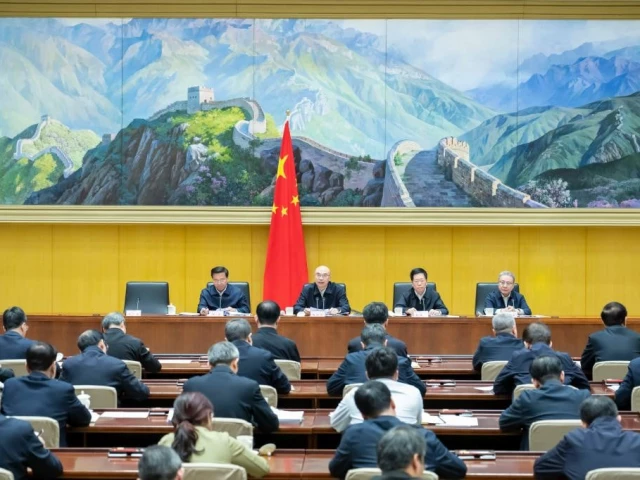
China’s Vice Premier Liu Guozhong has called for sustained momentum in the poverty eradication crusade. He exhorted authorities to steadily advance regular assistance and firm up the poverty eradication gains made over the years. Speaking at a conference in the capital, Beijing, last week, Liu delivered a clear message: vigilance must not slacken. Efforts must continue unabated to prevent relapse into poverty.
Liu said that 2026 marks the first year of a new phase of regularised assistance, according to Xinhua news agency. The approach, he added, must be sharper and more responsive. Support systems should be timely, targeted, and rooted in development. Concurrently, job creation must be expanded through different channels, creating stable and lasting opportunities for those at risk.
Liu also spoke about the need to rectify regional imbalances. Underdeveloped areas, he said, require greater support, while social security systems must be strengthened to provide a more reliable safety net. He called for closer coordination between eastern and western regions, alongside more effective backing from central departments.
Liu’s message was not just rhetorical. At the conference, eight eastern provincial regions signed assistance agreements with 10 western counterparts. It was a clear signal of a nationwide push toward cooperative development — shared responsibility and shared progress.
China’s eradication of abject poverty is one of the most significant socio-economic transformations of modern history. At its core, it is a story of scale and speed. In the late 1970s, hundreds of millions of Chinese lived in extreme deprivation. Villages were isolated. Opportunities were scarce. And basic services were limited.
Over the decades, however, that reality began to change—and then it changed with bewildering rapidity. China emerged as a global reference point in large-scale poverty eradication. By 2020, nearly 100 million villagers had been pulled out of absolute poverty, according to a CGTN report. This marked the culmination of a historic journey that began with reform and opening-up in 1978 and gained decisive momentum after 2012.
These are not merely China’s official figures. The miraculous turnaround has been widely recognised internationally. Over four decades, nearly 800 million people in China rose above the $1.90-a-day extreme poverty line — an achievement unmatched in scale, the World Bank acknowledged in a 2022 report. China alone accounts for nearly three-quarters of the global reduction in extreme poverty.
The global lender also stated that China met the UN’s 2030 poverty reduction target a full decade ahead of schedule. UN Secretary-General António Guterres lauded China’s anti-poverty feat as “the greatest anti-poverty achievement in history.”
This wasn’t a chance transformation. It was built on a development model that combined sustained economic growth with targeted social intervention, strong institutional coordination, and long-term political commitment. Growth created opportunity, but policy ensured inclusion. As China moves into its 15th Five-Year Plan (2026–30), the focus is shifting. Poverty eradication is no longer the end goal. Consolidation, rural revitalisation, and prevention of relapse now take centre stage.
When China set off on its reform journey in 1978, the scale of poverty was staggering — and daunting. Rural regions lagged behind, marked by weak infrastructure, limited access to education and healthcare, and minimal integration with markets. The response was both gradual and strategic. Over time, China adopted a dual-track approach — rapid economic expansion together with targeted poverty alleviation. It was a balancing act, but one that yielded results.
Broad-based growth created employment opportunities. Infrastructure projects connected remote villages to towns and cities. Agricultural reforms boosted productivity, while industrialisation absorbed surplus rural labour. Urbanisation, meanwhile, opened new doors. Millions moved, worked, and earned more than ever before.
By the early 21st century, the gains were already visible. Hundreds of millions had risen out of poverty. However, challenges remained. Some pockets of poverty were deeper, more complex, and harder to reach. That is when the strategy evolved. In 2012, China introduced targeted poverty alleviation. It was a shift from broad policies to precision interventions. Instead of general programmes, the focus turned to individuals, households, and villages. Who needed help? Where? And how?
Authorities developed comprehensive systems to identify the poorest communities. Millions of officials were moved to rural areas. They did not operate from a distance; they worked on the ground, village by village. Policies were tailored. One region needed roads. Another lacked schools. A third required industry. It was not a one-size-fits-all approach. Instead, customised solutions were applied.
China’s success was not driven by social policy alone. It rested on a much broader foundation: economic transformation. Industry expanded. Jobs multiplied. Infrastructure improved regional connectivity. Roads, railways, and digital networks reshaped rural life. Agriculture, too, evolved. Productivity increased. Incomes rose. Meanwhile, rural-to-urban migration allowed millions to find better-paying work in factories, construction sites, and service industries. The effect was cumulative. Each sector reinforced the other.
Joint studies involving Chinese institutions and the World Bank have pointed to these structural shifts as central to China’s poverty reduction success. Education improved skills. Healthcare strengthened resilience. Infrastructure-enabled access. Together, they created lasting change.
What set China’s model apart was its human-centred approach. Policies were not just about income; they were about dignity and well-being. Access to education, healthcare, and housing became central priorities. Rural infrastructure expanded at an unprecedented pace. Roads reached villages. Digital connectivity became widespread. Clean water systems improved living standards.
The results are visible in the numbers—and in everyday life. Health insurance coverage now exceeds 99 per cent in rural areas. Education retention rates remain high. These are not temporary gains. They are structural improvements.
Equally important was a shift in philosophy. China moved from “passive assistance” to “active development.” Instead of relying on subsidies, it focused on building capacity. Skills were developed. Industries were supported. Jobs were created. People were not just helped—they were empowered.
Younus Ghazali, a Pakistani youth who has lived in China for over a decade, summed up China’s poverty alleviation approach. “China’s poverty standard is not static; it has evolved from ensuring basic food and clothing to including education, healthcare, safe housing, and overall life stability, forming a dynamic system that continues to improve,” he told CGTN in a video interview. “Rather than relying solely on broad policy frameworks, the approach focuses on detailed household-level tracking, making it more responsive and adaptable.”
Behind this innovative approach was a governance model defined by coordination and continuity. Poverty alleviation was treated as a national priority. Leadership was centralised, but implementation was local. Officials worked on the ground. Policies were consistent across regions. The private sector was engaged. Resources were mobilised quickly—and used effectively. This system ensured that development was not fragmented. It was coherent. It was sustained.
Now, as China transitions to the 15th Five-Year Plan, the emphasis is evolving once again. The goal is no longer just to eliminate poverty, but to ensure that it does not return. The next phase prioritises consolidation, resilience, and balance. Rural industries will be strengthened. Public services will be improved. Environmental sustainability will be emphasised. Equal access to development will remain central. The aim is simple, yet ambitious: no one left behind.
A key concept guiding this phase is “endogenous development.” It is about building from within. Rural regions are expected to generate their own growth through local industries, skilled populations, and innovation. External support will remain, but internal strength will define the future.
China’s experience has drawn global attention. For many developing countries, it offers a working model—one that combines economic growth with targeted policy, strong governance, and long-term planning. It shows that transformation is possible, even at scale.
The journey is not over yet. The challenge ahead is different. It is about sustaining gains, reducing inequality, and aligning growth with environmental and social goals. China’s story carries a simple but powerful lesson: poverty reduction is not a one-time achievement, but a continuous process. It demands vision. It requires discipline. And above all, it depends on a consistent commitment to human development.
The author is an independent journalist with special interest in geo-economics.




COMMENTS
Comments are moderated and generally will be posted if they are on-topic and not abusive.
For more information, please see our Comments FAQ