
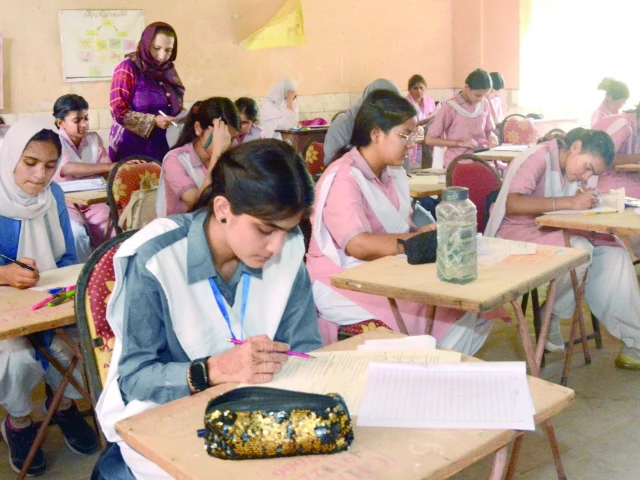
The 2026 board examinations in Sindh have once again exposed a system that is structurally compromised.
It is about a governance failure that has been normalised, tolerated, and, in many cases, quietly enabled.
Recent reports from the media confirm what students, parents, and educators have been saying for years.
Question papers leaked before exams began, circulating on social media 20 minutes prior.
Organised bribery networks, where students allegedly paid for guaranteed cheating access.
Examination centres arbitrarily changed mid-process, disrupting students and raising questions of manipulation because they are auctioned by middlemen.
It’s a complete system capture.
Over 1.35 million students are sitting exams across more than 1,600 centres, making this one of the largest public assessment exercises in the province. Yet the operational integrity does not match the scale; rather, actions tell us integrity is not needed.
On paper, the government response appears “modern”:
Introduction of watermarking systems to trace leaks
Deployment of e-marking in selected regions
Imposition of Section 144 and mobile phone bans
Here, technology is being used as a substitute for accountability, not a complement to it.
The provincial leadership has repeatedly acknowledged the problem, yet the system persists unchanged year after year, announcing inquiries after every scandal for face-saving.
A watermark does not stop a leak; it only helps identify it after the damage is done.
A mobile ban means little when enforcement is “only in name”.
Political will is for policy theatre instead of impact that the honest child demands.
Board administrations are the operational core. Persistent leaks, centre manipulation, and collusion clearly indicate institutional compromise.
Section 144, device bans, and vigilance teams exist, but enforcement is inconsistent, creating a dual system: one for those who can pay and one for those who cannot.
This is where merit died in the hands of the state, because meritocracy is eroded, higher education pipelines are polluted, public trust in state institutions does not exist, and students who can afford access to middlemen internalise corruption as a survival strategy.
If reform is serious, it must move beyond announcements to structural redesign.
Digitise and centralise centre allocation using randomisation with audit trails.
Separate boards from political and administrative influence. Governance must be autonomous, not patronage-driven.
Real-time leak prevention by introducing encrypted digital paper distribution, time-locked access protocols, and last-minute paper release windows.
No reform is credible if students sit exams in extreme heat, power outages, and broken facilities. Basic dignity is foundational.
Sindh’s examination crisis is a state-enabled structural failure.
Each year, the same pattern is not just repeated; it is sustained via: announcement → managed breakdown → symbolic inquiry → institutional silence → continuation.
This is no longer a question of dysfunction; it is a question of patronage. The system persists because it serves those entrusted to reform it.
The real question, therefore, is whether there is any political intent to dismantle a structure that is being actively preserved and find some other ethical ways to make money.
The writer is a former MPA, an education and child rights activist with 30 years of experience as a tech professional.




COMMENTS (3)
Comments are moderated and generally will be posted if they are on-topic and not abusive.
For more information, please see our Comments FAQ